Advertisements
Advertisements
प्रश्न
Explain vulcanization of rubber.
Advertisements
उत्तर
Vulcanization of rubber:
- The process by which a network of cross-links is introduced into an elastomer is called vulcanization.
- Vulcanization of rubber is carried out to improve the physical properties of natural rubber.
- The profound effect of vulcanization enhances the properties like tensile strength, stiffness, elasticity, toughness, etc. of natural rubber.
- Most frequently the used process of vulcanization is sulfur vulcanization. Sulfur forms crosslinks between polyisoprene chains which results in improved properties of natural rubber.
APPEARS IN
संबंधित प्रश्न
Write the chemical reaction to prepare novolac polymer.
Explain the following term: Homopolymers
Write the formulae of the raw materials used for preparation of Dextran.
Write the monomers of the following polymer :
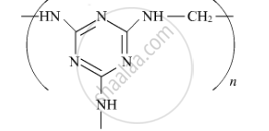
Answer the following in one sentence.
Identify 'A' in the following reaction:

Answer the following in one sentence.
Identify thermoplastic and thermosetting plastic from the following:
- PET
- Urea formaldehyde resin
- Polythene
- Phenol formaldehyde resin
Answer the following.
Name the polymer type in which following linkage is present.
\[\begin{array}{cc}\ce{- C - O -}\\||\phantom{.....}\\
\ce{O\phantom{.....}}\end{array}\]
Answer the following.
Match the following pairs:
| Name of polymer | Monomer |
| 1. Teflon | a. CH2 = CH2 |
| 2. PVC | b. CF2 = CF2 |
| 3. Polyester | c. CH2 = CHCl |
| 4. Polythene | d. C6H5OH and HCHO |
| 5. Bakelite | e. Dicarboxylic acid and polyhydoxyglycol |
Answer the following.
Draw the structures of polymers formed from the following monomers
H2N–(CH2)5 – COOH
Identify condensation polymers and addition polymers from the following.
\[\begin{array}{cc}\ce{-(CH2 - CH -)_{n}}\\
\phantom{....}|\\\ce{\phantom{.......}C6H5}
\end{array}\]
Attempt the following:
Write the chemical reactions involved in the manufacture of Nylon 6,6.
Write the reaction involved in the formation of bakelite.
Write preparation, properties, and uses of Teflon.
Answer the following.
Is synthetic rubber better than natural rubber? If so, in what respect?
Answer the following.
Write main specialities of Buna-S, Neoprene rubber?
Monomer used for preparation of polyacrylonitrile is _____________
Monomers ethylene glycol and terephthalic acid undergo condensation polymerization to give polymer called ___________
write the structure of the monomer used in natural rubber.
Write preparation of low density polythene.
Write chemical reaction for preparation of the following.
Neoprene
Write the name of one example of each polymer in which following repeating units.
\[\begin{array}{cc}
\ce{(-CF2-CF2-), -[NH-(CH2)5-CO] -, -(CH2-CH-), (-CH2-CH2-)}\\
\phantom{............................}|\\
\phantom{..............................}\ce{CN}
\end{array}\]
Write two uses and two properties of polythene.
The following structure represents the polymer:
\[\begin{array}{cc}
\ce{[-C-CH2-NH-C-(-CH2)5 NH -]_{{n}}}\\
\phantom{}||\phantom{.............}||\phantom{................}\\
\phantom{}\ce{O}\phantom{.............}\ce{O}\phantom{................}
\end{array}\]
Which of the following polymers is obtained from chloroprene?
Which of the following polymers is a heteropolymer?
Which among the following polymers can NOT be remoulded?
Identify the monomers used in the preparation of Novolac.
Identify the catalyst used in the manufacture of high density polythene.
Which of the following pair of compounds is used as monomers for bakelite?
Which among the following polymers is used to manufacture chemical containers?
Name the polymers used in laminated sheets and give the name of monomeric units involved in its formation.
Match the polymers given in Column I with their repeating units given in Column II.
| Column I | Column II |
| (i) Acrilan |
(a) \[\begin{array}{cc} |
| (ii) Polystyrene | (b) \[\begin{array}{cc} \ce{Cl}\phantom{.......}\\ |\phantom{........}\\ \phantom{}\ce{-(CH2 - C = CH - CH2)\underset{n}{-}} \end{array}\] |
| (iii) Neoprene | (c) \[\begin{array}{cc} \phantom{................................}\ce{CN}\\ \phantom{..............................}|\\ \ce{-(CH2 - CH = CH - CH2 - CH2 - CH)\underset{n}{-}} \end{array}\] |
| (iv) Novolac | (d) \[\begin{array}{cc} \ce{-(CH2 - CH)\underset{n}{-}}\\ \phantom{.....}|\\ \phantom{.......}\ce{CN} \end{array}\] |
| (v) Buna—N | (e)  |
| (f) \[\begin{array}{cc} \ce{-(CH2 - CH)\underset{n}{-}}\\ \phantom{.....}|\\ \phantom{......}\ce{Cl} \end{array}\] |
Which of the following is not a copolymer?
The monomer of Teflon is ______.
Which of the following polymer has ester linkage?
Trans - form of poly isoprene is:-
Which of the following polymers is synthesized using a free radical polymerisation technique?
Polymer used in bullet proof glass is ______.
Which of the following polymer is used for manufacturing of buckets, dustbins, pipes, etc?
Identify the monomer used to prepare neoprene.
Answer the following.
Name and draw structure of the repeating unit in natural rubber.
Match the following pairs:
| Polymer | Monomer | ||
| (i) | Teflon | (a) | CH2 = CH2 |
| (ii) | PVC | (b) | CF2 = CF2 |
| (iii) | Natural rubber | (c) | Isoprene |
| (iv) | Polythene | (d) | H2C=CHCl |
Write the structure and name of monomer of natural rubber.
Name and draw the structure of the repeating unit in natural rubber.
Write the structure of isoprene and the polymer obtained from it.
Name and draw structure of the repeating unit in natural rubber.
Name and draw structure of the repeating unit in natural rubber.
Write the structure of isoprene and the polymer obtained from it.
Name and draw structure of the repeating unit in natural rubber.
Write the structure of isoprene and the polymer obtained from it.
Name and draw structure of the repeating unit in natural rubber.
Which from following statements is NOT true regarding neoprene?
