Advertisements
Advertisements
प्रश्न
Explain price elasticity of demand.
Explain Price Elasticity of Demand. Draw the various degrees of it with diagrams.
Advertisements
उत्तर
Price Elasticity of Demand (PED) examines how sensitive the quantity looked for of a commodity is to a change in its price while maintaining all other factors constant.
`E_p = ("% Change in Quantity Demanded")/("% Change in Price")`
`E_p = (DeltaQ"/"Q)/(DeltaP"/"P)`
where:
- Ep = Price Elasticity of Demand
- ΔQ = Change in Quantity Demanded
- ΔP = Change in Price
- Q = Initial Quantity Demanded
- P = Initial Price
Degrees of Price Elasticity of Demand:
- Perfectly Elastic Demand: The quantity demanded changes infinitely in response to a very slight change in price. For example, Highly competitive markets for identical products.
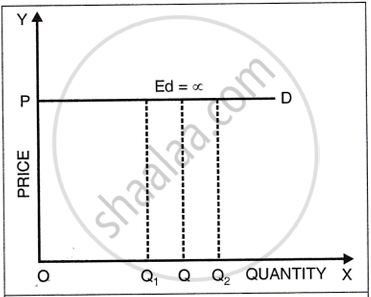
- Horizontal demand curve.
- Infinite responsiveness to price changes.
- Perfectly inelastic Demand: The quantity demanded remains constant, regardless of changes in prices. For example, life-saving drugs and essential goods such as salt.
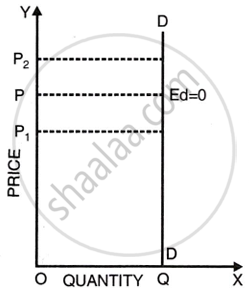
- Vertical demand curve.
- Zero responsiveness to price changes.
- Unitary Elastic Demand: Percentage change in quantity demanded is exactly equal to the percentage change in price. For example, certain everyday goods.
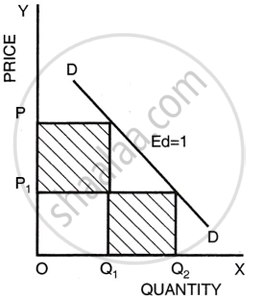
-
Demand changes exactly in proportion to price changes.
-
- Relatively Elastic Demand: Percentage change in quantity demanded is greater than the percentage change in price. For example, luxury goods, electronics.
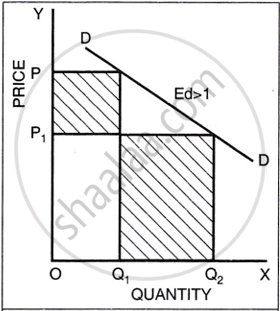
- High responsiveness to price changes.
- Relatively Inelastic Demand: Percentage change in quantity demanded is less than the percentage change in price. For example, necessities like milk and water.
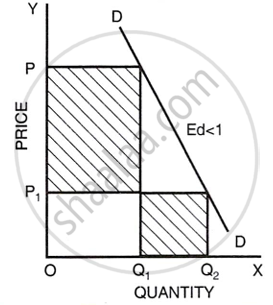
- Low responsiveness to price changes.
Notes
Students should refer to the answer according to the question.
APPEARS IN
संबंधित प्रश्न
Income elasticity of demand for inferior goods is negative.
Income elasticity of demand for inferior goods is negative.
Price elasticity of demand of goods X is -2 and goods Y is -3. Which of the two goods is more price elastic and why?
The price elasticity of demand for a good is - 0.4. If its price increases by 5 percent, by what percentage will its demand fall? Calculate.
When the price of a commodity X falls by 10 percent. Its demand rises from 150 units to 180
units. Calculate is price elasticity of demand. How much should be the percentage fall in its
price so that its demand rises from 150 to 210 units?
When the price of good rise from Rs 10 per unit to Rs 12 per unit, its quantity demanded falls by 20 percent. Calculate its price elasticity of demand. How much would be the percentage change in its quantity demanded, if the price rises from Rs 10 per unit to Rs 13 per unit?
The measure of price elasticity of demand of a normal good carries minus sign while price elasticity of supply carries plus sign. Explain why?
A consumer spends Rs 100 on a good priced at Rs 4 per unit. When price rises by 50 percent, the consumer continues to spend Rs 100 on the good. Calculate the price elasticity of demand by percentage method
A consumer spends Rs 1,000 on a good priced at Rs10 per unit. When its price falls by 20 percent, the consumer spends Rs800 on the good. Calculate the price elasticity of demand by the Percentage method
A consumer spends Rs 100 on a good priced at Rs 4 per unit. When its price falls by 25 percent, the consumer spends Rs 75 on the good. Calculate the price elasticity of demand by the Percentage method.
A consumer spends Rs 400 on a good priced at Rs 8 per unit. When its price rises by 25 percent, the consumer spends Rs 500 on the good. Calculate the price elasticity of demand by the Percentage method.
Price elasticity of demand of a good is (-)1. When its price per unit falls by one rupee, its de from 16 to 18 units. Calculate the price before a change
A consumer buys 30 units of a good at a price of the Rs10per unit. The price elasticity of demand for the good is (-) 1. How many units will the consumer buy at a price of Rs 9 per unit? Calculate.
When the price of good rises from Rs10 to Rs12 per unit, its demand falls from 25 units to 20 units. What can you say about price elasticity of demand of the good through the 'expenditure approach'?
A consumer buys 27 units of a good at a price of Rs 10 per unit. When the price falls to Rs 9 per unit, the demand rises to 30 units. What can you say about price elasticity of demand of the good through the 'expenditure approach'?
Price elasticity of demand of a good is (-) 1. Calculate the percentage change in price that will raise the demand from 20 units to 30 units.
A consumer spends Rs 400 on a good priced at Rs 4 per unit. When the price rises by 25 percent, the consumer continues to spend Rs 400. Calculate the price elasticity of demand by percentage method.
What is the elasticity of demand?
State whether the following statements are TRUE or FALSE :
The demand of foodgrains is inelastic.
What do you mean by complements? Give examples of two goods which are complements of each other.
Consider the demand curve D(p) = 10 − 3p. What is the elasticity at price `5/3` ?
State whether the following statement is TRUE and FALSE.
Unitary Elastic Demand rarely occurs in practice.
Define or explain the following concept:
Unitary Elastic Demand
Give reason or explain the following statement:
Demand for necessaries is inelastic.
Give reason or explain the following statement:
Concept of Elasticity of Demand helps trade union leaders.
Give reason or explain the following statement:
Demand for goods having snob appeal has elastic demand.
Write short answer for the following question :
Total outlay method of measuring price elasticity of demand.
State whether the following statement is true or false. Give valid reasons in support of your answer.
The coefficient of price elasticity of demand for the commodity is inversely related to the number of alternative uses of the commodity.
Choose the correct answer from given options.
The expenditure on a good would change in the opposite direction as the price changes only when demand is ______
Give an economic term:
Elasticity resulting from a proportionate change in quantity demanded due to a proportionate change in price.
What are the methods of measuring Elasticity of demand?
If a good takes up a significant share of consumers' budget, its demand will be ______.
Elasticity of the demand is available when:
The elasticity of demand for school bag will be ______.
Price elasticity of demand is defined as the percentage change in the quantity demanded of a commodity divided by the percentage change in the price of that commodity.
As a result of 5% fall in the price of a good, its demand rises by 12%, the demand for the good will said be ______.
What is meant by elastic demand?
Which type of good typically has inelastic demand?
What is unit elasticity of demand?
