Advertisements
Advertisements
प्रश्न
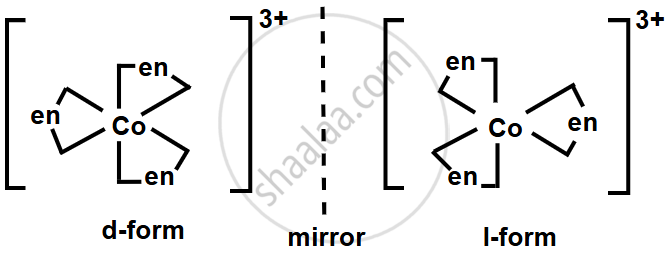
Draw optical isomers of [Co(en)3]3+.
Write the structures of the optical isomers of [Co(en)3]3+.
Advertisements
उत्तर
APPEARS IN
संबंधित प्रश्न
Write the structural formula and IUPAC names of all possible isomers of the compound with molecular formula C3H8O.
Draw isomers of the following.
\[\ce{Pt(NH3)2ClNO2}\]
Answer the following question.
Draw isomers of the following
[Cr(en2)Br2]⊕
Write the type of isomerism exhibited by [Co(NH3)5(NO2)]2+ and [Co(NH3)5ONO]2+ pair of complex ion.
Define the term Hydrated isomers.
Explain optical isomerism in coordination compounds with an example.
Which would exhibit coordination isomerism?
____________ isomers are formed when the ligand has two different donor atoms.
What type of isomerism is present between (I) [Cr(H2O)6]Cl3 and (II) [Cr(H2O)5Cl]Cl2.H2O?
The relationship between compound (i) and (ii) is
 |
 |
| (i) | (ii) |
Which of the following does not show optical isomerism?
Complex [COCl2(en)2]+ can
Which of the following shows maximum number of isomers?
Write the name of isomerism in the following complexes:
[Cu(NH3)4] [PtCl4] and [Pt(NH3)4] [ CuCl4]
Which of the following are isostructural pairs?
(A) \[\ce{SO^{2-}4}\] and \[\ce{CrO^{2-}4}\]
(B) SiCl4 and TiCl4
(C) NH3 and \[\ce{NO^-3}\]
(D) BCl3 and BrCl3
Which of the following compound is optically active?
Which compound would exhibit optical isomers?
The number of geometrical isomers of \[\ce{[Co(NH3)3 (NO3)3]}\] are ______.
White precipitate of AgCl dissolves in aqueous ammonia solution due to formation of ______.
The compounds [PtCl2(NH3)4]Br2 and [PtBr2(NH3)4]Cl2 constitutes a pair of ______.
Give cis isomer of [Co(NH3)4Cl2]⊕.
Draw the structure of cis isomers of Pt(NH3)2Cl2.
Draw the structure of trans isomers of Pt(NH3)2Cl2.
The co-ordination number of Co3+ ion in the complex [Co(NH3)4Cl2]⊕ is ______.
Which one of the following complex ions has geometrical isomers?
Three organic compounds A, B and C are non cyclic functional isomers of carbonyl compounds with molecular formula C4H8O. Isomers A and C give positive Tollen’s test while compound B does not give positive Tollen’s test but gives positive iodoform test. Compounds A and B on reduction with Zn amalgam and conc. HCl give the same product.
- Write the structures of the compounds A, B and C.
- Out of the compounds A, B and C, which one will be the least reactive towards addition of HCN.
