Advertisements
Advertisements
प्रश्न
Draw the electron-dot structure of N2 and state the type of bonding.
Advertisements
उत्तर
Electron-dot structure of N2 is
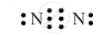
In N2, one nitrogen atom shares its three electrons with another nitrogen atom to form a covalent bond.
APPEARS IN
संबंधित प्रश्न
Why covalent compounds are different from ionic compounds?
State the type of bonding in the following molecule.
Water
Choose the most appropriate answer from the following list of oxides which fit the description.
A covalent oxide of a metalloid.
What type of bonds are present in hydrogen chloride and oxygen?
Give one example of a molecule containing a single covalent bond.
Give one example of a molecule containing a triple covalent bond.
Which inert gas does the Cl atom in HCl resemble in electron arrangement?
Using electron-dot diagrams which show only the outermost shell electrons, show how a molecule of nitrogen, N2, is formed from two nitrogen atoms. What name is given to this type of bonding? (Atomic number of nitrogen is 7)
What happens when methane (natural gas) burns in air? Write the chemical equation of the reaction involved.
Methane molecule is non-polar molecule. Explain.
Complete the following:
When the nuclei of two different reacting atoms are of ______ mass, then a bond so formed is called ______ covalent bond. (equal, unequal, polar, non-polar)
Give two example in following case:
Solid covalent compounds
Elements forming ionic compounds attain noble gas electronic configuration by either gaining or losing electrons from their valence shells. Explain giving reason why carbon cannot attain such a configuration in this manner to form its compounds. Name the type of bonds formed in ionic compounds and in the compounds formed by carbon. Also explain the reason why carbon compounds are generally poor conductors of electricity.
Draw electron - dot structure and structural formula of methane.
The molecule which contains a triple covalent bond is ______.
The particles present in strong electrolytes are
Define the functional group and complete the following table.
| S.I. No. | Functional Group | Compound | Formula |
| (1) | ______________ | _______________ |
C2H5OH |
| (2) | _______________ | _______________ | CH3CHO |
Write an Explanation.
Alkyne
Complete the following activity.
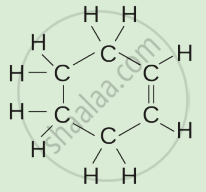
Write the names of the hydrocarbons for the following structural formula.
(isobutylene, cyclohexane, propene, cyclohexene, cyclopentane, benzene, propyne, isobutane, propane)
 |
Identify the incorrect statement and correct them.
- Like covalent compounds, coordinate compounds also contain charged particles (ions). So they are good conductors of electricity.
- Ionic bond is a weak bond when compared to Hydrogen bond.
- Ionic or electrovalent bonds are formed by mutual sharing of electrons between atoms.
- Loss of electrons is called Oxidation and gain of electron is called Reduction.
- The electrons which are not involved in bonding are called valence electrons.
