Advertisements
Advertisements
प्रश्न
Draw a ray diagram of a refracting astronomical telescope when final image is formed at infinity. Also write the expression for its angular magnification (magnifying power).
Draw a labelled ray diagram of an astronomical telescope when the final image is formed at infinity. Write the expression for its magnifying power.
Advertisements
उत्तर
In an astronomical telescope, the objective lens forms an intermediate real image, and the eye lens magnifies it.
- The object (e.g., a distant star) is placed far away, so the incoming rays are parallel.
- These parallel rays first pass through the objective lens, which converges them to form a real, inverted image at its focal point (Fo).
- The eye lens is then positioned such that this intermediate image lies at its focal point. As the eye lens diverges the rays, they appear to originate from infinity, creating the final image that is seen by the observer.
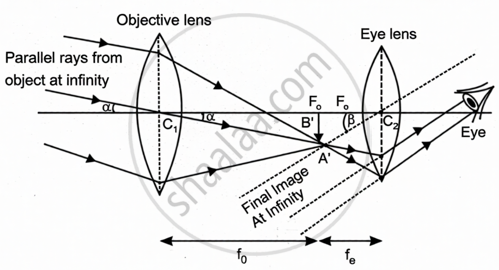
Magnifying power (Angular Magnification):
1. When the image is formed at a finite distance (e.g., at distance D):
The magnifying power is given by the formula:
M = `- f_o/f_e (1 + f_e/D)`
This formula takes into account the image formed at a distance D (closer than infinity).
2. When the image is formed at infinity (which is typical for astronomical telescopes):
The magnifying power simplifies to:
M = `- f_o/f_e`
This is the standard expression for magnifying power when the final image is at infinity.
संबंधित प्रश्न
Draw a schematic ray diagram of a reflecting telescope showing how rays coming from a distant object are received at the eyepiece.
You are given the following three lenses. Which two lenses will you use as an eyepiece and as an objective to construct an astronomical telescope ? Give reason
| Lenses | Power (D) | Aperture (cm) |
| L1 | 3 | 8 |
| L2 | 6 | 1 |
| L3 | 10 | 1 |
Draw a labelled ray diagram of an astronomical telescope to show the image formation of a distant object. Write the main considerations required in selecting the objective and eyepiece lenses in order to have large magnifying power and high resolution of the telescope.
Define its magnifying power and write the expression for it?
A giant refracting telescope at an observatory has an objective lens of focal length 15 m. If an eyepiece lens of focal length 1.0 cm is used, find the angular magnification of the telescope. If this telescope is used to view the moon, what is the diameter of the image of the moon formed by the objective lens? The diameter of the moon is 3.42 × 10⁶ m and the radius of the lunar orbit is 3.8 × 10⁸ m.
With the help of a ray diagram explain the working of a reflecting telescope.
The magnifying power of an astronomical telescope in normal adjustment is 2.9 and the objective and the eyepiece are separated by a distance of 150 cm. Find the focal lengths of the two lenses.
Assertion: An astronomical telescope has an objective lens having large focal length.
Reason: Magnifying power of an astronomical telescope varies directly with focal length of the objective lens.
For a terrestrial telescope used to observe objects on Earth such as mountains, trees, or players in a stadium, the final image must be:
During the formation of an image in a telescope under normal adjustment, the eyepiece is adjusted so that the intermediate image lies:
