Advertisements
Advertisements
प्रश्न
Draw a ray diagram of a refracting astronomical telescope when final image is formed at infinity. Also write the expression for its angular magnification (magnifying power).
Draw a labelled ray diagram of an astronomical telescope when the final image is formed at infinity. Write the expression for its magnifying power.
Advertisements
उत्तर
In an astronomical telescope, the objective lens forms an intermediate real image, and the eye lens magnifies it.
- The object (e.g., a distant star) is placed far away, so the incoming rays are parallel.
- These parallel rays first pass through the objective lens, which converges them to form a real, inverted image at its focal point (Fo).
- The eye lens is then positioned such that this intermediate image lies at its focal point. As the eye lens diverges the rays, they appear to originate from infinity, creating the final image that is seen by the observer.
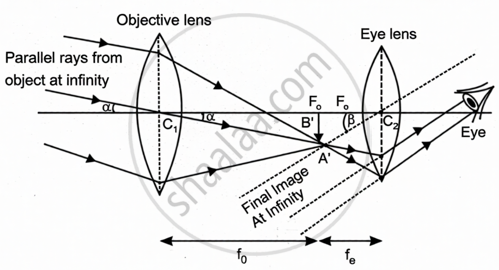
Magnifying power (Angular Magnification):
1. When the image is formed at a finite distance (e.g., at distance D):
The magnifying power is given by the formula:
M = `- f_o/f_e (1 + f_e/D)`
This formula takes into account the image formed at a distance D (closer than infinity).
2. When the image is formed at infinity (which is typical for astronomical telescopes):
The magnifying power simplifies to:
M = `- f_o/f_e`
This is the standard expression for magnifying power when the final image is at infinity.
संबंधित प्रश्न
Draw a schematic ray diagram of a reflecting telescope showing how rays coming from a distant object are received at the eyepiece.
A small telescope has an objective lens of focal length 144 cm and an eyepiece of focal length 6.0 cm. What is the magnifying power of the telescope? What is the separation between the objective and the eyepiece?
Draw a ray diagram depicting the formation of the image by an astronomical telescope in normal adjustment.
With regard to an astronomical telescope of refracting type~ state how you will increase its:
1) magnifying power
2) resolving power
A Galilean telescope is 27 cm long when focussed to form an image at infinity. If the objective has a focal length of 30 cm, what is the focal length of the eyepiece?
Draw a labelled ray diagram showing the formation of an image by a refracting telescope when the final image lies at infinity.
Define the term ‘resolving power of a telescope’.
During the formation of an image in a telescope under normal adjustment, the eyepiece is adjusted so that the intermediate image lies:
Which of the following changes improves the resolving power of a telescope?
Which type of telescope uses two convex lenses, with a large objective and a small eyepiece?
