Science (English Medium)
Academic Year: 2025-2026
Date & Time: 20th February 2026, 10:30 am
Duration: 3h
Advertisements
NOTE
- Please check that this question paper contains 27 printed pages.
- Q.P. Code given on the right hand side of the question paper should be written on the title page of the answer-book by the candidate.
- Please check that this question paper contains 33 questions.
- Please write down the Serial Number of the question in the answer-book at the given place before attempting it.
- 15 minute time has been allotted to read this question paper. The question paper will be distributed at 10.15 a.m. From 10.15 a.m. to 10.30 a.m., the candidates will read the question paper only and will not write any answer on the answer-book during this period.
General Instructions:
Read the following instructions carefully and follow them:
- This question paper contains 33 questions. All questions are compulsory.
- This question paper is divided into five sections - Sections A, B,C,D and E.
- In Section A - Questions no. 1 to 16 are Multiple Choice type questions. Each Question carries 1 mark.
- In Section B - Questions no. 17 to 21 are Very Short Answer type questions. Each question carries 2 marks.
- In Section C - Questions no. 22 to 28 are Short Answer type questions. Each question carries 3 marks.
- In Section D - Questions no. 29 and 30 are Case Study-based questions. Each question carries 4 marks.
- In Section E - Questions no. 31 to 33 are Long Answer type questions. Each question carries 5 marks.
- There is no overall choice given in the question paper. However, an internal choice has been provided in few questions in all the Sections except Section A. Kindly note that there is a separate question paper for Visually Impaired candidates.
- Use of calculators is not allowed.
You may use the following values of physical constants wherever necessary:
c = 3 × 10⁸ m/s
h = 6.63 × 10⁻³⁴ Js
e = 1.6 × 10⁻¹⁹ C
µ0 = 4π × 10−7 T m A−1
ε0 = 8.854 × 10⁻¹² C2 N−1 m−2
`1/(4pi ε_0) = 9 xx 10^9 N^-1 m^2 C^-2`
Mass of electron (me) = 9.1 × 10⁻³¹ kg
Mass of neutron = 1.675 × 10⁻²⁷ kg
Mass of proton = 1.673 × 10⁻²⁷ kg
Avogadro’s number = 6.023 × 10²³ per gram mole
Boltzmann constant = 1.38 × 10⁻²³ JK−1
The phase difference between the two superimposing waves that give rise to a bright spot in a Young’s double-slit experiment is (n is an integer) ______.
2nπ
`2nπ + π/4`
`2nπ + π/2`
2nπ + π
Chapter:
If r1 and r2 are the radii of atomic nuclei of mass numbers 64 and 27 respectively, then the value of `(r_1/r_2)` is ______.
1
`4/3`
`3/4`
`27/64`
Chapter:
An equiconvex lens of focal length 15 cm is cut into two equal plano-convex halves. The focal length of each half will be ______.
30 cm
20 cm
15 cm
7.5 cm
Chapter:
An electric dipole `vecP = 2qa hati` is placed in x-y plane, centred at the origin. Let E1 and E2 be the magnitudes of electric field at a point distant r (r >> a) from its centre, along its aixs and on its equatorial plane, respectively. Then the value of `(E_1/E_2)` is:
`1/4`
`1/2`
2
4
Chapter:
A plano-convex lens, made of glass (n = 1.5) has a curved surface whose radius is 40 cm. The image formed of an object is of the same size as that of the object. The distance of the object from the lens is ______.
40 cm
80 cm
160 cm
200 cm
Chapter:
Radiation of wavelength 200 nm is incident on a photosensitive surface of work function 4.2 eV. The kinetic energy of fastest photoelectrons emitted from this surface will be close to ______.
3.5 eV
3.0 eV
2.5 eV
2.0 eV
Chapter:
A metallic rod of 1 m length is rotated with a frequency of 40 rev/s, with one end hinged at the centre and the other end at the circumference of a circular metallic ring of radius 1 m, about an axis passing through the centre and perpendicular to the plane of the ring. A constant and uniform magnetic field of 0.5 T parallel to the axis is present in the region. The value of emf induced between the centre and the metallic ring is close to:
20 V
32 V
40 V
63 V
Chapter:
Which of the following p-n junction diodes is forward biased?
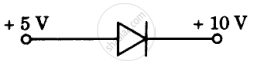
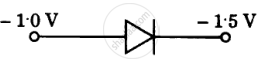
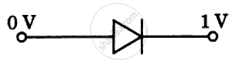
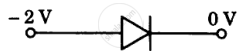
Chapter:
When the forward bias voltage in a semiconductor diode is changed from 0.8 V to 1.0 V, the forward current changes by 2.0 mA. The forward bias resistance of the diode will be ______.
200 Ω
175 Ω
100 Ω
125 Ω
Chapter:
A plane electromagnetic wave travels through a medium and the magnetic field associated with it is given by
B = 5 × 10⁻⁸ sin (3 × 10¹⁰ t − 150 x)T
where x is in metres and t is in seconds.
The velocity of the wave is:
2.0 × 10⁸ ms−1
4.5 × 10⁷ ms−1
3.5 × 10⁷ ms−1
2.5 × 10⁸ ms−1
Chapter:
The velocity of the photoelectrons emitted from a surface depends upon the ______.
Wavelength of incident radiation only
Intensity of incident radiation only
Work function of the surface only
Both wavelength of the incident radiation and work function of the surface
Chapter:
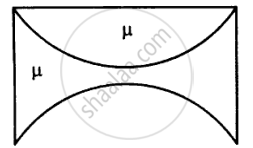
A thin plano-convex lens and a thin equi-concave lens are kept coaxially in contact as shown in the figure. Assuming both the lenses are made of glass of refractive index μ, and R is the radius of curvature of each curved surface, the focal length of the combination is:
`R/(mu - 1)`
`-R/(mu - 1)`
`(2R)/(mu - 1)`
`-(2R)/(mu - 1)`
Chapter:
Assertion (A): Photoelectric current depends upon the intensity of the incident radiation.
Reason (R): Stopping potential is independent of the intensity of the incident radiation.
Both Assertion (A) and Reason (R) are true and Reason (R) is the correct explanation of the Assertion (A).
Both Assertion (A) and Reason (R) are true, but Reason (R) is not the correct explanation of the Assertion (A).
Assertion (A) is true, but Reason (R) is false.
Both Assertion (A) and Reason (R) are false.
Chapter:
Assertion (A): Nuclear forces are always attractive.
Reason (R): The nuclear force between protons and neutrons in a nucleus is a weak force.
Both Assertion (A) and Reason (R) are true and Reason (R) is the correct explanation of the Assertion (A).
Both Assertion (A) and Reason (R) are true, but Reason (R) is not the correct explanation of the Assertion (A).
Assertion (A) is true, but Reason (R) is false.
Both Assertion (A) and Reason (R) are false.
Chapter:
Assertion (A): The cylindrical soft iron core in a moving coil galvanometer only makes the magnetic field radial and does not affect the strength of the magnetic field.
Reason (R): In a moving coil galvanometer, the plane of the coil is always perpendicular to the magnetic field.
Both Assertion (A) and Reason (R) are true and Reason (R) is the correct explanation of the Assertion (A).
Both Assertion (A) and Reason (R) are true, but Reason (R) is not the correct explanation of the Assertion (A).
Assertion (A) is true, but Reason (R) is false.
Both Assertion (A) and Reason (R) are false.
Chapter:
Assertion (A): In a Wheatstone bridge circuit, if we interchange the position of the cell and the galvanometer, the balance condition `P/Q = R/S` remains unchanged.
Reason (R): `P/Q = R/S ⇒ Q/S = P/R`, so balance condition remains same.
Both Assertion (A) and Reason (R) are true and Reason (R) is the correct explanation of the Assertion (A).
Both Assertion (A) and Reason (R) are true, but Reason (R) is not the correct explanation of the Assertion (A).
Assertion (A) is true, but Reason (R) is false.
Both Assertion (A) and Reason (R) are false.
Chapter:
Advertisements
Calculate the de Broglie wavelength of a neutron having kinetic energy of 150 eV.
Chapter:
Describe briefly, with the help of a diagram, the role of the two important processes involved in the formation of a p-n junction.
Chapter:
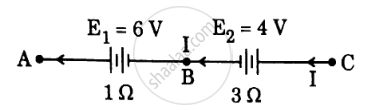
In the given figure, a steady current I flows through the circuit when points A and C are connected by a wire of negligible resistance. Find the potential difference between points B and C.
Chapter:
A battery of emf 21 V and internal resistance 3 Ω is connected to a resistor. If the current in the circuit is 3 A, find:
- The resistance of the resistor.
- The terminal voltage of the battery.
Chapter:
Draw a ray diagram of a refracting astronomical telescope when final image is formed at infinity. Also write the expression for its angular magnification (magnifying power).
Chapter: [9] Ray Optics and Optical Instruments
Explain the terms mass defect and binding energy. How are they related?
Chapter:
With the help of circuit diagrams, briefly explain the forward biasing of a p-n junction diode.
Chapter:
With the help of circuit diagrams, briefly explain the reverse biasing of a p-n junction diode.
Chapter:
A small bulb is placed at the bottom of a tank containing a liquid of refractive index µ at a depth H. It is observed that light emerges from a circular area of radius r of the surface. Obtain the expression for r in terms of H and µ.
Chapter:
A circular coil of 30 turns and radius 8.0 cm carrying a current of 6 A is suspended vertically in a uniform horizontal magnetic field of 1.0 T. The field lines make an angle of 30° with the plane of the coil. Calculate the magnitude of the external torque that must be applied to prevent the coil from turning. What would happen if the circular coil is replaced by a planar coil of irregular shape that encloses the same area, keeping other parameters unchanged?
Chapter:
An alpha particle (mass 6.4 × 10⁻²⁷ kg and charge 3.2 × 10⁻¹⁹ C) having 8.0 MeV energy, enters a region of a uniform magnetic field of 0.5 T. If the field is directed perpendicular to the velocity of the particle, find the radius of the circular path described by the particle. Mention the condition under which the particle in this region (i) describes a helical path, and (ii) goes straight undeviated.
Chapter:
A series combination of circuit elements X and Y is connected across an ac source. It is found that the voltage is ahead of current in phase by `pi/4` radian. When element Y is replaced by element Z, the current leads the voltage by `pi/4` radian.
- Identify the elements X, Y and Z.
- What will the phase angle and power factor for the circuit be if X, Y and Z were connected in series across the same ac source? What can you say about the current that flows in the circuit in this case?
Chapter:
Depict the variation of electric field (`vecE`) and magnetic field (`vecB`) with respect to the direction of propagation of an electromagnetic wave. Write their two important characteristics.
Chapter:
Show that `1/sqrt(ε_0µ_0)` gives the velocity of an electromagnetic wave in free space.
Chapter:
Differentiate between nuclear fission and nuclear fusion. Give one example for each with nuclear reaction.
Chapter:
Advertisements
Draw a plot showing the variation of potential energy of a pair of nucleons as a function of their separation (r). Using this plot, show that the nuclear force is (i) attractive for r > r0, and (ii) repulsive for r < r0.
Chapter:
Read the following paragraphs and answer the questions that follow:
| A charged particle +q in an electric field `vecE` experiences a force in the direction of the electric field. As a result, its kinetic energy changes. Similarly, the charged particle also experiences a force when it moves in a magnetic field `vecB`. But this magnetic force is perpendicular to both the velocity `vecv` of the charged particle and the magnetic field `vecB`, so it cannot change the kinetic energy of the charged particle. Consider two charged particles 1 and 2 of masses m and `m/2` having charges −q and +2q, respectively. They are accelerated from rest through the same potential difference V and acquire kinetic energy K1 and K2. Then they enter in a region of uniform magnetic field `vecB` perpendicular to their velocities. |
(i) The ratio of their kinetic energies `((K_1)/(K_2))` is ______.
- `1/2`
- `1/4`
- 4
- 1
(ii) The ratio of the radii of the circular paths described by them `((r_1)/(r_2))` is ______.
- `1/sqrt2`
- `sqrt2`
- `1/2`
- 2
(iii) Suppose particles 1 and 2 enter the magnetic field `vecB = B_0hatk` with velocities `vecv_1 = v_1hati and vec2 = v_2hati`. Then ______.
- Both particles revolve clockwise
- Both particles revolve anticlockwise
- Particle 1 revolves clockwise while particle 2 revolves anticlockwise.
- Particle 1 revolves anticlockwise while particle 2 revolves clockwise.
(iv) (a) If period of revolution for particle 1 is 4 s, then for particle 2, the period will be ______.
- 1 s
- 2 s
- 4 s
- 8 s
OR
(iv) (b) If the value of momentum for particles 1 and 2 are p1 and p2, then ______.
- `p_1 = (p_2)/(2)`
- p1 = p2
- p1 = 2p2
- p1 = 4p2
Chapter:
Read the following paragraph and answer the questions that follow:
|
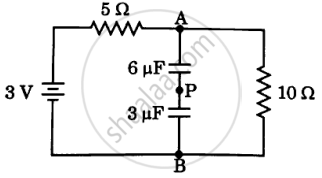
Capacitors are manufactured with certain standard capacitances and working voltages. However, these standard values may not be the ones that are actually needed in a particular application. Two or more capacitors can be grouped in series or in parallel to achieve desired capacitance and voltage. When connected in series, the total capacitance decreases while the voltage rating increases, whereas in parallel connections, the total capacitance increases and maintains the same voltage rating. A capacitor stores energy in the electric field between its plates and stored energy is proportional to the square of the voltage and capacitance `U = 1/2 C V^2`, where symbols have their usual meanings.
Two capacitors, one of 3 µF and the other of 6 µF, are connected in series in the circuit as shown in the figure, for a long time. |
(i) The total capacitance of the circuit is ______.
- 6 µF
- 3 µF
- 9 µF
- 2 µF
(ii) The current in the 10 resistor is ______.
- 0.3 A
- 0.6 А
- 0.2 А
- 0
(iii) The potential difference between point A and B is ______.
- 2 V
- 0.3 V
- 0.2 V
- 3 V
(iv) (a) The value of charge on the plates of the 6 µF capacitor is ______.
- 6 μC
- 4μC
- 12 μC
- 6 μC
OR
(iv) (b) The wire between two capacitors is cut at point P. The current in the circuit will ______.
- increase
- decrease
- remain the same
- first increase then become stable
Chapter:
A light bulb and an open coil inductor are connected in series across an AC source of variable frequency. How will the glow of the bulb be affected when:
- an iron bar is inserted inside the coil, and
- the frequency of the source is decreased?
Justify your answers. Assume that in each above case other factors remain unchanged.
Chapter:
An ac voltage V = 280 sin(100π t) volt is connected across a series LCR circuit in which R = 400 Ω, L = `5/π` H and C = `50/π` µF. Taking `sqrt(2) = 1.4`, calculate:
- Impedance of the circuit.
- Rms value of current that flows in the circuit.
- Power factor of the circuit.
Chapter:
State Lenz’s Law.
Chapter: [6] Electromagnetic Induction
Explain that Lenz’s law follows the law of conservation of energy.
Chapter:
Write the dimensional formula for self-inductance.
Chapter:
The current in a coil changes from 8.0 A to 2.0 A in 0.6 s. If an average emf induced in the coil is 50 V, calculate the self-inductance of the coil.
Chapter:
A point object is kept in front of a convex spherical surface of radius of curvature R. Draw the ray diagram to show the formation of image and derive the relation between the object and image distance (u and v) in terms of refractive index n of the medium and R.
Chapter:
A convex lens of focal length 20 cm is used to form the image of an object placed 30 cm away from the lens. Find the position and nature of the image formed.
Chapter:
Two thin converging lenses of focal lengths f1 and f2 are placed coaxially in contact. Derive expression for focal length of combination.
Chapter:
A beam of coherent light of wavelength 550 nm is incident normally to the plane of a pair of two slits S1 and S2 each of width 1.2 × 10⁻⁶ m separated by 1.1 mm. Dark and bright fringes are observed on a screen 2.2 m away from the plane of the slits.
Calculate:
- Fringe width.
- Distance of second dark fringe from central maximum.
- What will happen when the entire apparatus is immersed in water?
Chapter:
In the figure, OA and OB show the variation of electric potential V at a point due to two point charges Q1 and Q2 with `1/r` respectively. Here r represents the distance of the point from the two point charges.
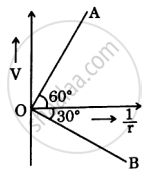
- Identify the nature of the two charges Q1 and Q2.
- What is the value of `((Q_1)/(Q_2))?` Justify your answer.
Chapter:
Two point charges −2μC and 5μC are placed at (−30 cm, 0) and (30 cm, 0) respectively in an external electric field `vecE = A/x^2 hati`, where A = 9 × 10⁵ Nm2 C−1. Find the electrostatic potential energy of this configuration.
Chapter:
Two infinitely long straight wires having linear charge densities −λ and 3λ are held vertically parallel to each other, distance r apart in free space. Find the nature and magnitude of the force/length exerted by one wire on the other.
Chapter:
A small hollow conducting sphere radius r1 is given a charge Q. It is surrounded by a concentric conducting spherical shell of inner radius r2 and outer radius r3, having charge −3q.
If a point charge 2q were kept at the centre, find:
- The electric flux through a concentric spherical Gaussian surfaces of radius x for (1) x < r1, and (2) r1 < x < r2.
- Electric field at a point distant x from the centre for (1) x > r3, and (2) r1 < x < r2.
- Surface charge density on inner surfaces of (1) sphere, and (2) shell.
Chapter:
Other Solutions
Submit Question Paper
Help us maintain new question papers on Shaalaa.com, so we can continue to help studentsonly jpg, png and pdf files
CBSE previous year question papers Class 12 Physics with solutions 2025 - 2026
Previous year Question paper for CBSE Class 12 Physics-2026 is solved by experts. Solved question papers gives you the chance to check yourself after your mock test.
By referring the question paper Solutions for Physics, you can scale your preparation level and work on your weak areas. It will also help the candidates in developing the time-management skills. Practice makes perfect, and there is no better way to practice than to attempt previous year question paper solutions of CBSE Class 12.
How CBSE Class 12 Question Paper solutions Help Students ?
• Question paper solutions for Physics will helps students to prepare for exam.
• Question paper with answer will boost students confidence in exam time and also give you an idea About the important questions and topics to be prepared for the board exam.
• For finding solution of question papers no need to refer so multiple sources like textbook or guides.
