Advertisements
Advertisements
प्रश्न
In the figure, OA and OB show the variation of electric potential V at a point due to two point charges Q1 and Q2 with `1/r` respectively. Here r represents the distance of the point from the two point charges.
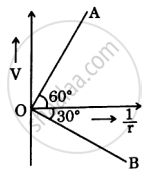
- Identify the nature of the two charges Q1 and Q2.
- What is the value of `((Q_1)/(Q_2))?` Justify your answer.
Advertisements
उत्तर
Core Principle:
The electric potential V at a distance r from a point charge Q is given by:
V = `(kQ)/r`
= `(kQ) . 1/r`
This equation is in the form y = mx, where y = V and x = `1/r`.
Therefore, the slope (m) of the line represents kQ.
(I) Nature of the Charges Q1 and Q2:
Charge Q1, (Line OA): This line lies in the positive V region (above the horizontal axis). Since the potential is positive, Q1 is a positive charge.
Charge Q2 (Line OB): This line lies in the negative V region (below the horizontal axis). Since the potential is negative, Q2 is a negative charge.
(II) The slope of a line on a graph is equal to the tangent of the angle (tan θ) it makes with the positive horizontal axis.
Slope1 = kQ1
= tan (60°)
= `sqrt3`
Since line OB is below the axis, it represents a negative slope:
Slope2 = kQ2
= tan (−30°)
= `-1/sqrt3`
The ratio of the charges:
`((Q_1)/(Q_2)) = (kQ_1)/(kQ_2)`
= `(tan 60°)/(-tan 30°)`
= `(sqrt3)/(-1/sqrt3)`
= `-(sqrt3 xx sqrt3)`
= −3
