Advertisements
Advertisements
प्रश्न
Draw a labelled diagram to show the internal structure of a mammalian tooth with two roots.
Advertisements
उत्तर

APPEARS IN
संबंधित प्रश्न
The stomach releases hydrochloric acid and ______ juices which act on food.
Which of the organs performs the function in humans?
Absorption of food
In which part of the digestive system is water absorbed?
The length of small intestine in a human adult is about ______.
| When a person puts food in his mouth, then teeth cut it into small pieces, chew and grind it. The glands A in the mouth secrete a substance B which is mixed with the food by tongue. The substance B contains an enzyme C which starts the digestion of food in the mouth. The slightly digested food from the mouth goes down a tube D. The special type of movements E in the walls of tube D push the food into stomach for further digestion. The stomach wall secretes gastric juice containing three substance F, G and H. One of the functions of F is to kill bacteria which may enter the stomach with food. The substance G protects the inside layer of stomach from the damaging effect of substance F whereas substance H is and enzyme for digestion. The partially digested food then enters into small intestine for further digestion. |
- What are (i) gland A, (ii) substance B, and (iii) enzyme C?
- Name the tube D.
- What is the movement E known as?
- What are (i) F, (ii) G, and (iii) H?
Why is there no enzyme to digest vitamins?
Define the following term:
Peristalsis
Complete the following table by filling in the blanks 1 to 8.
|
Organ |
Enzyme |
Food acted upon |
Find product |
|
1 |
Pepsin |
2 |
3 |
| Mouth | 4 | 5 | Disaccharide |
|
6 |
7 |
Maltose |
8 |
Write the function of the following in the human alimentary canal:
Villi
Write true or false for the below statement. Rewrite the false statements correctly.
The process of taking in food is called assimilation
Define with examples: Heterotrophs
State one difference in nutrition: Parasite and Saprophyte
Describe the human alimentary canal.
Who is telling a lie?
Lung: I play an important role in excretion.
Bile helps in the digestion of ______.
What is digestion?
Read the following passage carefully and answer the questions that follow it.
| Bile juice is stored in a sac called, gall bladder, located near its organ of secretion, liver. The gall bladder releases the bile juice into the small intestine whenever food reaches there. Though bile juice is devoid of any digestive enzymes, it is required for the digestion of fats. The fats cannot be digested easily because they are insoluble in water and are present as large globules. Bile juice breaks down big fat droplets into smaller droplets. These are then easily digested by the enzymes released from the pancreas. |
- Which organ secretes the bile juice?
- Why is digestion of fats difficult as compared to that of other nutrients?
- How does bile juice help in the digestion of fat?
- Where is the digestion of fat completed?
- Does bile juice digest fat completely?
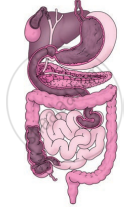
Label the following parts in Figure and name them.
- The largest gland in our body.
- The organ where protein digestion starts.
- The organ that releases digestive juice into the small intestine.
- The organ where bile juice gets stored.
How does tooth enamel get corroded? What is the preventive measure for this?
Mucosa forms __a__ in stomach and ___b___ in intestine respectively.
