Advertisements
Advertisements
प्रश्न
Discuss the variation of conductivity and molar conductivity with concentration.
Advertisements
उत्तर
Both conductivity and molar conductivity change with changes in the concentration of the electrolyte. Conductivity always decreases as the concentration of both weak and strong electrolytes decreases. This can be explained by the fact that with dilution, the number of ions carrying electric current per unit volume decreases. The conductivity of a solution at any concentration is the conductivity of a unit volume of the solution placed between two platinum electrodes having a unit cross-sectional area and situated at a unit distance from each other.
This is clear from the following equation:
C = `(kappa A)/l` = κ ...(Both A and l are in appropriate units m or cm)
The molar conductivity of a solution at a given concentration is the conductivity of volume (V) of the solution containing one mole of electrolyte dissolved in it and placed between two electrodes of cross-sectional area (A), located at a unit distance from each other. So,
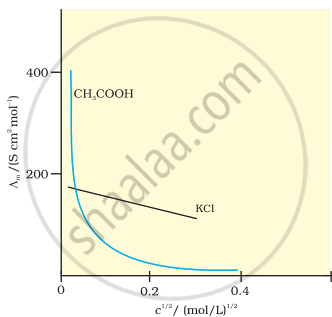
Plot of c1/2 versus molar conductivity for potassium chloride (a strong electrolyte) in aqueous solution.
∧m = `(kappa A)/l` = κ
Since l = 1 and A = V (volume in which one mole of electrolyte is dissolved)
∧m = κ V
Molar conductivity increases with decreasing concentration. This is because the total volume (V) in which one mole of electrolyte is present also increases. It has been found that, upon dilution of the solution, the increase in volume is much greater than the decrease in κ.
Strong Electrolytes: For strong electrolytes, the value of ∧m increases gradually with dilution, and it can be represented by the following equation:
∧m = `Lambda_m^0 - Ac^(1//2)`
It can be seen that if ∧m is plotted against c1/2, we get a straight line with intercept A and slope equal to ‘A’. The value of constant ‘A’ at a given solvent and temperature depends on the type of electrolyte, i.e., on the charges of the cation and anion produced on dissociation of the electrolyte in solution. Thus, NaCl, CaCl2, and MgSO4 are known as 1-1, 2-1 and 2-2 electrolytes, respectively. The value of ‘A’ is the same for all electrolytes of the same type.
APPEARS IN
संबंधित प्रश्न
Define “Molar conductivity”.
Resistance of conductivity cell filled with 0.1 M KCl solution is 100 ohms. If the resistance of the same cell when filled with 0.02 M KCl solution is 520 ohms, calculate the conductivity and molar conductivity of 0.02 M KCl solution. [Given: Conductivity of 0.1 M KCl solution is 1.29 S m-1 .]
State Kohlrausch’s law of independent migration of ions.
The molar conductivity of cation and anion of salt BA are 180 and 220 mhos respectively. The molar conductivity of salt BA at infinite dilution is_____________ .
(a) 90 mhos.cm2
(b) 110 mhos.cm2.mol-1
(c) 200 mhos.cm2.mol-1
(d) 400 mhos.cm2.mol-1
Define limiting molar conductivity.
Why does the conductivity of a solution decrease with dilution?
The molar conductivity of 0.025 mol L−1 methanoic acid is 46.1 S cm2 mol−1. Calculate its degree of dissociation and dissociation constant. Given \[\ce{λ^0_{(H^+)}}\] = 349.6 S cm2 mol−1 and \[\ce{λ^0_{(HCOO^-)}}\] = 54.6 S cm2 mol−1.
How can you determine limiting molar conductivity, 0 m for strong electrolyte and weak electrolyte?
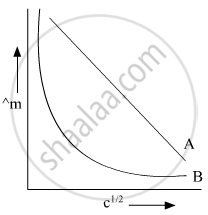
In the plot of molar conductivity (∧m) vs square root of concentration (c1/2), following curves are obtained for two electrolytes A and B:
Answer the following:
(i) Predict the nature of electrolytes A and B.
(ii) What happens on extrapolation of ∧m to concentration approaching zero for electrolytes A and B?
Conductivity always decreases with decrease in concentration both, for weak and strong electrolytes because of the fact that ____________.
Kohlrausch law of independent migration of ions states ____________.
\[\ce{Λ^0_m H2O}\] is equal to:
(i) \[\ce{Λ^0_m_{(HCl)} + \ce{Λ^0_m_{(NaOH)} - \ce{Λ^0_m_{(NaCl)}}}}\]
(ii) \[\ce{Λ^0_m_{(HNO_3)} + \ce{Λ^0_m_{(NaNO_3)} - \ce{Λ^0_m_{(NaOH)}}}}\]
(iii) \[\ce{Λ^0_{(HNO_3)} + \ce{Λ^0_m_{(NaOH)} - \ce{Λ^0_m_{(NaNO_3)}}}}\]
(iv) \[\ce{Λ^0_m_{(NH_4OH)} + \ce{Λ^0_m_{(HCl)} - \ce{Λ^0_m_{(NH_4Cl)}}}}\]
Assertion: Λm for weak electrolytes shows a sharp increase when the electrolytic solution is diluted.
Reason: For weak electrolytes degree of dissociation increases with dilution of solution.
Which of the following halogen acids is the strongest reducing agent?
The molar conductance of NaCl, HCl, and CH3COONa at infinite dilution are 126.45, 426.16, and 91.0 S cm2 mol−1 respectively. The molar conductance of CH3COOH at infinite dilution is. Choose the right option for your answer.
Molar conductivity of substance “A” is 5.9 × 10³ S/m and “B” is 1 × 10–16 S/m. Which of the two is most likely to be copper metal and why?
The following questions are case-based questions. Read the passage carefully and answer the questions that follow:
| Rahul set up an experiment to find the resistance of aqueous KCl solution for different concentrations at 298 K using a conductivity cell connected to a Wheatstone bridge. He fed the Wheatstone bridge with a.c. power in the audio frequency range 550 to 5000 cycles per second. Once the resistance was calculated from the null point, he also calculated the conductivity K and molar conductivity ∧m and recorded his readings in tabular form. |
| S. No. | Conc. (M) |
k S cm−1 | ∧m S cm2 mol−1 |
| 1. | 1.00 | 111.3 × 10⁻³ | 111.3 |
| 2. | 0.10 | 12.9 × 10⁻³ | 129.0 |
| 3. | 0.01 | 1.41 × 10⁻³ | 141.0 |
Answer the following questions:
(a) Why does conductivity decrease with dilution? (1)
(b) If `∧_"m"^0` of KCl is 150.0 S cm2 mol−1, calculate the degree of dissociation of 0.01 M KCI. (1)
(c) If Rahul had used HCl instead of KCl then would you expect the ∧m values to be more or less than those per KCl for a given concentration? Justify. (2)
OR
(c) Amit a classmate of Rahul repeated the same experiment with CH3COOH solution instead of KCl solution. Give one point that would be similar and one that would be different in his observations as compared to Rahul. (2)
The unit of molar conductivity is ______.
The resistance of a conductivity cell with a 0.1 M KCl solution is 200 ohm. When the same cell is filled with a 0.02 M NaCl solution, the resistance is 1100 ohm. If the conductivity of 0.1 M KCl solution is 0.0129 ohm-1 cm-1, calculate the cell constant and molar conductivity of 0.02 M NaCl solution.
