Advertisements
Advertisements
प्रश्न
Discuss in pair and answer question below in a short paragraph (30 − 40 words.
Why did Jerome have to reopen the packed bag?
Advertisements
उत्तर
Jerome had to reopen the packed bag twice owing to his forgetfulness. Once he had to reopen the bag as he had forgotten to pack the boots. The next time, he unpacked when he realised he had packed his tobacco-pouch in.
संबंधित प्रश्न
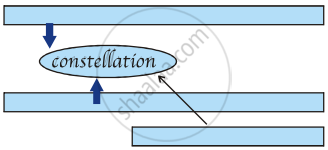
Read the following extracts from the story, and try to puzzle out the meanings of the encircled words from other words and phrases in the extract. Write the clues in the empty boxes. Then give your own explanation of the encircled words.
I saw individual stars, but I could not distinguish the constellation they belonged to. Then dawn came and put out all my stars.
Therefore, constellation means ______.
Here's a glimpse of a naughty child whose life is full of fun and frolic .
One of the reasons why Tom's mind had drifted away from ita secret troubles was that it bad found a new and weighty matter to interest itself about. Becky Thatcher had stopped coming to school. Tom bad struggled with his pride a few days and tried to "whistle her down the wind," but failed. He began to find himself hanging around her father's house all night and feeling very miserable. She was ill. What if she should die! There was distraction in the thought. Tom Sawyer no longer took an interest in war, nor even in piracy. The charm of life was gone; there was nothing but dreariness left. He put his hoop away, and his bat; there was no joy in them any more. His aunt was concerned. She began to try all manners of remedies on him. She was one of those people who are Infatuated with patent medicines and all new-fangled methods of producing health or mending it. She was an inveterate experimenter in these things. When something fresh in this line came out, she was in a fever, right away, to try it; not on herself, for she was never ailing, but on anybody else that came handy.
2. She tried every remedy she could. Yet, not with standing all this, the boy grew more and more melancholy and pale and dejected. She added hot baths, sitz baths, shower baths, and plunges. The boy remained as dismal as a hearse. She began to assist the boy with a slim oatmeal diet and blister-plaster&. She calculated his capacity as she would judge and filled him up every day with quack cure-alls.
3. Tom had become indifferent to persecution by this time. This phase filled the old lady's heart with consternation. This indifference must be broken up at any cost. Now she heard of Pain-killer for the first time. She ordered a lot at once. She tasted it and was filled with gratitude. It was simply fire in a liquid form. She dropped the water treatment and everything else, and pinned her faith on Pain-killer. She gave Tom a teaspoonful and watched with the deepest anxiety for the result. Her troubles were instantly at rest, her soul at peace again; for the 'indifference' was broken up. The boy could not have shown a wilder, heartier interest, if she had built a fire under him.
4. Tom felt that it was time to wake up; this sort of life might be romantic enough, in his blighted condition, but it was getting to have too little sentiment and too much distracting variety about it. So he thought over various plans for relief and finally hit upon that of professing to be fond of Pain-killer. He asked for it so often that he became a nuisance and his aunt ended up by telling him to help himself and quit bothering her. If it had been Sid, she would have had no misgivings to alloy her delight; but since it was Tom, she watched the bottle clandestinely. She found that the medicine did really diminish, but it did not occur to her that the boy was mending the health of a crack in the sitting-room floor with it.
5. One day Tom was in the act of dosing the crack when his aunt's yellow cat came along, purring, eyeing the teaspoon avariciously and begging for a taste. Tom said: "Peter, now you've asked for it, and I'll give it to you, because there ain't anything mean about me; but if you find you don't like it, you mustn't blame anybody but your own self."
6. Tom pried his mouth open and poured down the Pain-killer. Peter sprang a couple of yards in the air, and then delivered a war-whoop and set off round and round the room, banging against furniture, upsetting flower-pots, and making general havoc. Next he rose on his hind feet and pranced around, in a frenzy of enjoyment, with his head over his shoulder and his voice proclaiming his unappeasable happiness. Then he went tearing around the house again spreading chaos and destruction in his path. Aunt Polly entered in time to see him throw a few double summersaults, deliver a final mighty hurrah, and sail through the open window, carrying the rest of the flower-pots with him. The old lady stood petrified with astonishment, peering over her glasses; Tom lay on the floor hysterical with laughter.
"Tom, what on earth ails that cat?"
"I don't know, aunt," gasped the boy.
7. The old lady was bending down, Tom watching, with interest emphasized by anxiety. Too late he divined her 'drift'. The handle of the telltale teaspoon was visible under the sofa. Aunt Polly took it, held it up. Tom winced, and dropped his eyes. Aunt Polly raised him by the usual handle - his ear - and cracked his head soundly with her thimble.
"Now, sir, what did you want to treat that poor dumb beast so, for?"
"I done it out of pity for him - because he hadn't any aunt."
"Hadn't any aunt! -you numskull. What has that got to do with it?"
"Heaps. Because if he'd had one, she'd a burnt him out herself! She'd a roasted his bowels out of him 'thout any more feeling than if he was a human!"
Tom looked up in her face with just a perceptible twinkle peeping through his gravity.
"I know you was meaning for the best, aunty, and so was I with Peter. It done him good, too. I never see him get around so-"
He looked at me very blankly and tiredly, and then said, having to share his worry with someone, “The cat will be all right, I am sure. There is no need to be unquiet about the cat. But the others. Now what do you think about the others?”
“Why they’ll probably come through it all right.”
“You think so?”
“Why not,” I said, watching the far bank where now there were no carts.
“But what will they do under the artillery when I was told to leave because of the artillery?”
“Did you leave the dove cage unlocked?” I asked.
“Yes.”
“Then they’ll fly.”
“Yes, certainly they’ll fly. But the others. It’s better not to think about the others,” he said.
Read the extract given below and answer the question that follow.
Why is the old man worried about the goats?
When there was a strong wind, the pine trees made sad, eerie sounds that kept most people to the main road. But Mr. Oliver was not a nervous or imaginative man. He carried a torch – and on the night I write of, its pale gleam, the batteries were running down – moved fitfully over the narrow forest path. When its flickering light fell on the figure of a boy, who was sitting alone on a rock, Mr. Oliver stopped.
Boys were not supposed to be out of school after seven P.M. and it was now well past nine. What are you doing out here, boy, asked Mr. Oliver sharply, moving closer so that he could recognize the miscreant.
Read the extract given below and answer the question that follow.
Why did Mr Oliver take the shortcut? What did he carry with him?
In a desert the temperature rises during the day and falls rapidly at night. Why?
Why did the king refuse to give reward to anyone?
What were the replies the king received for his first question?
We should be friendly towards our neighbours. Why so?
What surprised Mr. Purcell one day?
Why/when did Abbu Khan become unhappy?
Why did the narrator’s Grandfather visit Lucknow?
Pick out the line that suggests that the child is afraid of snakes.
Make noun from the word given below by adding –ness, ity, ty or y
Sincere ___________.
What trick did the mongoose apply to overpower and kill the cobra?
With your partner, complete the following sentence in your own word using the ideas in the poem.
English is a __________________ with words that everyone can play.
Answer the following question:
In what way did the shopkeeper make a fool of Rasheed?
Why did the daimio reward the farmer, but punish his neighbour for the same act?
Complete the following sentence by providing a reason:
In Act III, Scene II of the play The Tempest, Stephano and Trinculo are angry with Caliban as they struggle out of the filthy pool because ______.
Complete the following sentence by providing a reason:
In the short story, The Sound Machine, Dr. Scott thought Klausner was ill when Klausner rang up the doctor because ______.
Gratiano explains, "We are the Jasons, we have won the fleeee." In this context the word 'fleeee' refers to ______.
