Advertisements
Advertisements
प्रश्न
Differentiate between the following with suitable examples- A basic radical and an acid radical
Advertisements
उत्तर
The positive part is called the basic radical and the negative part is called the acid radical.
A compound maybe consider having –
- A positive part [e.g. metal or ammonium ion]
- A negative part [e.g. chloride, bromide, sulphate, nitrate etc.]
| Compound | Positive part - Basic Radical | Negative part - Acid radical |
| Sodium | \[\ce{Na+}\] | \[\ce{NO3-}\] |
| Ammonium | \[\ce{NH4+}\] | `"SO"_4^--` |
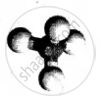
| Sulphate |
\[\begin{bmatrix} |
|
|
|
APPEARS IN
संबंधित प्रश्न
Write the names of `"H"_2"S"` compounds :
Fill in the following blank with suitable word:
The particle which is formed by the loss or gain of electrons by an atom is called..............
The valencies (or charges) of some of the ions are given below :
Ion Valency Ion Valency (Charge) (Charge)
Sodium ion 1+ Nitrate ion 1–
Copper ion 2+ Sulphide ion 2–
Using this information, write down the formulae of :
- Sodium sulphide
- Copper nitrate
Give example.
Trivalent basic radicals
Write symbols of the following elements and the radicals obtained from them and indicate the charge on the radicals.
Mercury, potassium, nitrogen, copper, sulphur, carbon, chlorine, oxygen
Write the basic radicals and acidic radicals of the following and then write the chemical formulae of these compounds.
Barium sulphate
Write the basic radicals and acidic radicals of the following and then write the chemical formulae of these compound.
Calcium silicate
Write the basic radicals and acidic radicals of the following and then write the chemical formulae of these compound.
Potassium ferrocyanide
Write the basic radicals and acidic radicals of the following and then write the chemical formulae of these compound.
Stannic oxide
Write the basic radicals and acidic radicals of the following and then write the chemical formulae of these compound.
Potassium manganate
