Advertisements
Advertisements
प्रश्न
Differentiate between the following with suitable examples- A basic radical and an acid radical
Advertisements
उत्तर
The positive part is called the basic radical and the negative part is called the acid radical.
A compound maybe consider having –
- A positive part [e.g. metal or ammonium ion]
- A negative part [e.g. chloride, bromide, sulphate, nitrate etc.]
| Compound | Positive part - Basic Radical | Negative part - Acid radical |
| Sodium | \[\ce{Na+}\] | \[\ce{NO3-}\] |
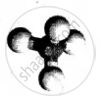
| Ammonium | \[\ce{NH4+}\] | `"SO"_4^--` |
| Sulphate |
\[\begin{bmatrix} |
|
|
|
APPEARS IN
संबंधित प्रश्न
What are polyatomic ions? Give examples.
Write the names of `"CuCo"_3` compounds :
Write the names of `"ZnCl"_2 ` compounds :
Write the names of `"H"_2"S"` compounds :
What is the name of a particle which contains 10 electrons, 11 protons and 12 neutrons ?
Fill in the following blank with suitable word:
A sulphide ion has negative charge because it contains less ....................... than ...................
Write the basic radicals and acidic radicals of the following and then write the chemical formulae of these compound.
Sodium zincate
Write the basic radicals and acidic radicals of the following and then write the chemical formulae of these compound.
Stannic phosphate
Complete the following table.
|
Acid Radicals `→` |
Chloride |
Nitrate |
Sulphate |
Carbonate |
Hydroxide |
Phosphate |
|
Basic Radicals `↓` |
||||||
|
Magnesium |
MgCl2 |
Mg(NO3)2 |
MgSO4 |
MgCO3 |
Mg(OH)2 |
Mg3(PO4)2 |
|
Sodium |
|
|
|
|
|
|
|
Zinc |
|
|
|
|
|
|
|
Silver |
|
|
|
|
|
|
|
Ammonium |
|
|
|
|
|
|
|
Calcium |
|
|
|
|
|
|
|
Iron (II) |
|
|
|
|
|
|
|
Potassium |
|
|
|
|
|
|
State if the following element or radical is divalent?
Sulphite
