Advertisements
Advertisements
प्रश्न
Describe with examples of pyramids of number and biomass.
Advertisements
उत्तर १
- Pyramid of numbers: It is a graphical representation of the number of individuals present at each trophic level in the food chain of an ecosystem. The pyramid of numbers can be upright or inverted depending on the number of producers. For example, in a grassland ecosystem, the pyramid of numbers is upright. In this type of food chain, the number of producers (plants) is followed by the number of herbivores (mice), which in turn is followed by the number of secondary consumers (snakes) and tertiary carnivores (eagles). Hence, the number of individuals at the producer level will be the maximum, while the number of individuals present at the top carnivores will be the least.
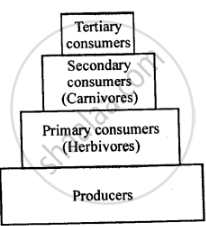
The pyramid of numbers in a grassland ecosystem
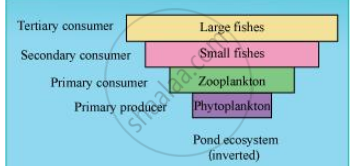
On the other hand, in a parasitic food chain, the pyramid of numbers is inverted. In this type of food chain, a single tree (producer) provides food to several fruit-eating birds, which in turn support several insect species. - Pyramid of biomass: A pyramid of biomass is a graphical representation of the total amount of living matter present at each trophic level of an ecosystem. It can be upright or inverted. In grasslands and forest ecosystems, the amount of biomass present at the producer level is higher than at the top carnivore level. In a pond ecosystem, the biomass of fish far exceeds the biomass of zooplankton (upon which they feed).

उत्तर २
Pyramid of numbers:
- The relative number of individuals per unit area at different trophic levels constitutes the pyramid of numbers.
- In a most well-balanced ecosystem, the pyramid of numbers is upright, i.e., producers are more in number than herbivores, and herbivores are more in number than carnivores.

Upright pyramid of numbers - However, a pyramid of numbers can also be inverted in some cases.
- E.g., a tree ecosystem represents an inverted pyramid of numbers. If we plot the number of insects on a single tree, smaller birds feeding on insects, and parasites on those birds, we get an inverted pyramid.
Pyramid of biomass:
- The amount of biomass per unit area across different trophic levels forms the biomass pyramid.
- In a most well-balanced ecosystem, the pyramid of biomass is upright, i.e., the biomass of producers is more than that of herbivores, and the biomass of herbivores is more than that of carnivores.

Upright pyramid of biomass - However, the pyramid of biomass can also be inverted in some cases. For example, the Oceanic ecosystem exhibits an inverted biomass pyramid. In this case, the biomass of phytoplankton (producers) is less than that of zooplankton and fish.
संबंधित प्रश्न
Give diagrammatic representation of pyramid of numbers.
“It is often said that the pyramid of energy is always upright. On the other hand, the pyramid of biomass can be both upright and inverted.” Explain with the help if examples and sketches.
Why the pyramid of energy is always upright? Explain.
Distinguish between a food chain and a food web.
Which organisms constitute the last trophic level?
“The pyramid of biomass is not always upright.” Explain the statement.
With reference to the levels of an organisation, differentiate between living organisms and non-living objects.
Write any two limitations of ecological pyramids.
'The pyramid of energy is always upright.' Explain
Give an example of an ecosystem that shows an inverted pyramid of biomass.
Distinguish between the upright and inverted pyramid of biomass.
In a tree ecosystem the pyramid of numbers is:
Pyramid of energy in grassland and pond ecosystem is always ______.
Which one of the following is not used for construction of ecological pyramids?
Which of the following organism form the decomposers?
Which one of the following statements for pyramid of energy is incorrect, whereas the remaining three are correct?
Pyramid of biomass in terrestrial ecosystem shows sharp decline in
Which of the following statements is not correct?
Pyramid of numbers is ______.
The number of trophic levels in an ecosystem are limited. Comment.
What are the shortcomings of ecological pyramids in the study of ecosystems?
Write a short note on pyramid of numbers and pyramid of biomass.
(a) Given below is a pyramid of biomass in an ecosystem where each bar represents the standing crop available in the trophic level. With the help of an example explain the conditions where this kind of pyramid is possible in nature.

(b) Will the pyramid of energy be also of the same shape in this situation? Give a reason for your response.
(a) Draw a pyramid of numbers where a large number of insects are feeding on the leaves of a tree. What is the shape of this pyramid?
(b) Will the pyramid of energy be also of the same shape in this situation? Give a reason for your response.
A graphic representation of the biomass relationship between the producer and consumer in an ecosystem is called ______.
The biomass of a standing crop of phytoplankton is 4 kg/m2, which supports a large standing crop of zooplankton having a biomass of 11 kg/m2. This is consumed by small fishes having a biomass of 25 kg/m2, which are then consumed by large fishes with a biomass of 37 kg/m2.
Draw an ecological pyramid indicating the biomass at each stage and also name the trophic levels. Mention whether it is an upright or inverted pyramid.
Describe pyramid of energy with the help of diagram.
What does the base of each ecological pyramid represent?
What does a pyramid of numbers represent?
Which statement explains the inverted pyramid of biomass in oceanic ecosystems?
What does a pyramid of energy represent?
Why can the pyramid of energy never be inverted?
Which food chains have more available energy?
