Advertisements
Advertisements
प्रश्न
Describe geometry of the Young’s double slit experiment with the help of a ray diagram. What is fringe width? Obtain an expression of it. Write the conditions for constructive as well as destructive interference.
Advertisements
उत्तर
i. Let S1 and S2 be the two coherent monochromatic sources that are separated by short distance d. They emit light waves of wavelength λ.
ii. Let D = horizontal distance between screen and source.
iii. Draw S1M and S2N ⊥ AB
OP = perpendicular bisector of the slit.
Since S1P = S2P, the path difference between waves reaching P from S1 and S2 is zero, therefore there is a bright point at P.
iv. Consider a point Q on the screen which is at a distance y from the central point P on the screen. Light waves from S1 and S2 reach at Q simultaneously by covering paths S1Q and S2Q, where they superimpose. 
Derivation:
In Δ S1MQ, (S1Q)2 = (S1M)2 + (MQ)2
`("S"_1"Q")^2 = "D"^2 + ["y" - "d"/2]^2` ....(1)
In `Δ "S"_2"NQ", ("S"_2"Q")^2 = ("S"_2"N")^2 + ("NQ")^2`
∴ `("S"_2"Q")^2 = "D"^2 + ["y" + "d"/2]^2` ....(2)
Subtract equation (1) from (2),
`("S"_2"Q")^2 - ("S"_1"Q")^2 = ["D"^2 + ("y" + "d"/2)^2] - ["D"^2 + ("y" - "d"/2)^2]`
= `"D"^2 + ("y" + "d"/2)^2 - "D"^2 - ("y" - "d"/2)^2`
= `("y" + "d"/2)^2 - ("y" - "d"/2)^2`
= `("y"^2 + "d"^2/4 + "yd") - ("y"^2 + "d"^2/4 - "yd")`
= `"y"^2 + "d"^2/4 + "yd" - "y"^2 - "d"^2/4 + "yd"("S"_2"Q")^2 - ("S"_1"Q")^2`
= 2yd
∴ `("S"_2"Q" + "S"_1"Q")("S"_2"Q" - "S"_1"Q")` = 2yd
∴ `"S"_2"Q" - "S"_1"Q" = (2"yd")/("S"_2"Q" + "S"_1"Q")` ....(3)
If y << D and d << D then, S1Q ≈ S2Q ≈ D
S2Q + S1Q = 2D
∴ Equation (3) becomes,
`"S"_2"Q" - "S"_1"Q" = (2"yd")/(2"D")`
∴ `"S"_2"Q" - "S"_1"Q" = "yd"/"D"`
∴ Δl = `"yd"/"D"` ....(4)
Equation (4) gives the path difference of two interfering light waves. Point Q will be bright if,
Δl = nλ = 2n`lambda/2`
where n = 0, 1, 2,….
∴ `("y"_"n""d")/"D" = "n"λ = 2"n"lambda/2` ........….[From equation (4)]
∴ `"y"_"n" = "n"(lambda"D")/"d"` ….(5)
Equation (5) represents the distance of the nth bright fringe from the central bright fringe.
Point Q will be a dark point if,
`Deltal = (2"n" - 1)lambda/2`
where n = 1, 2, 3,……
∴ `("y"_"n"^'"d")/"D" = (2"n" - 1)lambda/2`
∴ `"y"_"n"^' = (2"n" - 1)(lambda"D")/(2"d") = ("n" - 1/2) (lambda"D")/"d"` .........(6)
Equation (6) represents the distance of nth dark fringe from the central maximum.
Fringe width:
The distance between any two successive dark or any two successive bright fringes is equal. This is called the fringe width and is given by, Fringe width = W = Δy = `"y"_("n" + 1) - "y"_"n" = "y"_"n + 1"^' - "y"_"n"^'`
W = `λ"D"/"d"`
Thus, both dark and bright fringes are equidistant and have equal widths.
Conditions for constructive and destructive interference:
The phase difference between the two waves reaching P, from `"S"_1` and `"S"_2` is given by,
`Deltaphi = "y""d"/"D"((2pi)/lambda)` ..........`(∵ Deltal = "yd"/"D")`
The condition for constructive interference in terms of phase difference is given by,
ΔΦ = n2π, where, n = 0, ±1 ±2
∴ The condition for destructive interference in terms of phase difference is given by
`Deltaphi = ("n" - 1/2)2pi,` where, n = ±1, ±2
APPEARS IN
संबंधित प्रश्न
A narrow slit S transmitting light of wavelength λ is placed a distance d above a large plane mirror, as shown in the following figure. The light coming directly from the slit and that coming after the reflection interfere at a screen ∑ placed at a distance D from the slit. (a) What will be the intensity at a point just above the mirror, i.e. just above O? (b) At what distance from O does the first maximum occur?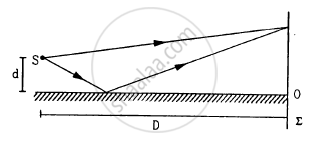
Answer the following question.
Describe any two characteristic features which distinguish between interference and diffraction phenomena. Derive the expression for the intensity at a point of the interference pattern in Young's double-slit experiment.
Answer in brief:
Explain what is the optical path length. How is it different from actual path length?
What is meant by coherent sources?
The intensity of the light coming from one of the slits in Young's experiment is twice the intensity of the light coming from the other slit. What will be the approximate ratio of the intensities of the bright and dark fringes in the resulting interference pattern?
Two coherent sources whose intensity ratio is 25:1 produce interference fringes. Calculate the ratio of amplitudes of light waves coming from them.
One of Young’s double slits is covered with a glass plate as shown in figure. The position of central maximum will,

How does wavefront division provide coherent sources?
Discuss the interference in thin films and obtain the equations for constructive and destructive interference for transmitted and reflected light.
Does diffraction take place at Young’s double-slit?
The ratio of maximum and minimum intensities in an interference pattern is 36 : 1. What is the ratio of the amplitudes of the two interfering waves?
Light of wavelength 600 nm that falls on a pair of slits producing interference pattern on a screen in which the bright fringes are separated by 7.2 mm. What must be the wavelength of another light which produces bright fringes separated by 8.1 mm with the same apparatus?
In Young's double-slit experiment, in an interference pattern, a second minimum is observed exactly in front of one slit. The distance between the two coherent sources is 'd' and the distance between source and screen is 'D'. The wavelength of the light source used is ______
A thin transparent sheet is placed in front of a slit in Young's double slit experiment. The fringe width will ____________.
In a Young's double-slit experiment, the intensity at a point where the path difference is `lambda/3` (`lambda` being the wavelength of the light used) is I. If I0 denotes the maximum intensity, then `"I"/"I"_0` is equal to ______.
In a biprism experiment, D = 1 m, `lambda` = 6000 Å. When a convex lens is interposed between the biprism ru1d the eyepiece, then the distance between the images of the slits given by the Jens at two positions are 1.5 mm and 6.0 mm. The fringe width will be ______.
In Young's double slit experiment with a source of light of wavelength 5860 Å, the first maxima will occur when ____________.
In Young's double slit experiment fifth dark fringe is formed opposite to one of the slits. If D is the distance between the slits and the screen and d is the separation between the slits, then the wavelength of light used is ______.
The phenomenon of interference is based on ______.
Two coherent light sources of intensity ratio 'n' are employed in an interference experiment. The ratio of the intensities of the maxima and minima in the interference pattern is (I1 > I2).
In biprism experiment, the 4th dark band is formed opposite to one of the slits. The wavelength of light used is ______.
In Young's double-slit experiment, if the two sources of light are very wide, then ______.
A double slit experiment is immersed in water of refractive index 1.33. The slit separation is 1 mm, distance between slit and screen is 1.33 m. The slits are illuminated by a light of wavelength 6300 Å. The fringe width is ______.
What is meant by Constructive interference?
The interference pattern is obtained with two coherent light sources of intensity ratio 4 : 1. And the ratio `("I"_"max" - "I"_"min")/("I"_"max" + "I"_"min")` is `5/x`. Then the value of x will be equal to ______.
Interference fringes are produced on a screen by using two light sources of intensities I and 9I. The phase difference between the beams is `pi/2` at point P and π at point Q on the screen. The difference between the resultant intensities at point P and Q is ______.
In biprism experiment the maximum intensity is ‘I0’. If the path difference between the two interfering waves is ‘λ/4’ then intensity at the point on the screen is ______.
`[sin 45^circ = cos 45^circ = 1/sqrt 2]`
