Advertisements
Advertisements
प्रश्न
Explain Young’s double-slit experimental setup and obtain the equation for path difference.
Advertisements
उत्तर

Young’s double-slit experiment
- Wavefronts from S1 and S2 spread out and overlapping takes place to the right side of the double slit.
- When a screen is placed at a distance of about 1 meter from the slits, alternately bright and dark fringes which are equally spaced appear on the screen. These are called interference fringes or bands.
Equation for path difference: - Let d be the distance between the double slits S1 and S2 which act as coherent sources of wavelength λ.
- A screen is placed parallel to the double-slit at a distance D from it. The mid-point of S1 and S2 is C and the mid-point of the screen O is equidistant from S1 and S2. P is any point at a distance y from O.
- The waves from S1 and S2 meet at P either in-phase or out-of-phase depending upon the path difference between the two waves.

Young’s double-slit experimental setupδ = S2P – S1P
δ = S2P – MP = S2M -
The angular position of the point P from C is θ. ∠ OCP = θ.
- From the geometry, the angles ∠ OCP and ∠ S2S1M are equal.
∠ OCP = ∠ S2S1M = θ.
In right-angle triangle ∆ S1S2M, the path difference,
S2M = d sin θ
δ = d sin θ
If the angle θ is small, sin θ »tan θ θ
From the right angle triangle ∆ OCP,
tan θ = `"y"/"D"`
The path difference, δ = `"dy"/"d"`
APPEARS IN
संबंधित प्रश्न
A narrow slit S transmitting light of wavelength λ is placed a distance d above a large plane mirror, as shown in the following figure. The light coming directly from the slit and that coming after the reflection interfere at a screen ∑ placed at a distance D from the slit. (a) What will be the intensity at a point just above the mirror, i.e. just above O? (b) At what distance from O does the first maximum occur?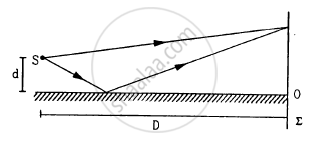
A long narrow horizontal slit is paced 1 mm above a horizontal plane mirror. The interference between the light coming directly from the slit and that after reflection is seen on a screen 1.0 m away from the slit. If the mirror reflects only 64% of the light energy falling on it, what will be the ratio of the maximum to the minimum intensity in the interference pattern observed on the screen?
In Young’s double slit experiment, the slits are separated by 0.5 mm and screen is placed 1.0 m away from the slit. It is found that the 5th bright fringe is at a distance of 4.13 mm from the 2nd dark fringe. Find the wavelength of light used.
Describe Young's double-slit interference experiment and derive conditions for occurrence of dark and bright fringes on the screen. Define fringe width and derive a formula for it.
A double-slit arrangement produces interference fringes for sodium light (λ = 589 nm) that are 0.20° apart. What is the angular fringe separation if the entire arrangement is immersed in water (n = 1.33)?
Draw a neat labelled ray diagram of the Fresnel Biprism experiment showing the region of interference.
Describe geometry of the Young’s double slit experiment with the help of a ray diagram. What is fringe width? Obtain an expression of it. Write the conditions for constructive as well as destructive interference.
What is interference of light?
How does wavefront division provide coherent sources?
The interference pattern is obtained with two coherent light sources of intensity ratio n. In the interference pattern, the ratio `("I"_"max" - "I"_"min")/("I"_"max" + "I"_"min")` will be ______
In Young's double-slit experiment, in an interference pattern, a second minimum is observed exactly in front of one slit. The distance between the two coherent sources is 'd' and the distance between source and screen is 'D'. The wavelength of the light source used is ______
In a double slit experiment, the two slits are 2 mm apart and the screen is placed 1 m away. A monochromatic light of wavelength 500 nm is used. What will be the width of each slit for obtaining ten maxima of double slit within the central maxima of single slit pattern?
In Young's double-slit experiment, an interference pattern is obtained on a screen by a light of wavelength 4000 Å, coming from the coherent sources S1 and S2 At certain point P on the screen, third dark fringe is formed. Then the path difference S1P - S2P in microns is ______.
Two coherent light sources of intensity ratio 'n' are employed in an interference experiment. The ratio of the intensities of the maxima and minima in the interference pattern is (I1 > I2).
If two waves represented by `"y"_1 = 3 "sin" omega "t"` and `"y"_2 = 5 "sin" (omega "t" + pi/3)` interfere at a point, then the amplitude of the resulting wave will be about ____________.
`phi "and" phi_2 (phi_1 > phi_2)` are the work functions of metals A and B. When light of same wavelength is incident on A and B, the fastest emitted electrons from A are ____________ those emitted from B.
In biprism experiment, if the 5th bright band with wavelength 'λ1' coincides with the 6th dark band with wavelength 'λ2' then the ratio `(lambda_2/lambda_1)` is ______
If two light waves reaching a point produce destructive interference, then the condition of phase difference is ______
In Young's double-slit experiment, if the two sources of light are very wide, then ______.
A beam of electrons is used in Young's double-slit experiment. If the speed of electrons is increased then the fringe width will ______.
