Advertisements
Advertisements
प्रश्न
Complete the following statement by means of one of those given in brackets against each:
Consecutive angles of a parallelogram are ...................
विकल्प
supplementary
complementary
Advertisements
उत्तर
Consecutive angles of a parallelogram are supplementary.
Reason:
Let ABCD be the given parallelogram.
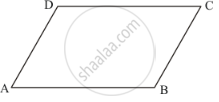
hus, AB || DC.
Therefore, ∠A +∠D = 180
Consecutive angles ∠A and ∠D are supplementary.
APPEARS IN
संबंधित प्रश्न
Show that if the diagonals of a quadrilateral bisect each other at right angles, then it is a rhombus.
In ΔABC and ΔDEF, AB = DE, AB || DE, BC = EF and BC || EF. Vertices A, B and C are joined to vertices D, E and F respectively (see the given figure). Show that
(i) Quadrilateral ABED is a parallelogram
(ii) Quadrilateral BEFC is a parallelogram
(iii) AD || CF and AD = CF
(iv) Quadrilateral ACFD is a parallelogram
(v) AC = DF
(vi) ΔABC ≅ ΔDEF.

In a parallelogram ABCD, ∠D = 135°, determine the measures of ∠A and ∠B
The following statement are true and false.
In a parallelogram, the diagonals bisect each other.
The following statement are true and false .
In any quadrilateral, if a pair of opposite sides is equal, it is a parallelogram.
PQRS is a quadrilateral, PR and QS intersect each other at O. In which of the following case, PQRS is a parallelogram?
PQ = 7 cm, QR = 7 cm, RS = 8 cm, SP = 8 cm
The bisectors of any two adjacent angles of a parallelogram intersect at
The bisectors of the angle of a parallelogram enclose a
Diagonals of a quadrilateral ABCD bisect each other. If ∠A= 45°, then ∠B =
ABCD is a parallelogram and E is the mid-point of BC. DE and AB when produced meet at F. Then, AF =
