Advertisements
Advertisements
प्रश्न
The bisectors of any two adjacent angles of a parallelogram intersect at
विकल्प
30°
45°
60°
90°
Advertisements
उत्तर
Let the figure be as follows:
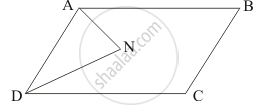
ABCD is a parallelogram.
We have to find ∠DNA
AN and AD is the bisectors of ∠A and ∠D.
Therefore,
`∠DAN = 1/2 ∠A` …… (i)
And
`∠ADN = 1/2 ∠D` …… (ii)
We know that AB || DC.
Therefore, the sum of consecutive interior angles must be supplementary.
`∠A + ∠D = 180°`
`1/2∠A + 1/2∠D = 180°/2`
From (i) and (ii), we get
∠DAN + ∠ADN = 90°…… (iii)
By angle sum property of a triangle:
∠DAN + ∠DAN + ∠ADN = 180°
∠DNA + 90° = 180°
∠DNA = 180° - 90°
∠DNA = 90°
Hence the correct choice is (d).
APPEARS IN
संबंधित प्रश्न
The following statement are true and false .
In a parallelogram, the diagonals are equal
The following statement are true and false.
In a parallelogram, the diagonals bisect each other.
The following statement are true and false .
In a parallelogram, the diagonals intersect each other at right angles .
The following statement are true and false .
If three angles of a quadrilateral are equal, it is a parallelogram .
If measures opposite angles of a parallelogram are (60 − x)° and (3x − 4)°, then find the measures of angles of the parallelogram.
Complete the following statement by means of one of those given in brackets against each:
Consecutive angles of a parallelogram are ...................
PQRS is a quadrilateral, PR and QS intersect each other at O. In which of the following case, PQRS is a parallelogram?
OP = 6.5 cm, OQ = 6.5 cm, OR = 5.2 cm, OS = 5.2 cm
ABCD is a parallelogram and E and F are the centroids of triangles ABD and BCDrespectively, then EF =
Diagonals of a quadrilateral ABCD bisect each other. If ∠A= 45°, then ∠B =
ABCD is a parallelogram and E is the mid-point of BC. DE and AB when produced meet at F. Then, AF =
