Advertisements
Advertisements
प्रश्न
The bisectors of any two adjacent angles of a parallelogram intersect at
पर्याय
30°
45°
60°
90°
Advertisements
उत्तर
Let the figure be as follows:
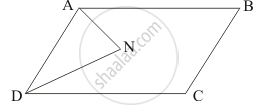
ABCD is a parallelogram.
We have to find ∠DNA
AN and AD is the bisectors of ∠A and ∠D.
Therefore,
`∠DAN = 1/2 ∠A` …… (i)
And
`∠ADN = 1/2 ∠D` …… (ii)
We know that AB || DC.
Therefore, the sum of consecutive interior angles must be supplementary.
`∠A + ∠D = 180°`
`1/2∠A + 1/2∠D = 180°/2`
From (i) and (ii), we get
∠DAN + ∠ADN = 90°…… (iii)
By angle sum property of a triangle:
∠DAN + ∠DAN + ∠ADN = 180°
∠DNA + 90° = 180°
∠DNA = 180° - 90°
∠DNA = 90°
Hence the correct choice is (d).
APPEARS IN
संबंधित प्रश्न
The angles of quadrilateral are in the ratio 3: 5: 9: 13. Find all the angles of the quadrilateral.
In a parallelogram ABCD, ∠D = 135°, determine the measures of ∠A and ∠B
The following statement are true and false .
In any quadrilateral, if a pair of opposite sides is equal, it is a parallelogram.
If ABCD is a rhombus with ∠ABC = 56°, find the measure of ∠ACD.
The perimeter of a parallelogram is 22 cm. If the longer side measures 6.5 cm, what is the measure of shorter side?
Complete the following statement by means of one of those given in brackets against each:
If one angle of a parallelogram is a right angle, then it is necessarily a .................
PQRS is a quadrilateral, PR and QS intersect each other at O. In which of the following case, PQRS is a parallelogram?
∠P =85°, ∠Q = 85°, ∠R = 95°
The figure formed by joining the mid-points of the adjacent sides of a quadrilateral is a
If one angle of a parallelogram is 24° less than twice the smallest angle, then the measure of the largest angle of the parallelogram is
Diagonals of a quadrilateral ABCD bisect each other. If ∠A= 45°, then ∠B =
