Advertisements
Advertisements
प्रश्न
Diagonals of a quadrilateral ABCD bisect each other. If ∠A= 45°, then ∠B =
पर्याय
115°
120°
125°
135°
Advertisements
उत्तर
We know that the diagonals of a parallelogram bisect each other.
Thus, the given quadrilateral ABCD is a parallelogram.
∠A = 45° and ∠B are consecutive interior angles, which must be supplementary.
Therefore, we have
∠A + ∠B = 180°
45° +∠B = 180°
∠B = 180°- 45°
∠B = 135°
Hence the correct choice is (d).
APPEARS IN
संबंधित प्रश्न
The angles of quadrilateral are in the ratio 3: 5: 9: 13. Find all the angles of the quadrilateral.
ABCD is a rhombus. Show that diagonal AC bisects ∠A as well as ∠C and diagonal BD bisects ∠B as well as ∠D.
The following statement are true and false .
If all the angles of a quadrilateral are equal, it is a parallelogram .
The following statement are true and false .
If three sides of a quadrilateral are equal, it is a parallelogram .
The following statement are true and false .
If all the sides of a quadrilateral are equal it is a parallelogram.
If measures opposite angles of a parallelogram are (60 − x)° and (3x − 4)°, then find the measures of angles of the parallelogram.
In the given figure, ABCD and AEFG are two parallelograms. If ∠C = 58°, find ∠F.
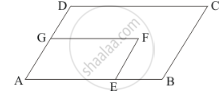
Complete the following statement by means of one of those given in brackets against each:
If one angle of a parallelogram is a right angle, then it is necessarily a .................
In a parallelogram ABCD, if ∠DAB = 75° and ∠DBC = 60°, then ∠BDC =
ABCD is a parallelogram and E is the mid-point of BC. DE and AB when produced meet at F. Then, AF =
