Advertisements
Advertisements
प्रश्न
The figure formed by joining the mid-points of the adjacent sides of a rectangle is a
पर्याय
square
rhombus
trapezium
none of these
Advertisements
उत्तर
We get a rhombus by joining the mid-points of the sides of a rectangle.
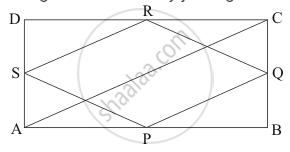
It is given that rectangle ABCD in which P,Q,R and S are the mid-points AB,BC,CD and DA respectively.
PQ,QR,RS and SP are joined.
In ΔABC, P and Q are the mid-points AB and BC respectively.
Therefore,
PQ || AC and `PQ = 1/2 AC`……(i)
Similarly, In ΔADC,R and S are the mid-points CD and AD respectively.
Therefore,
SR || ACand `SR = 1/2 AC `……(ii)
From (i) and (ii), we get
PQ || SR and PQ = SR
Therefore, PQRS is a parallelogram. …… (iii)
Now ABCD is a rectangle.
Therefore,
AD = BC
`1/2 AD = 1/2 BC`
AS = BQ …… (iv)
In ΔAPS and ΔBPQ , we have:
AP = BP (P is the mid point of AB)
∠PAS = ∠PBQ (Each is a right angle)
AS = BQ (From equation (iv))
So, by SAS congruence criteria, we get:
ΔAPS ≅ ΔBPQ
By Corresponding parts of congruent triangles property we have:
PS = PQ …… (v)
From (iii) and (v) we obtain that PQRS is a parallelogram such that PS = PQ.
Thus, the two adjacent sides are equal.
Thus, PQRS is a rhombus .
Hence the correct choice is (b).
APPEARS IN
संबंधित प्रश्न
The following statement are true and false .
In a parallelogram, the diagonals are equal
The following statement are true and false .
In any quadrilateral, if a pair of opposite sides is equal, it is a parallelogram.
The following statement are true and false .
If all the sides of a quadrilateral are equal it is a parallelogram.
If ABCD is a rhombus with ∠ABC = 56°, find the measure of ∠ACD.
The perimeter of a parallelogram is 22 cm. If the longer side measures 6.5 cm, what is the measure of shorter side?
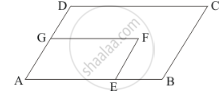
In the given figure, ABCD and AEFG are two parallelograms. If ∠C = 58°, find ∠F.
PQRS is a quadrilateral, PR and QS intersect each other at O. In which of the following case, PQRS is a parallelogram?
OP = 6.5 cm, OQ = 6.5 cm, OR = 5.2 cm, OS = 5.2 cm
The bisectors of any two adjacent angles of a parallelogram intersect at
ABCD is a parallelogram and E and F are the centroids of triangles ABD and BCDrespectively, then EF =
The diagonals of a parallelogram ABCD intersect at O. If ∠BOC = 90° and ∠BDC = 50°, then ∠OAB =
