Advertisements
Advertisements
प्रश्न
Show that if the diagonals of a quadrilateral bisect each other at right angles, then it is a rhombus.
Advertisements
उत्तर

Let ABCD be a quadrilateral, whose diagonals AC and BD bisect each other at right angle i.e., OA = OC, OB = OD, and ∠AOB = ∠BOC = ∠COD = ∠AOD = 90º. To prove ABCD a rhombus, we have to prove ABCD is a parallelogram and all the sides of ABCD are equal.
In ΔAOD and ΔCOD,
OA = OC (Diagonals bisect each other)
∠AOD = ∠COD (Given)
OD = OD (Common)
∴ ΔAOD ≅ ΔCOD (By SAS congruence rule)
∴ AD = CD (1)
Similarly, it can be proved that
AD = AB and CD = BC (2)
From equations (1) and (2),
AB = BC = CD = AD
Since opposite sides of quadrilateral ABCD are equal, it can be said that ABCD is a parallelogram. Since all sides of a parallelogram ABCD are equal, it can be said that ABCD is a rhombus.
संबंधित प्रश्न
ABCD is a rhombus. Show that diagonal AC bisects ∠A as well as ∠C and diagonal BD bisects ∠B as well as ∠D.
In a parallelogram ABCD, ∠D = 135°, determine the measures of ∠A and ∠B
The following statement are true and false .
If three sides of a quadrilateral are equal, it is a parallelogram .
If ABCD is a rhombus with ∠ABC = 56°, find the measure of ∠ACD.
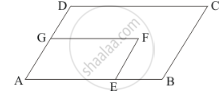
In the given figure, ABCD and AEFG are two parallelograms. If ∠C = 58°, find ∠F.
The bisectors of any two adjacent angles of a parallelogram intersect at
The bisectors of the angle of a parallelogram enclose a
The figure formed by joining the mid-points of the adjacent sides of a quadrilateral is a
In a parallelogram ABCD, if ∠DAB = 75° and ∠DBC = 60°, then ∠BDC =
ABCD is a parallelogram and E and F are the centroids of triangles ABD and BCDrespectively, then EF =
