Advertisements
Advertisements
प्रश्न
Complete the following statement by means of one of those given in brackets against each:
If one angle of a parallelogram is a right angle, then it is necessarily a .................
विकल्प
rectangle
square
rhombus
Advertisements
उत्तर
If one angle of a parallelogram is a right angle, then it is necessarily a rectangle.
Reason:
Let ABCD be the given parallelogram.
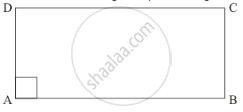
We have, ∠A = 90°
In a parallelogram, opposite angles are equal.
Therefore,
∠C = 90°
Similarly,
∠A + ∠D = 180°
90° + ∠D = 180°
∠D = 90°
Also, ∠B = 90°
Thus, a parallelogram with all the angles being right angle and opposite sides being equal is a rectangle.
APPEARS IN
संबंधित प्रश्न
The angles of quadrilateral are in the ratio 3: 5: 9: 13. Find all the angles of the quadrilateral.
ABCD is a rhombus. Show that diagonal AC bisects ∠A as well as ∠C and diagonal BD bisects ∠B as well as ∠D.
In a parallelogram ABCD, ∠D = 135°, determine the measures of ∠A and ∠B
The following statement are true and false .
In a parallelogram, the diagonals intersect each other at right angles .
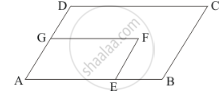
In the given figure, ABCD and AEFG are two parallelograms. If ∠C = 58°, find ∠F.
Complete the following statement by means of one of those given in brackets against each:
Consecutive angles of a parallelogram are ...................
PQRS is a quadrilateral, PR and QS intersect each other at O. In which of the following case, PQRS is a parallelogram?
OP = 6.5 cm, OQ = 6.5 cm, OR = 5.2 cm, OS = 5.2 cm
The figure formed by joining the mid-points of the adjacent sides of a quadrilateral is a
In a parallelogram ABCD, if ∠DAB = 75° and ∠DBC = 60°, then ∠BDC =
The diagonals of a parallelogram ABCD intersect at O. If ∠BOC = 90° and ∠BDC = 50°, then ∠OAB =
