Advertisements
Advertisements
प्रश्न
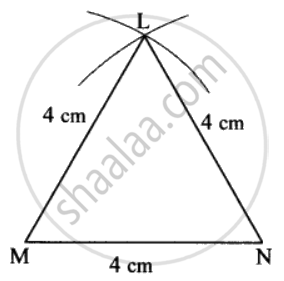
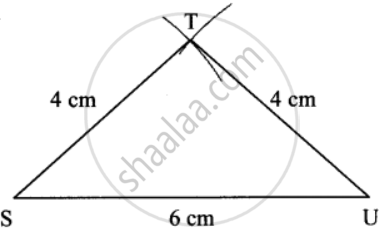
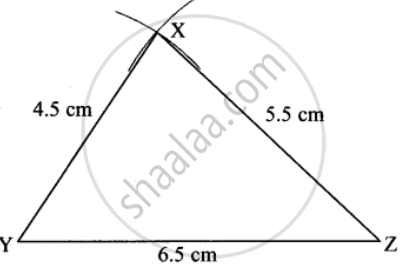
Choose the lengths of the sides yourself and draw one equilateral, one isosceles and one scalene triangle.
Advertisements
उत्तर
1. Equilateral triangle LMN, l(LM) = l(MN) = l(LN) = 4 cm.
2. Isosceles triangle STU, l(ST) = l(TU) = 4cm, l(SU) = 6 cm
3. Scalene triangle XYZ, l(XY) = 4.5 cm, l(XY) = 6.5 cm, l(XZ) = 5.5 cm
APPEARS IN
संबंधित प्रश्न
In ΔABC, l(AB) = 5.5 cm, l(BC) = 4.2 cm, l(AC) = 3.5 cm
Draw an isosceles triangle with base 5 cm and the other sides 3.5 cm each.
Draw triangle with the measures given below.
In ∆ NTS, m ∠T = 40°, l(NT) = l(TS) = 5 cm
Construct a triangle of the measures given below.
In ∆MNP, l(NP) = 5.2 cm, m∠N = 70°, m ∠P = 40°
Construct a triangle using the given data: AB = 6.5cm, BC = 8.4cm and AC = 7.2cm
Construct a triangle using the given data: DE = 6.5cm, EF = 5.8cm and DF = 4.2cm
Construct an isosceles triangle in which: XY = XZ, YZ = 5.5 cm and ∠X = 60°
Construct a triangle PQR with PQ = 5.4 cm, QR = 4.6 cm and ∠Q = 60°. Draw the perpendicular PS at QR, measure the lengths of SP and SQ,
Construct a ΔRST with side ST = 5.4 cm, RST = 60° and the perpendicular from R on ST = 3.0 cm.
In Construction of △ABC where AB = 3 cm, BC = 5 cm, and ∠ABC = 60°, which side must be drawn first as the base?
