Advertisements
Advertisements
प्रश्न
Choose the correct statement from the following:
विकल्प
Cleistogamous flowers always exhibit autogamy.
Chasmogamous flowers always exhibit geitonogamy.
Cleistogamous flowers exhibit both autogamy and geitonogamy.
Chasmogamous flowers never exhibit autogamy.
Advertisements
उत्तर
Cleistogamous flowers always exhibit autogamy.
Explanation:
Cleistogamous flowers never open, so pollen from other plants cannot reach their stigma. This means they are always pollinated by their pollen, ensuring self-pollination (autogamy). This mechanism does not rely on external pollinating agents, making autogamy guaranteed in cleistogamous flowers.
APPEARS IN
संबंधित प्रश्न
A flower of tomato plant following the process of sexual reproduction produces 240 viable seeds.
Answer the following questions giving reasons :
(a) What is the minimum number of pollen grains that must have been involved in the pollination of its pistil?
(b) What would have been the minimum number of ovules present in the ovary?
(c) How many megaspore mother cells were involved?
(d) What is the minimum number of microspore mother cells involved in the above case?
(e) How many male gametes were involved in this case?
Enlist advantages and disadvantages of cross pollination
Add a note on pollination mechanism in Salvia.
Give the floral adaptations for anemophily.
Describe the structure of its microsporangium.
Write two ways in which pollination may occur in plants.
Fill in the blank:
Male sex cells in plants are called _________.
Find the odd-one out, giving reason:
Ovary, style, pollen grain, stigma
Complete the following chart and rewrite.
| Sr.No. | Agencies | type of pollination |
| 1 | Water | .................... |
| 2 | ........................... | Entomophily |
| 3 | Bat | .................... |
| 4 | ....................... | Ornithophily |
(Or)
Explain outbreeding devices in angiospermic plants.
Mention any two contrivances in flowers which favour cross-pollination.
Answer the following question.
Express the process of pollination in Vallisneria.
Put a tick mark (✓) against the correct alternative in the following statements
Pollen is produced in the
Name the two types of pollination.
Describe pollination. How many types of pollinations are found?
Mention various adaptations for wind pollination.
A dioecious flowering plant prevents both ______.
Plants with ovaries having only one or a few ovules are generally pollinated by ______.
Which of these is a condition that makes flowers invariably autogamous?
Which type of flower has ovary superior?
The flower which does not open at all are called ______.
Which one of these statements is incorrect?
The following statements seem to describe the water-pollinated submerged plants.
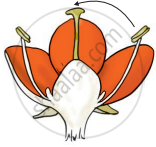
Which type of pollination does the figure indicate?
Describe any three adaptations in anemophilous flowers.
Consider the following statements depicting adaptation of flowers to carryout successful pollination.
- Stigma is long, sticky and unwettable.
- Sepals, petals or perianth (if present) have waxy coating.
- Stamens with long filament and versatile anthers.
- Tubular corolla is seen.
- Flowers are noctumal.
Which of the above statements clearly depict hydrophily?
Which of the following floral adapation are adapted by hydrophilous flowers?
Name the pollinating agent of a flowering plant with large and coloured flowers with sticky stigma. State one characteristic feature of the pollen grains produced in such flowers.
Comparatively a large amount of pollen grains are wasted during ______.
Hydrophily (Hypo) is characterized by which of the following conditions?
