Advertisements
Advertisements
प्रश्न
Complete the following chart and rewrite.
| Sr.No. | Agencies | type of pollination |
| 1 | Water | .................... |
| 2 | ........................... | Entomophily |
| 3 | Bat | .................... |
| 4 | ....................... | Ornithophily |
(Or)
Explain outbreeding devices in angiospermic plants.
Advertisements
उत्तर
1. Water Hydrophily
2. Insect Entomophily
3. Bat Chiropterophily
4. Birds Ornithophily
(Or)
1) Most of the Angiosperms produce bisexual flowers. Cross pollination is preferred by majority of flowering plants and they develop out breeding devices.
2) In many plants self pollination is avoided as stamens and carpels do not mature simultaneously. This
is called dichogamy.
3) In some plants, pollen grains are released much before stigma becomes receptive, this is protandry
e.g. Sunflower and in some plants, stigma becomes receptive first, this is protogyny e.g. Michelia.
4) The third device to avoid self pollination is genetic mechanism and it is called self-incompability or
self sterility, e.g. Orchids.
5) Pollen germination on the stigma of the same flower is inhibited. The fourth device is to produce
unisexual flowers. i.e. unisexuality.
6) In some plants like Castor, male and female flowers are produced on the same plant and such plants
are called monoecious. In dioecious plants like Papaya, male and female flowers are produced on
different plants. This condition prevents autogamy as well as geitonogamy while monoecious condition
prevents only autogamy.
APPEARS IN
संबंधित प्रश्न
A flower of tomato plant following the process of sexual reproduction produces 240 viable seeds.
Answer the following questions giving reasons :
(a) What is the minimum number of pollen grains that must have been involved in the pollination of its pistil?
(b) What would have been the minimum number of ovules present in the ovary?
(c) How many megaspore mother cells were involved?
(d) What is the minimum number of microspore mother cells involved in the above case?
(e) How many male gametes were involved in this case?
Describe the structure of its microsporangium.
Name two characteristics of flowers in which pollination occur by wind.
Answer the following question.
Write the difference in the characteristics of the progeny produced as a result of the two processes.
- Nucellus
- Antipodals
- Synergids
- Micropyle
Which of the following is not a water pollinated plant?
Which type of pollination does the figure indicate?
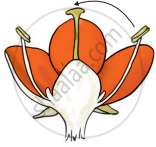
Which of the following floral adapation are adapted by hydrophilous flowers?
Comparatively a large amount of pollen grains are wasted during ______.
Identify the set of correct statements:
- The flowers of Vallisneria are colourful and produce nectar.
- The flowers of waterlily are not pollinated by water.
- In most of water-pollinated species, the pollen grains are protected from wetting.
- Pollen grains of some hydrophytes are long and ribbon like.
- In some hydrophytes, the pollen grains are carried passively inside water.
Choose the correct answer from the options given below:
