Advertisements
Advertisements
प्रश्न
Choose the correct statement from the following:
पर्याय
Cleistogamous flowers always exhibit autogamy.
Chasmogamous flowers always exhibit geitonogamy.
Cleistogamous flowers exhibit both autogamy and geitonogamy.
Chasmogamous flowers never exhibit autogamy.
Advertisements
उत्तर
Cleistogamous flowers always exhibit autogamy.
Explanation:
Cleistogamous flowers never open, so pollen from other plants cannot reach their stigma. This means they are always pollinated by their pollen, ensuring self-pollination (autogamy). This mechanism does not rely on external pollinating agents, making autogamy guaranteed in cleistogamous flowers.
APPEARS IN
संबंधित प्रश्न
Lever mechanism of pollination is observed in
- Salvia
- Jasmine
- Bougainvillea
- Butea
Why angiosperm anthers are called dithecous?
Name of the parts of the ovary which give rise to:
Fruit wall ______
Give one word/term for the following:
When stigma and anthers do not grow up to the same height, which favors only cross-pollination.
Give one word/term for the following:
Pollination of flowers by insects.
In bisexual flowers, maturation of gynoecium before androecium is known as ______.
Can a plant flowering in Mumbai be pollinated by pollen grains of the same species growing in New Delhi? Provide explanations to your answer.
Coelacanth was caught in South Africa. State the significance of the discovery of Coelacanth in the evolutionary history of vertebrates.
Put a tick mark (✓) against the correct alternative in the following statements
Pollen is produced in the
Write different modes of pollination in detail with suitable examples.
Describe the Advantages and Disadvantages of self-pollination to the Plant.
Explain water pollination in detail with its types.
Flowers which have single ovule in the ovary and are packed into inflorescence are usually pollinated by ______.
A dioecious flowering plant prevents both ______.
Which of the following is not a water pollinated plant?
Which of these is a condition that makes flowers invariably autogamous?
During Hybridization process anther of the bisexual flower is removed before it dehisces is called ______.
Which type of flower has ovary superior?
Pollination refers to the ______.
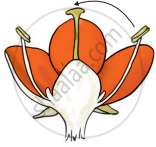
Which type of pollination does the figure indicate?
Advantage of cleistogamy is:
Describe any three adaptations in anemophilous flowers.
Pollination in water lilies is carried out by ______.
What is epihydrophily?
Name the following:
One plant each of Hypohydrophily and epihydrophily.
Briefly discuss any two methods by which plants avoid self-pollination.
What is the definition of pollination?
Which type of pollination involves the transfer of pollen between different plants of the same species?
