Advertisements
Advertisements
प्रश्न
Autogamy can occur in a chasmogamous flower if ______.
विकल्प
Pollen matures before maturity of ovule
Ovules mature before maturity of pollen
Both pollen and ovules mature simultaneously
Both anther and stigma are of equal lengths.
Advertisements
उत्तर
Autogamy can occur in a chasmogamous flower if both pollen and ovules mature simultaneously.
Explanation:
Autogamy in chasmogamous flowers occurs when pollen and ovules mature at the same time, allowing pollen to fertilize ovules within the same flower. Without simultaneous maturity, self-pollination is unlikely in open flowers like chasmogamous ones.
APPEARS IN
संबंधित प्रश्न
With the help of a suitable example, explain protandry.
Describe the characteristic features of wind pollinated flowers.
Make a list of any three outbreeding devices that flowering plants have developed and explain how they help to encourage cross-pollination.
Define the term Pollinating.
Which one of the following is one of the characteristics of self-pollinated flowers?
Fill in the blanks with suitable words.
Different timings for the maturation of gynoecium and androecium is called ________.
Name of the part of the ovary which gives rise to:
Fruit ______
State four features of flowers pollinated by insects.
Differentiate between geitonogamy and xenogamy (allogamy).
Put a tick mark (✓) against the correct alternative in the following statements
Pollen is produced in the
What are the adaptations which are required in self-pollinated plants?
Cleistogamous flowers are ______.
A dioecious flowering plant prevents both ______.
Even in absence of pollinating agents seed-setting is assured in ______.
Plants with ovaries having only one or a few ovules are generally pollinated by ______.
Which of the following is not a water pollinated plant?
The flower which does not open at all are called ______.
Pollination refers to the ______.
Which type of pollination does the figure indicate?
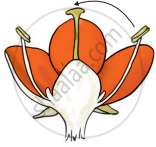
In which one of the following pollination is autogamous?
Name the following:
Aquatic plants which are anemophilous.
Complete the following table:
| Sr. | Type of pollination | Agent | Kind of flower | Examples |
| (i) | ______ | Wind | ______ | Maize |
| (ii) | Chiropterophily | ______ | Dull colour, with strong fragrance, abundant nectar | Adansonia |
| (iii) | Entamophily | Insects | ______ | Rose/Jasmine |
| (iv) | Ornithophily | ______ | Brightly coloured, large and showy. They secrete profuse, dilute n ectar | ______ |
Briefly discuss any two methods by which plants avoid self-pollination.
Name the pollinating agent of a flowering plant with large and coloured flowers with sticky stigma. State one characteristic feature of the pollen grains produced in such flowers.
When and why does a plant breeder employ the emasculation technique?
Identify the set of correct statements:
- The flowers of Vallisneria are colourful and produce nectar.
- The flowers of waterlily are not pollinated by water.
- In most of water-pollinated species, the pollen grains are protected from wetting.
- Pollen grains of some hydrophytes are long and ribbon like.
- In some hydrophytes, the pollen grains are carried passively inside water.
Choose the correct answer from the options given below:
Hydrophily (Hypo) is characterized by which of the following conditions?
Which plant is an example of ornithophily?
