Advertisements
Advertisements
प्रश्न
From among the situations given below, choose the one that prevents both autogamy and geitonogamy.
विकल्प
Monoecious plant bearing unisexual flowers
Dioecious plant bearing only male or female flowers
Monoecious plant with bisexual flowers
Dioecious plant with bisexual flowers
Advertisements
उत्तर
Dioecious plant bearing only male or female flowers
APPEARS IN
संबंधित प्रश्न
Geitonogamous flowering plants are genetically autogamous but functionally cross-pollinated. Justify.
List the different types of pollination depending upon the source of pollen gain.
A flower of tomato plant following the process of sexual reproduction produces 240 viable seeds.
Answer the following questions giving reasons :
(a) What is the minimum number of pollen grains that must have been involved in the pollination of its pistil?
(b) What would have been the minimum number of ovules present in the ovary?
(c) How many megaspore mother cells were involved?
(d) What is the minimum number of microspore mother cells involved in the above case?
(e) How many male gametes were involved in this case?
Compare the characteristic features of insect pollinated and wind pollinated flowers. Explain how the respective features assist in pollination.
State the name of the chief pollinating agent against the corresponding plant by choosing from those given in brackets.
Dahlia_______ .
Name of the parts of the ovary which give rise to:
Fruit wall ______
Give one word/term for the following:
Pollination of flowers by birds.
In bisexual flowers, maturation of gynoecium before androecium is known as ______.
Type of interaction where an individual sacrifices its own welfare (life) for the benefit of another animal of its own species is ______.
Put a tick mark (✓) against the correct alternative in the following statements
Vegetative propagation is not observed in:
What is a flower? Draw a typical flower and label its different parts.
Anemophily type of pollination is found in ______.
During Hybridization process anther of the bisexual flower is removed before it dehisces is called ______.
The flower which does not open at all are called ______.
In the dioecious aquatic plant shown, identify the characteristics of the male flowers that reach the female flowers for pollination:

| Size of the flower | Colour of flower | The characteristic feature of pollen grain | |
| A | small | brightly coloured | Lightweight and non-sticky |
| B | large | colourless | large and sticky |
| C | small | white | small, covered with mucilage |
| D | large | colourless | non-sticky |
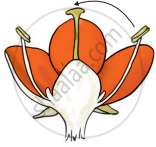
Which type of pollination does the figure indicate?
Advantage of cleistogamy is:
Mention any one example of the anemophilous flower.
What are the major abiotic factors that influence habitat?
Name the following:
One plant each of Hypohydrophily and epihydrophily.
