Advertisements
Advertisements
प्रश्न
From among the situations given below, choose the one that prevents both autogamy and geitonogamy.
पर्याय
Monoecious plant bearing unisexual flowers
Dioecious plant bearing only male or female flowers
Monoecious plant with bisexual flowers
Dioecious plant with bisexual flowers
Advertisements
उत्तर
Dioecious plant bearing only male or female flowers
APPEARS IN
संबंधित प्रश्न
As a senior biology student you have been asked to demonstrate to the students of secondary level in your school, the procedure(s) that shall ensure cross-pollination in a hermaphrodite flower. List the different steps that you would suggest and provide reasons for each one of them.
Add a note on pollination mechanism in Salvia.
Complete the following chart and rewrite.
| Sr.No. | Agencies | type of pollination |
| 1 | Water | .................... |
| 2 | ........................... | Entomophily |
| 3 | Bat | .................... |
| 4 | ....................... | Ornithophily |
(Or)
Explain outbreeding devices in angiospermic plants.
Name of the part of the ovary which gives rise to:
Fruit ______
Name of the parts of the ovary which give rise to:
Fruit wall ______
Name the two types of pollination.
Differentiate Between Cross Pollination and Self Pollination:
In the dioecious aquatic plant shown, identify the characteristics of the male flowers that reach the female flowers for pollination:

| Size of the flower | Colour of flower | The characteristic feature of pollen grain | |
| A | small | brightly coloured | Lightweight and non-sticky |
| B | large | colourless | large and sticky |
| C | small | white | small, covered with mucilage |
| D | large | colourless | non-sticky |
A botanist studying Viola (common pansy) noticed that one of the two flower types withered and developed no further due to some unfavorable condition, but the other flower type on the same plant survived and it resulted in an assured seed set. Which of the following will be correct?
Pollination refers to the ______.
Which type of pollination does the figure indicate?
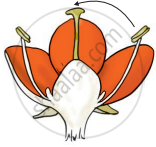
Consider the following statements depicting adaptation of flowers to carryout successful pollination.
- Stigma is long, sticky and unwettable.
- Sepals, petals or perianth (if present) have waxy coating.
- Stamens with long filament and versatile anthers.
- Tubular corolla is seen.
- Flowers are noctumal.
Which of the above statements clearly depict hydrophily?
Name the following:
One plant each of Hypohydrophily and epihydrophily.
Complete the following table:
| Sr. | Type of pollination | Agent | Kind of flower | Examples |
| (i) | ______ | Wind | ______ | Maize |
| (ii) | Chiropterophily | ______ | Dull colour, with strong fragrance, abundant nectar | Adansonia |
| (iii) | Entamophily | Insects | ______ | Rose/Jasmine |
| (iv) | Ornithophily | ______ | Brightly coloured, large and showy. They secrete profuse, dilute n ectar | ______ |
Name the pollinating agent of a flowering plant with large and coloured flowers with sticky stigma. State one characteristic feature of the pollen grains produced in such flowers.
Which one of the following flower is hypohydrophilous?
What is the definition of pollination?
Anemophily is the process of pollination by which agent?
Which plant is an example of ornithophily?
Chiropterophily involves pollination by which organisms?
