Advertisements
Advertisements
प्रश्न
Can you think of some other ending for the story?
Advertisements
उत्तर
The current chapter concludes with Mahendra’s decision to leave the haunting place. However, that is not the appropriate finish. Mahendra should not have decided to leave the haunted house without learning the truth. The narrative could conclude like this: Mahendra bravely approached the woman and took the time to learn the truth. As soon as Mahendra captured the woman, the secret was revealed. It was none other than Iswaran dressed as a ghostly woman.
संबंधित प्रश्न
Tick the right answer.
When a government bans something, it wants it (stopped/started).
Thinking about the Text
Here are some headings for paragraphs in the text. Write the number(s) of the
paragraph(s) for each title against the heading. The first one is done for you.
| (i) | Einstein’s equation 9 |
| (ii) | Einstein meets his future wife |
| (iii) | The making of a violinist |
| (iv) | Mileva and Einstein’s mother |
| (v) | A letter that launched the arms race |
| (vi) | A desk drawer full of ideas |
| (vii) | Marriage and divorce |
Why does the world remember Einstein as a “world citizen”?
Now rewrite the pair of sentences given below as one sentence.
Grandfather told me about the old days. All books were printed on paper then.
The teacher will read out the story of a young girl about a special day.
One day our teacher announced that there was a surprise awaiting us the next day. We were asked to get whatever little pocket money we could.
The next day our teacher said, 'Today is Grandparents' Day' and you will be meeting many grandparents who do not live with their families. Yes, we were going to an Old Age Home! On the way we bought a nice big cake, chart paper and balloons. We entered an old, big building. Later we were taken into a hall and were allowed to decorate it.
We blew balloons and hung them around the hall. We cut out chart paper, wrote quotes, drew pictures and stuck them on the wall. Then came in all the grey–haired sweethearts, some alone, some couples, some in groups ans settled down.
It was time to welcome them. Robert, who was a good speaker, greeted them and told them that we had come along to make their day a little special. We gathered in front and started singing songs for them. Most of the people were single grandparents whose spouses had expired. The other few were couples; many of them were smiling and singing along too. But there were a few who sat without any expression. While some of us sang the others sat beside them and spoke to them.
Two of us cut the cake into several pieces to be distributed. We were informed by the caretaker that there were diabetic people amongst them and they couldn't have sweets. He said they could have fruit instead the non-diabetics and fruit to those who were diabetic. Many of them missed their grand children. One of them told me that her son was in the U.S. and as he found it difficult to look after her, he had left her at this Home.
While returning home we realized that our grandparents are lonely and insecure. They spend their second childhood in their old age homes. Most of those living in old age homes do not complain. It is left to us to decide how happy their old age can be. We do not need any special day to make them feel their worth. If you have never told them how much you love them, say it before it's too late.
(b) List any three feelings of the old people in this story.
- _____________________________
- _____________________________
- _____________________________
(c) Complete the following :
- We can make our grandparents happy by ________________
- We can avoid constructing more and more Old Age Homes by___________
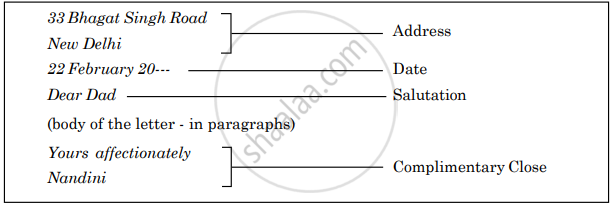
When we write informal letters (to a friend, or to a member of our family), we use this layout.
What was in the cat’s name that pleased Mridu?
Which was the toughest part of the bicycle that the author’s friend found the toughest to fix?
How the author and his friend spent the entire day?
Who finds it difficult to imagine what a desert is Uke?
When and how did Timothy become unfriendly?
How did Tilloo’s father manage the ugly situation when Tilloo was caught impersonating?
Narrate the tale of two birds in your own words.
Which line in the poem suggests that you need a keen eye and a sharp ear to enjoy a meadow? Read aloud the stanza that contains this line.
Fill in the blank to name a different kind of intelligence. One has been done for you.
When I enjoy listening to people and solving their problems I use my interpersonal intelligence
When I enjoy working with numbers and solving maths problems, I use my ________ intelligence.
What does the poem Whatif talk about? Give a few examples of some of the child’s worries or cynical fears.
Answer the following question:
Why do you think Rasheed’s uncle asked him not to buy anything in his absence?
Referring closely to the poem, Dover Beach, show how the poet correlates the gradual receding of the "Sea of Faith" with the gradual loss of human faith in religion.
Complete the following sentence by providing a reason.
In the short story, Atithi, Motilal Babu and Annapurna choose Tarapada as a prospective groom for their daughter because ______.
In what ways does power corrupt in the play Macbeth? Discuss any one character who is corrupted by power in the play. Incorporate the following details and answer in 100-150 words.
- The character’s traits before coming to power
- The character’s degeneration after coming into power
