Advertisements
Advertisements
प्रश्न
Calculate the mass of ice required to lower the temperature of 300 g of water 40°C to water at 0°C.
(Specific latent heat of ice = 336 J g−1, the Specific heat capacity of water = 4.2J g−1 °C−1)
Advertisements
उत्तर
Given: Mass of water, \(m_1=300\,\text{g}\)
Initial temperature of water, \(T_1=40^\circ\text{C}\)
Final temperature, \(T_2=0^\circ\text{C}\)
Specific heat capacity of water, \(c=4.2\,\text{J g}^{-1}\,^\circ\text{C}^{-1}\)
Specific latent heat of fusion of ice, \(L=336\,\text{J g}^{-1}\)
Assuming the ice is initially at 0°C and no heat is lost to the surroundings,
According to the principle of calorimetry,
\[ \text{Heat lost by water}=\text{Heat gained by ice} \]
The heat lost by water.
\[ Q=m_1c(T_1-T_2) \]
\[ =300\times4.2\times(40-0) \]
\[ =50400\,\text{J} \]
The mass of ice required.
Heat gained by ice during melting:
\[ Q=m_2L \]
\[ 50400=m_2\times336 \]
\[ m_2=\frac{50400}{336} \]
\[ {m_2=150\,\text{g}} \]
संबंधित प्रश्न
Specific heat capacity of substance A is 3.8 J g−1 K−1 whereas the specific heat capacity of substance B is 0.4 J g−1 K−1.
- Which of the two is a good conductor of heat?
- How is one led to the above conclusion?
- If substances A and B are liquids then which one would be more useful in car radiators?
State the effect of enhancement of green house effect.
Who shall pay carbon tax ?
Without green house effect, the average temperature of earth’s surface would have been:
(a) – 18℃
(b) 33℃
(c) 0℃
(d) 15℃
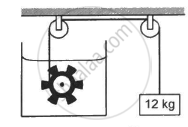
Figure shows a paddle wheel coupled to a mass of 12 kg through fixed frictionless pulleys. The paddle is immersed in a liquid of heat capacity 4200 J K−1 kept in an adiabatic container. Consider a time interval in which the 12 kg block falls slowly through 70 cm. (a) How much heat is given to the liquid? (b) How much work is done on the liquid? (c) Calculate the rise in the temperature of the liquid neglecting the heat capacity of the container and the paddle.
Calculate the ratio of two specific heats of polyatomic gas molecules.
If 'f' is the number of degrees of freedom of a molecule of a gas and ratio of molar specific heats of a gas, ϒ = 1 + `2/"f"` where ϒ = Cp/Cv. The ratio of 'ϒ' for monoatomic gas to 'ϒ' for (rigid) f diatomic gas is ______.
Two metals A and B have specific heat capacities in the ratio 2 : 3. If they are supplied the same amount of heat then
Which metal piece will show a greater rise in temperature given their masses is the same?
Match the following
| 1. | Specific heat capacity | a. | Dewar bottle |
| 2. | Calorimeter | b. | Lavoisier and Simon |
| 3. | Vacuum flask | c. | J Kg-1 K-1 |
| 4. | Ice – calorimeter | d. | Heat capacity |
The specific heat capacity of water is ______.
