Advertisements
Advertisements
प्रश्न
Answer the following question.
Draw isomers of the following
[Cr(en2)Br2]⊕
Advertisements
उत्तर
Cis and trans isomers of [Cr(en2)Br2]⊕
a. Cis and trans isomers of [Cr(en2)Br2]+
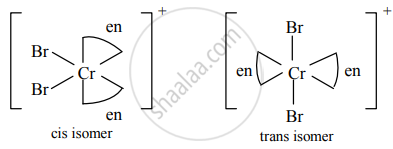
b. Optical isomers of [Cr(en2)Br2]+

APPEARS IN
संबंधित प्रश्न
Choose the most correct option.
Which of the following complexes exist as cis and trans isomers?
1. [Cr(NH3)2Cl4]-
2. [Co(NH3)5Br]2⊕
3. [PtCl2Br2]2- (square planar)
4. [FeCl2(NCS)2]2- (tetrahedral)
Answer the following in one or two sentences.
Consider the complexes \[\ce{[Cu(NH3)4][PtCl4] and [Pt(NH3)4] [CuCl4]}\]. What type of isomerism these two complexes exhibit?
Answer the following question.
Draw geometric isomers and enantiomers of the following complex.
[Pt(en)3]4⊕
Draw the geometrical isomers of the following complexes [Pt(NH3)(H2O)Cl2].
Draw optical isomers of [Co(en)3]3+.
Which one of the following pairs represents linkage isomers?
Which kind of isomerism is possible for a complex [Co(NH3)4Br2]Cl?
Explain optical isomerism in coordination compounds with an example.
The compound(s) that exhibit(s) geometrical isomerism is (are):
(I) [Pt(en)Cl2]
(II) [Pt(en)2]Cl2
(III) [Pt(en)2Cl2]
(IV) [Pt(NH3)2Cl2]
The formula of two complexes X and Y of chromium are given below:
\[\ce{\underset{(X)}{[Cr(H2O)6]Cl3}}\] and \[\ce{\underset{(Y)}{[Cr(H2O)5Cl]Cl2.H2O}}\]
X and Y are examples of ____________ isomers.
Indicate the complex ion which shows geometrical isomerism.
\[\ce{IUPAC}\] name of \[\ce{[Pt(NH3)2 Cl(NO2)]}\] is ______.
The relationship between compound (i) and (ii) is
 |
 |
| (i) | (ii) |
Which of the following compounds show optical isomerism?
\[\ce{CH3CH2COO- Na+ ->[NaOH, + ?][Heat] CH3CH3 + Na2CO3}\]
Consider the above reaction and identify the missing reagent/chemical.
Which compound would exhibit optical isomers?
Define Distereoisomers.
Give cis isomer of [Co(NH3)4Cl2]⊕.
Write structures for geometrical isomers of diamminebromochloroplatinum (II).
What are structural isomers?
Explain the ionisation isomers.
Match the pairs in column I (pairs of isomers) and column II (types of isomers)
| Column I (Pairs of isomers) |
Column II (Types of isomers) |
| (A) [Cr(H2O)5Cl]Cl2.H2O and [Cr(H2O)4Cl2]Cl.2H2O | (i) Ionization isomers |
| (B) [Co(en)2(NO2)2]+ and [Co(en)2(ONO2)]+ | (ii) Hydrate isomers |
| (C) [Co(NH3)6] [Cr(CN)6] and [Cr(NH3)6] [Co(CN)6] | (iii) Linkage isomers |
| (D) [Pt(NH3)4Cl2] Br2 and [Pt(NH3)4Br2]Cl2 | (iv) Coordination isomers |
Draw the geometrical isomers of the following complexes [Co(NH3)4Cl2]+
Draw the structure of trans isomers of Pt(NH3)2Cl2.
Name the type of isomerism exhibited by the following pair of compounds:
[Cr(H2O)5Cl]Cl2.H2O and [Cr(H2O)4Cl2]Cl.2H2O
Name the type of isomerism exhibited by the following pair of compound:
\[\ce{[Pt(NH3)4Cl2]Br2 and [Pt(NH3)4 Br2]Cl2}\]
Match List-I with List-II:
| List-I (Complex) |
List-II (Type of isomerism) |
| A. [Co(NH3)5(NO2)]Cl2 | I. Solvate isomerism |
| B. [Co(NH3)5(SO4)]Br | II. Linkage isomerism |
| C. [Co(NH3)6][Cr(CN)6] | III. Ionisation isomerism |
| D. [Co(H2O)6]Cl3 | IV. Coordination isomerism |
Choose the correct answer from the options given below:
