Advertisements
Advertisements
प्रश्न
Answer the following question briefly.
Who was the passenger of chair No. 9? What did he suddenly do?
Advertisements
उत्तर
John A. Pescud was the passenger of chair No. 9. Suddenly he hurled a book on to the floor between his chair and the window. The book was named “The Rose Lady and Trevelyan”. It was one of the best-selling novels
of the present day.
APPEARS IN
संबंधित प्रश्न
Now that you have enjoyed reading the story, answer the following question by choosing the correct option.
The grandmother could relate to the central character of the story 'Kashi Yatre' as __________.
Given below are five qualities that Charles Hooper displayed during his struggle for survival.

Get into groups of four. Each team will choose one quality to talk about to the whole class for about one minute. But before you talk you have two minutes to think about it. You can make notes if you wish.
Answer the following question briefly.
Describe John A. Pescud with reference to the following points:
- Physical appearance
- His philosophy on behaviour
- His profession
- His first impression of his wife
- His success
Answer the following questions:
Bicker’ means ‘to quarrel’. Why does the poet use this word here?
Answer the following question.
The Poem invokes beautiful imagery which is built around 'sigh of the sea', 'laughter of
the field' and 'tears of heaven'. Explain the three expressions in the context of rain.
On the basis of your understanding of the poem, answer the following question
by ticking the correct choice.
All 'have their exits and their entrances'. Exits and entrances refer to __________.
On the basis of your understanding of the poem, answer the following question
by ticking the correct choice.
The seven roles that a man plays correspond to his __
Answer the following question.
With reference to the poem, how can you look after your teeth?
Below are certain words that appear in the story of Amelia Earhart's journey.The meanings have been given in a jumbled order. Match the words with their meanings.
| Words | Meanings |
| 1.Navigator | (a) an infection of the bowels |
| 2.Skirting | (b) a person who flies an aircraft. |
| 3.Dysentery | (c) a person who plans a route for a ship or plane |
| 4.Parachute | (d) to put something in a safe place |
| 5.Cable | (e) to leave something with no intention of returning |
| 6.Precise | (f) to go or around the edge of something |
| 7.Transmit | (g) a device that is attached to people or objects to make them fall slowly and safely. |
| 8.Implement | (h) a small boat made of rubber or plastic that is filled with air. |
| 9.Raft | (i) a set of wires, covered in plastic or rubber that carries electricity or telephone signals |
| 10.Stowed | (j) carry out |
| 11.Aviator | (k) exact |
| 12.Abandoned | (l) to send an electric signal |
Study the given notes and complete the paragraph that follows by filling in the blanks.
Mobile phones — emit electromagneticfield — prolonged exposure — researchneeded — brain illness — cancer memoryloss — evidence — likely to cause — healthscares — press reports — people worryneedlessly.
Think about it. Every time you use a mobile phone, (a)_____________ head to electromagnetic emission. Manufacturers (b)___________to prove there is no risk (c)_____________ . Some evidence, so far suggests that mobile phone emissions (d)_________ . These health scares (e)______ . So, people worry needlessly.
(a) (i) he exposes his
(ii) one exposes his
(iii) one exposes one’s
(b) (i) needed
(ii) are needed
(iii) have needed
(iv) need
(c) (i) in brain cancer or memory loss
(ii) from brain cancer or memory loss
(iii) with brain cancer or memory loss
(iv) of brain cancer or memory loss
(d) (i) are likely to cause illness
(ii) are likely for causing illness
(iii) is likely in causing illness
(v) is likely to cause illness
(e) (i) is base on press reports
(ii) have been based on press reports
(iii) are based on press reports
(iv) are being based on press reports
Comparing Quantities
Study the following graph depicting major exports from Medland in the
current year.
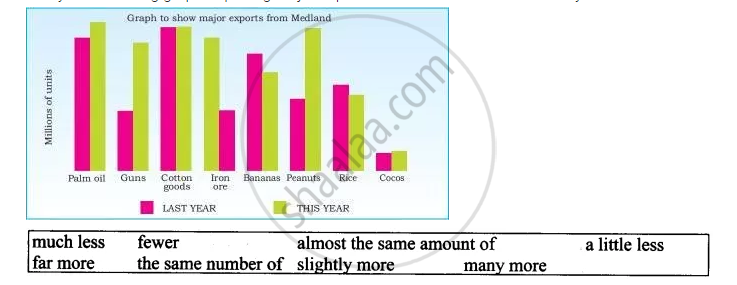
Write a short report on major exports from Medland this year compared with the last year. Use words from the box above. Divide your report into two paragraphs as indicated:
Medland’s Export Trends
On the whole, Medland exported slightly less this year than the last year. Concerning foodstuffs,
_________________________________________________________________
As regards non-edible goods,_____________________________________________
Is there enough variety of content?
What would you do if you became invisible? Would you use your invisibility to play tricks on people or for the good of people?
Write a short paragraph on 'If I was invisible'.
Past passive –
“Where was it made?”
Look at what your partner is wearing. Imagine where the various items of clothing were (or might have been) made, and tell your partner. Use your imagination!
e.g. A : Was your shirt made in France ?
B : No, actually it was made in Brazil.
Fill in the empty bubbles in Column C with reports of what was said in Column A, as in the box given above.

Study the following graph and the accompanying report.

Our study of the time spent by students at the computer and studying at home in three countries has revealed some interesting facts.
First, the majority of boys and girls in the age groups of 14-16 in these countries spend more time at the computer than studying at home. Children in these countries spend an average of20-30 hours per week in comparison to 10-15 hours of studying at home. The only exception is Burland where girls spend more time studying at home than at the computer.
Secondly it is evident that in all three countries, time spent at the computer is having a serious impact on the number of hours spent studying at home. In fact, the greater the number of hours spent at the computer, the fewer number of hours are being spent studying. For example, boys in Burland spend an average of 32 hours at the computer while they spend about 8 hours studying at home.
Report the following questions. (Use if/whether or why, as appropriate.)
- Have you met my sister?
She asked _________________ (use you and her) - Do you want a drink?
He asked _________________ (use you) - Why didn’t you study for the Unit test?
She asked _________________ (use he) - Can you help me with my homework this evening?
He asked _________________ (use she) - Have you had lunch yet?
They asked _________________ (use he)
Your school is playing a football / hockey match with the neighbouring school. You are the official commentator for the match. Give a running commentary on the last few breathtaking minutes of the match.
OR
In groups of four, give a running commentary of the whole match. Each student must become the commentator at some point of time. (Your commentary should not be for more than three minutes)
Study the map and the key given below carefully, and complete the sentences that follow.

Key
- Lalnagar
- Sarkor
- Timpur
- Rampur (Capital)
- Marwah
- Chickoor
- Strange Lake
- Neverest Hills
- Nafran
- Lakshrnanpur
(a)
|
__________________________ Rampur
|
is is situated lies ____________ is located |
half-way along the west coast of Halsi Island.
on the south coast of the island, north of ___ |
(b) Now describe the position of the other eight places, using some of the words in
the box.
| at | along | among |
| to | next to | opposite |
| on | between | |
| in | above | |
| by | below | |
| over | ||
| under |
Think of a person in your class, and use adjective + prepositions to describe him/her in about two or three sentences. Don't give a name.
(a) e.g. She’s good at Maths.
She’s keen on hiking.
Show your description to your partner. Let her or him guess who it is.
(b) The following diagram explains the use of some of these prepositions.
| Destination | Position | Destination | Position | Reference |
| to •X | at •X | away from x ⇒ |
away from x • |
Referring to a |
| on (to) | on | off | off | Referring to a line or surface. |
| into | in | out of | out of | Referring to an enclosed area |
Notice the following peculiarities in the use of Prepositions.
1) at relates to a small extent of space or time while in relates to a wider extent.
2) with relates to the instrument used for doing something.
by relates to the doer
e.g. (1) This poem was composed~me
(2) I wrote with a Shaffer's pen.
3) between, among: between is used when there are two things or persons or
ideas, among is used for more than two.
e.g. ( 1) The property was divided between the twins.
(2) The gossip spread among the villagers.
4) beside, besides : beside means by the side of, besides means in addition to
e.g. (1) Ram sat beside his grandmother.
(2) Besides music, he is interested in painting.
5) in and within : in denotes at the close of some future period, within denotes
sometime short of the close
e.g. (1) The project will be implemented in a week's time.(= at the close)
(2) The plan will be sanctioned within a fort night(= less than)
