Advertisements
Advertisements
प्रश्न
Add im- or in- to each of the following words and use them in place of the italicised words in the sentences given below.
| patient, proper, possible, sensitive, competent |
He appears to be without sensitivity. In fact, he is very emotional.
Advertisements
उत्तर
He appears to be insensitive. In fact, he is very emotional.
संबंधित प्रश्न
Who had these opinion about Einstein?
He was boring.
Think about the Text
Discuss in pairs and answer question below in a short paragraph (30 − 40 words).
What two “important” and “earth-shaking” decisions did the doctor take while he was
looking into the mirror?
Thinking about Poem
What is the meaning of “anchoring earth” and “earth cave”?
What is Johnsy’s illness? What can cure her, the medicine or the willingness to live?
Listen to this extract from Shakespeare's play As You Like It. As you listen, read
the poem aloud; you can do this more than once.
All the world's a stage
And all the men and women merely players:
They have their exits and their entrances;
And one man in his time plays many parts,
His acts being seven ages. At first the infant,
Mewling and puking in the nurse's arms.
Then the whining schoolboy, with his satchel
And shining morning face, creeping like snail
Unwillingly to school. And then the lover,
Sighing like furnace, with a woeful ballad
Made to his mistress' eyebrow. Then a soldier.
Full of strange oaths, and bearded like the pard,
Jealous in honour, sudden and quick in quarrel,
Seeking the bubble reputation.
Even in the cannon's mouth. And then the justice,
In fair round belly with good capon lined,
With eyes severe and beard of formal cut,
Full of wise saws and modern instances;
And so he plays his part. The sixth age shifts
Into the lean and slippered pantaloon,
With spectacles on nose and pouch on side,
His youthful hose, well saved, a world too wide
For his shrunk shank; and his big manly voice,
Turning again toward childish treble, pipes
And whistles in his sound. Last scene of all,
That ends this strange eventful history,
Is second childishness and mere oblivion,
Sans teeth, sans eyes, sans taste, sans everything.
About the Poet
William Shakespeare (1564-1616) was born in Stratford-upon-Avon. He is
considered by many to be the greatest dramatist of all time. He wrote 154 sonnets, two
long narrative poems and about three dozen plays. Shakespeare used poetic and
dramatic means to create unified aesthetic effects. In verse, he perfected the dramatic
blank verse.
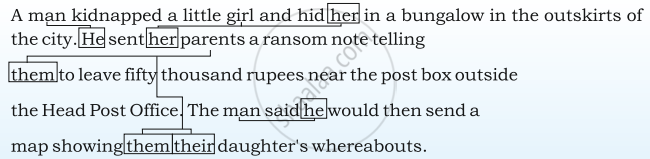
Look at the passage below and study how the personal pronouns refer to different people.
The black man's face bespoke revenge
As the fire passed from his sight.
For all he saw in his stick of wood
Was a chance to spite the white.
The last man of this forlorn group
Did nought except for gain.
Giving only to those who gave
Was how he played the game.
Their logs held tight in death's still hands
Was proof of human sin.
They didn't die from the cold without
They died from the cold within.
Read the lines given above and answer the question that follow.
What does this say about what prejudice can do to people and the importance of working together?
Joe did not see the Guardians of the Poor on that day, on the next, nor on the day following. In fact, he never saw them at all on Maggie’s account, for in less than a week Mrs. Joe Thompson would as soon leave thought of taking up her own abode in the almshouse as sending Maggie there.
What light and blessing did that sick and helpless child bring to the home of Joe Thompson, the poor wheelwright! It had been dark, and cold, and miserable there for a long time just because his wife had nothing to love and care for out of herself, and so became soar, irritable, ill-tempered, and self-afflicting in the desolation of her woman’s nature. Now the sweetness of that sick child, looking ever to her in love, patience, and gratitude, was as honey to her soul, and she carried her in her heart as well as in her arms, a precious burden. As for Joe Thompson, there was not a man in all the neighbourhood who drank daily of a more precious wine of life than he. An angel had come into his house, disguised as a sick, helpless, and miserable child, and filled all its dreary chambers with the sunshine of love.
Read the extract given below and answer the question that follow.
What had changed Mrs Thompson?
What are the three things Arragon was obliged by the oath to obey?
Answer the following question.
Who advised Golu to go to the Limpopo river?
The tiger was still licking his arm, with increasing relish. The phrase in underlined suggests that Timothy
In answer to the second question, whose advice did the people say would be important to the king?
Read the following sentence.
(a) If she knows we have a cat, Paati will leave the house.
(b) She won’t be so upset if she knows about the poor beggar with sores on his feet.
(c) If the chappals do fit, will you really not mind?
Notice that the sentence consists of two parts. The first part begins with ‘if’. It is known as if-clause. Rewrite each of the following pairs of sentences as a single sentence. Use ‘if’ at the beginning of the sentence.
Don’t tire yourself now. You won’t be able to work in the evening.
Find in the poem lines that match the following. Read both one after the other.
He is noisy on purpose
Why Rukku Manni asked Ravi to send away the-beggar?
What are the functions of feelers or antennae for an ant?
Why did Abbu Khan name his young goat as Chandni?
What did the other courtiers feel about Tansen?
Why is the child asked to stand straight?
How does the poet describe the facts/journey or antics of a kite in the sky?
