Advertisements
Advertisements
प्रश्न
A student sitting in the last row of the class-room is not able to read clearly the writing on the blackboard.
How can this defect by corrected?
Advertisements
उत्तर
To correct his defect, he should use concave lenses in his spectacles.
संबंधित प्रश्न
Given below is a diagram showing a defect of human eye. Study it and answer the following questions.

(i) Name the defect shown in the figure.
(ii) Give reason for this defect of eye in human being.
(iii) Name the type of lens used to correct the eye defect.
List three common refractive defects of vision. Suggest the way of correcting these defects.
The far point of a myopic person is 80 cm in front of the eye. What is the nature and power of the lens required to correct the problem?
A student is unable to see clearly the words written on the black board placed at a distance of approximately 3 m from him. Name the defect of vision the boy is suffering from. State the possible causes of this defect and explain the method of correcting it.
Where is the near point of a person suffering from hypermetropia (or long-sightedness)?
A student sitting in the last row of the class-room is not able to read clearly the writing on the blackboard.
- Name the type of defect he is suffering from.
- How can this defect by corrected?
An eye has a far point of 2 m. What type of lens in spectacles would be needed to increase the far point to infinity? Also calculate the power of lens required. Is this eye long-sighted or short-sighted?
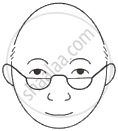
The picture given here shows a person wearing ‘half-moon’ spectacles. What sort of eye-defect do you think he has? Why are these particular spectacles useful to him?
Name an old age eye defect. What happens in it?
When do we consider a student sitting in the class to be myopic? List two causes of this defect. Explain using a ray diagram how this defect of eye can be corrected.
Given alongside is a diagram depicting a defect of the human eye. Study the same and then answer the questions that follow:
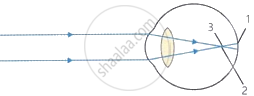
- Identify the defect.
- Name the parts labelled 1, 2 and 3.
- Give two possible reasons for this eye defect.
- Draw a labelled diagram to show how the above mentioned defect is rectified.
Differentiate between:
Myopia and Hypermetropia.
Explain the Term: Presbyopia
Study the following diagram carefully and then answer the questions that follow. The diagram is depicting a defect of the human eye :

(i) Identify the defect shown in the diagram.
(ii) Give two possible reasons for the above defect.
With respect to human eye explain:
(i) How is the image formed on the retina?
(ii) How is the amount of light entering the eye-controlled?
(iii) What type of lens is used for the correction of ‘Long sight’ defect?
(iv) With the help of a ray, diagram show the defect of the eye and then its correction after the use of a lens.
A person cannot see distinctly objects kept beyond 2 m. This defect can be corrected by using a lens of power:
Correlate the given sequence:
Hypermetropia : Convex lens : ______ : Concave lens
A person is unable to see clearly a poster fixed on a distant wall. He however sees it clearly when standing at a distance of about 2 m from the wall.
- Draw ray diagram to show the formation of image by his eye lens when he is far away from the wall.
- List two possible reasons of this defect of vision.
- Draw ray diagram to show the correction of this defect using appropriate lens.
