Advertisements
Advertisements
प्रश्न
A plane is in level flight at a constant speed and each of its two wings has an area of 25 m2. If the speed of the air is 180 km/h over the lower wing and 234 km/h over the upper wing surface, determine the plane’s mass. (Take air density to be 1 kg m–3).
Advertisements
उत्तर १
The area of the wings of the plane, A = 2 × 25 = 50 m2
Speed of air over the lower wing, V1 = 180 km/h = 50 m/s
Speed of air over the upper wing, V2 = 234 km/h = 65 m/s
Density of air, ρ = 1 kg m–3
Pressure of air over the lower wing = P1
Pressure of air over the upper wing= P2
The upward force on the plane can be obtained using Bernoulli’s equation as:
`P_1 + 1/2 rhoV_1^2 = P_2 + 1/2 rhoV_^2`
`P_1 - P_2= 1/2 rho(V_2^2 - V_1^2)` ...(i)
The upward force (F) on the plane can be calculated as:
`(P_1 - P_2)A`
`= 1/2 rho(V_2^2 - V_1^2)A` Using equation (i)
`= 1/2 xx 1 xxx((65)^2 - (50)^2)xx 50`
= 4400.51 Kg
~ 4400 kg
Hence, the mass of the plane is about 4400 kg.
उत्तर २
Here speed of air over lower wing `v_1 = 180 km/h = 180 xx 5/18 = 50 ms^(-1)`
Speed over the upper wing `v_2 = 234 "km/h" = 234 xx 5/18 = 65 ms^(-1)`
:. Pressure difference, `P_1 -P_2 = 1/2 rho (v_2^2 - v_1^2) = 1/2 xx 1(65^2 - 50^2) = 862.5 Pa`
:. Net upward force , `F = (P_1 -P_2)A`
This upward force balances the weight of the plane
:. `mg = F =(P_1 - P_2)A` [A = 25 x 2 = 50 `m^2`]
:. `m = ((P_1 - P_2)A)/g = (862.5xx50)/9.8 = 4400 N`
APPEARS IN
संबंधित प्रश्न
In problem 10.9, if 15.0 cm of water and spirit each are further poured into the respective arms of the tube, what is the difference in the levels of mercury in the two arms? (Specific gravity of mercury = 13.6)
A man exerts same pressure on the ground whether he is standing or he is lying.
The S.I. unit of pressure is pascal.
The unit of thrust is ..........
Pressure is reduced if .................... increases.
The feet of lizards act like
Name two factors on which the pressure on a surface depends.
When does a man exert more pressure on the floor: while standing or while walking?
Find the area of a body which experiences a pressure of 50000 Pa by a thrust of 100 N?
A boy weighing 60 kgf stands on platform of dimensions 2.5 cm x 0.5 cm. What pressure in pascal does he exert?
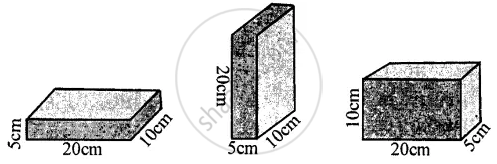
The figure shows a brick of weight 2 kgf and dimensions 20 cm × 10 cm × 5 cm placed in three different positions on the ground. Find the pressure exerted by the brick in each case.
The pressure in a liquid at two points in the same horizontal plane are equal. Consider an elevator accelerating upward and a car accelerating on a horizontal road. The above statement is correct in
Find the pressure 200m below the surface of the ocean if pressure on the free surface of liquid is one atmosphere. (Density of seawater = 1060 kg/m3)
Assertion: The pressure at the bottom of the sea is lesser than that near the surface.
Reason: The pressure exerted by a liquid depends upon the depth of the liquid and density of the liquid.
Give reasons why:
heavy trucks are fitted with 6 to 8 wheels
Fluids in general are ______.
Assertion (A): A sleeping mattress is so designed that when you lie on it, a large area of your body comes in its contact.
Reason (R): This reduces the pressure on the body and sleeping becomes comfortable.
The force exerted by liquid perpendicular to the surface of the body is equal to the product of ______ at that point.
