Advertisements
Advertisements
प्रश्न
A plane is in level flight at a constant speed and each of its two wings has an area of 25 m2. If the speed of the air is 180 km/h over the lower wing and 234 km/h over the upper wing surface, determine the plane’s mass. (Take air density to be 1 kg m–3).
Advertisements
उत्तर १
The area of the wings of the plane, A = 2 × 25 = 50 m2
Speed of air over the lower wing, V1 = 180 km/h = 50 m/s
Speed of air over the upper wing, V2 = 234 km/h = 65 m/s
Density of air, ρ = 1 kg m–3
Pressure of air over the lower wing = P1
Pressure of air over the upper wing= P2
The upward force on the plane can be obtained using Bernoulli’s equation as:
`P_1 + 1/2 rhoV_1^2 = P_2 + 1/2 rhoV_^2`
`P_1 - P_2= 1/2 rho(V_2^2 - V_1^2)` ...(i)
The upward force (F) on the plane can be calculated as:
`(P_1 - P_2)A`
`= 1/2 rho(V_2^2 - V_1^2)A` Using equation (i)
`= 1/2 xx 1 xxx((65)^2 - (50)^2)xx 50`
= 4400.51 Kg
~ 4400 kg
Hence, the mass of the plane is about 4400 kg.
उत्तर २
Here speed of air over lower wing `v_1 = 180 km/h = 180 xx 5/18 = 50 ms^(-1)`
Speed over the upper wing `v_2 = 234 "km/h" = 234 xx 5/18 = 65 ms^(-1)`
:. Pressure difference, `P_1 -P_2 = 1/2 rho (v_2^2 - v_1^2) = 1/2 xx 1(65^2 - 50^2) = 862.5 Pa`
:. Net upward force , `F = (P_1 -P_2)A`
This upward force balances the weight of the plane
:. `mg = F =(P_1 - P_2)A` [A = 25 x 2 = 50 `m^2`]
:. `m = ((P_1 - P_2)A)/g = (862.5xx50)/9.8 = 4400 N`
APPEARS IN
संबंधित प्रश्न
Explain why Atmospheric pressure at a height of about 6 km decreases to nearly half of its value at the sea level, though the height of the atmosphere is more than 100 km
The pressure on a surface increases with an increase in the thrust on the surface.
The unit of thrust is
How is the thrust related to pressure?
Why do camels or elephants have broad feet?
It is easier to cut with a sharp knife than with a blunt one. Explain.
A boy weighing 60 kgf stands on platform of dimensions 2.5 cm x 0.5 cm. What pressure in pascal does he exert?
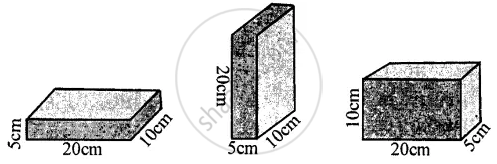
The figure shows a brick of weight 2 kgf and dimensions 20 cm × 10 cm × 5 cm placed in three different positions on the ground. Find the pressure exerted by the brick in each case.
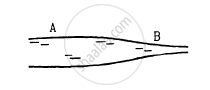
Water flows through a horizontal tube of variable cross section. The area of cross section at A and B are 4 mm2 and 2 mm2 respectively. If 1 cc of water enters per second through A, find (a) the speed of water at A, (b) the speed of water at B and (c) the pressure difference PA − PB.
In a hydraulic lift, the input piston had surface area 30 cm2 and the output piston has surface area of 1500 cm2. If a force of 25 N is applied to the input piston, calculate weight/force on output piston.
An air bubble of radius 0.2 mm is situated just below the water surface. Calculate the gauge pressure. Surface tension of water = 7.2 × 10⁻² N/m.
A drinking straw works on the existence of ______.
Assertion: The pressure at the bottom of the sea is lesser than that near the surface.
Reason: The pressure exerted by a liquid depends upon the depth of the liquid and density of the liquid.
Why dams are made stronger and thicker at the bottom than at the top?
Determine the pressure when a force of 200 N acts on the area
- 20 m2
- 8 m2
Give reasons why:
a single nail pricking the body is painful when compared to lying on a bed of nails.
The net force in a particular direction is called ______.
What is the SI unit of pressure?
A vessel filled with water is kept on a weighing pan and the scale adjusted to zero. A block of mass M and density ρ is suspended by a massless spring of spring constant k. This block is submerged inside into the water in the vessel. What is the reading of the scale?
