Advertisements
Advertisements
प्रश्न
A man 2 metres tall walks away from a lamp post 5 metres height at the rate of 4.8 km/hr. The rate of increase of the length of his shadow is
विकल्प
1.6 km/hr
6.3 km/hr
5 km/hr
3.2 km/hr
Advertisements
उत्तर
Let AB be the lamp post. Suppose at any time t, the man CD be at a distance of x km from the lamp post and y m be the length of his shadow CE.
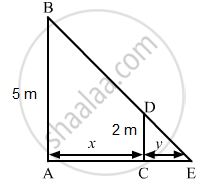
\[\text { Since triangles ABE and CDE are similar }, \]
\[\frac{AB}{CD} = \frac{AE}{CE}\]
\[\Rightarrow \frac{5}{2} = \frac{x + y}{y}\]
\[ \Rightarrow \frac{x}{y} = \frac{5}{2} - 1\]
\[ \Rightarrow \frac{x}{y} = \frac{3}{2}\]
\[ \Rightarrow y = \frac{2}{3}x\]
\[ \Rightarrow \frac{dy}{dt} = \frac{2}{3}\left( \frac{dx}{dt} \right)\]
\[ \Rightarrow \frac{dy}{dt} = \frac{2}{3} \times 4 . 8\]
\[ \Rightarrow \frac{dy}{dt} = 3 . 2 \ km/hr\]
APPEARS IN
संबंधित प्रश्न
The Volume of cube is increasing at the rate of 9 cm 3/s. How fast is its surfacee area increasing when the length of an edge is 10 cm?
The volume of a cube is increasing at the rate of 8 cm3/s. How fast is the surface area increasing when the length of an edge is 12 cm?
The sum of the perimeter of a circle and square is k, where k is some constant. Prove that the sum of their areas is least when the side of square is double the radius of the circle.
The volume of a sphere is increasing at the rate of 8 cm3/s. Find the rate at which its surface area is increasing when the radius of the sphere is 12 cm.
The volume of a sphere is increasing at the rate of 3 cubic centimeter per second. Find the rate of increase of its surface area, when the radius is 2 cm
The total cost C(x) associated with the production of x units of an item is given by C(x) = 0.005x3 – 0.02x2 + 30x + 5000. Find the marginal cost when 3 units are produced, whereby marginal cost we mean the instantaneous rate of change of total cost at any level of output.
Find the rate of change of the total surface area of a cylinder of radius r and height h, when the radius varies?
Find the rate of change of the volume of a sphere with respect to its surface area when the radius is 2 cm ?
Find the rate of change of the area of a circular disc with respect to its circumference when the radius is 3 cm ?
The total cost C (x) associated with the production of x units of an item is given by C (x) = 0.007x3 − 0.003x2 + 15x + 4000. Find the marginal cost when 17 units are produced ?
The total revenue received from the sale of x units of a product is given by R (x) = 13x2 + 26x + 15. Find the marginal revenue when x = 7 ?
A man 2 metres high walks at a uniform speed of 5 km/hr away from a lamp-post 6 metres high. Find the rate at which the length of his shadow increases.
If y = 7x − x3 and x increases at the rate of 4 units per second, how fast is the slope of the curve changing when x = 2?
The top of a ladder 6 metres long is resting against a vertical wall on a level pavement, when the ladder begins to slide outwards. At the moment when the foot of the ladder is 4 metres from the wall, it is sliding away from the wall at the rate of 0.5 m/sec. How fast is the top-sliding downwards at this instance?
How far is the foot from the wall when it and the top are moving at the same rate?
A balloon in the form of a right circular cone surmounted by a hemisphere, having a diameter equal to the height of the cone, is being inflated. How fast is its volume changing with respect to its total height h, when h = 9 cm.
The radius of a cylinder is increasing at the rate 2 cm/sec. and its altitude is decreasing at the rate of 3 cm/sec. Find the rate of change of volume when radius is 3 cm and altitude 5 cm.
The volume of metal in a hollow sphere is constant. If the inner radius is increasing at the rate of 1 cm/sec, find the rate of increase of the outer radius when the radii are 4 cm and 8 cm respectively.
Sand is being poured onto a conical pile at the constant rate of 50 cm3/ minute such that the height of the cone is always one half of the radius of its base. How fast is the height of the pile increasing when the sand is 5 cm deep ?
If \[V = \frac{4}{3}\pi r^3\] , at what rate in cubic units is V increasing when r = 10 and \[\frac{dr}{dt} = 0 . 01\] ? _________________
The volume of a sphere is increasing at 3 cm3/sec. The rate at which the radius increases when radius is 2 cm, is
The distance moved by a particle travelling in straight line in t seconds is given by s = 45t + 11t2 − t3. The time taken by the particle to come to rest is
The volume of a sphere is increasing at the rate of 4π cm3/sec. The rate of increase of the radius when the volume is 288 π cm3, is
For the curve y = 5x – 2x3, if x increases at the rate of 2 units/sec, then how fast is the slope of curve changing when x = 3?
Two men A and B start with velocities v at the same time from the junction of two roads inclined at 45° to each other. If they travel by different roads, find the rate at which they are being seperated.
The sides of an equilateral triangle are increasing at the rate of 2 cm/sec. The rate at which the area increases, when side is 10 cm is ______.
The instantaneous rate of change at t = 1 for the function f (t) = te-t + 9 is ____________.
If the rate of change of the area of the circle is equal to the rate of change of its diameter then its radius is equal to ____________.
A ladder 5 m long is leaning against a wall. The bottom of the ladder is pulled along the ground, away from the wall, at the rate of 2 cm/s. How fast is its height on the wall decreasing when the foot of the ladder is 4 m away from the wall?
If equal sides of an isosceles triangle with fixed base 10 cm are increasing at the rate of 4 cm/sec, how fast is the area of triangle increasing at an instant when all sides become equal?
The median of an equilateral triangle is increasing at the ratio of `2sqrt(3)` cm/s. Find the rate at which its side is increasing.
If a quantity \(y\) varies with another quantity \(x\) based on the rule \(y=f(x)\), which expression represents the rate of change of \(y\) with respect to \(x\)?
When \(x\) and \(y\) both vary with respect to \(t\), which formula gives the rate of change of \(y\) with respect to \(x\)?
For a circle with area \[A=\pi r^2\], what is \[\frac{dA}{dr}\]?
When should a given value be substituted while finding a rate of change?
In calculus, which expression represents the rate of change of \(y\) with respect to \(x\) and is used in geometry, motion, business mathematics, and many real-life situations?
