Advertisements
Advertisements
प्रश्न
A line is such that its segment between the straight lines 5x − y − 4 = 0 and 3x + 4y − 4 = 0 is bisected at the point (1, 5). Obtain its equation.
Advertisements
उत्तर
Let P1P2 be the intercept between the lines 5x − y − 4 = 0 and 3x + 4y − 4 = 0.
Let P1P2 make an angle \[\theta\] with the positive x-axis.
Here,
\[\left( x_1 , y_1 \right) = A \left( 1, 5 \right)\]
So, the equation of the line passing through A (1, 5) is
\[\frac{x - x_1}{cos\theta} = \frac{y - y_1}{sin\theta}\]
\[ \Rightarrow \frac{x - 1}{cos\theta} = \frac{y - 5}{sin\theta}\]
\[ \Rightarrow \frac{y - 5}{x - 1} = \tan\theta\]
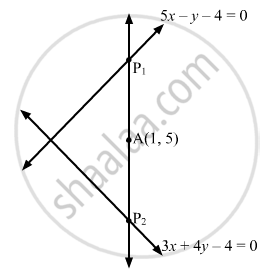
Let \[A P_1 = A P_2 = r\]
Then, the coordinates of \[P_1 \text { and } P_2\] are given by \[\frac{x - 1}{cos\theta} = \frac{y - 5}{sin\theta} = r \text { and } \frac{x - 1}{cos\theta} = \frac{y - 5}{sin\theta} = - r\]
So, the coordinates of \[P_1 \text { and } P_2\] are \[\left( 1 + rcos\theta, 5 + r\sin\theta \right) \text { and } \left( 1 - rcos\theta, 5 - r\sin\theta \right)\] respectively.
Clearly,
\[P_1 \text { and } P_2\] lie on 5x − y − 4 = 0 and 3x + 4y − 4 = 0, respectively.
\[\therefore 5\left( 1 + rcos\theta \right) - 5 - r\sin\theta - 4 = 0 \text { and } 3\left( 1 - rcos\theta \right) + 4\left( 5 - r\sin\theta \right) - 4 = 0\]
\[ \Rightarrow r = \frac{4}{5cos\theta - sin\theta} \text { and } r = \frac{19}{3cos\theta + 4sin\theta}\]
\[ \Rightarrow \frac{4}{5cos\theta - sin\theta} = \frac{19}{3cos\theta + 4sin\theta}\]
\[ \Rightarrow 95cos\theta - 19sin\theta = 12cos\theta + 16sin\theta\]
\[ \Rightarrow 83cos\theta = 35sin\theta\]
\[ \Rightarrow tan\theta = \frac{83}{35}\]
Thus, the equation of the required line is
\[\frac{y - 5}{x - 1} = tan\theta\]
\[ \Rightarrow \frac{y - 5}{x - 1} = \frac{83}{35}\]
\[ \Rightarrow 83x - 35y + 92 = 0\]
APPEARS IN
संबंधित प्रश्न
Find the equation of the line perpendicular to x-axis and having intercept − 2 on x-axis.
Find the equation of the line parallel to x-axis and having intercept − 2 on y-axis.
Find the equations of the straight lines which pass through (4, 3) and are respectively parallel and perpendicular to the x-axis.
Find the equation of the line passing through \[(2, 2\sqrt{3})\] and inclined with x-axis at an angle of 75°.
Find the equation of the straight line which passes through the point (1,2) and makes such an angle with the positive direction of x-axis whose sine is \[\frac{3}{5}\].
Find the equation of the straight line passing through (3, −2) and making an angle of 60° with the positive direction of y-axis.
Find the equation of the straight line which divides the join of the points (2, 3) and (−5, 8) in the ratio 3 : 4 and is also perpendicular to it.
Prove that the perpendicular drawn from the point (4, 1) on the join of (2, −1) and (6, 5) divides it in the ratio 5 : 8.
Find the equation of the straight lines passing through the following pair of point:
(a, b) and (a + c sin α, b + c cos α)
Find the equation of the straight lines passing through the following pair of point :
(a cos α, a sin α) and (a cos β, a sin β)
Find the equations to the diagonals of the rectangle the equations of whose sides are x = a, x = a', y= b and y = b'.
Find the equation to the straight line which cuts off equal positive intercepts on the axes and their product is 25.
Find the equation of the line which passes through the point (− 4, 3) and the portion of the line intercepted between the axes is divided internally in the ratio 5 : 3 by this point.
Find the equation of the straight line which passes through the point (−3, 8) and cuts off positive intercepts on the coordinate axes whose sum is 7.
Find the equation of a line which passes through the point (22, −6) and is such that the intercept of x-axis exceeds the intercept of y-axis by 5.
Find the equations of the straight lines each of which passes through the point (3, 2) and cuts off intercepts a and b respectively on X and Y-axes such that a − b = 2.
A straight line drawn through the point A (2, 1) making an angle π/4 with positive x-axis intersects another line x + 2y + 1 = 0 in the point B. Find length AB.
Find the equation of a line passing through the point (2, 3) and parallel to the line 3x − 4y + 5 = 0.
Find the equation of a line passing through (3, −2) and perpendicular to the line x − 3y + 5 = 0.
The line 2x + 3y = 12 meets the x-axis at A and y-axis at B. The line through (5, 5) perpendicular to AB meets the x-axis and the line AB at C and E respectively. If O is the origin of coordinates, find the area of figure OCEB.
Find the length of the perpendicular from the point (4, −7) to the line joining the origin and the point of intersection of the lines 2x − 3y + 14 = 0 and 5x + 4y − 7 = 0.
Find the equation of the straight lines passing through the origin and making an angle of 45° with the straight line \[\sqrt{3}x + y = 11\].
Find the equations to the straight lines which pass through the origin and are inclined at an angle of 75° to the straight line \[x + y + \sqrt{3}\left( y - x \right) = a\].
Find the equations to the sides of an isosceles right angled triangle the equation of whose hypotenues is 3x + 4y = 4 and the opposite vertex is the point (2, 2).
Find the equations of the two straight lines through (1, 2) forming two sides of a square of which 4x+ 7y = 12 is one diagonal.
Find the equations of two straight lines passing through (1, 2) and making an angle of 60° with the line x + y = 0. Find also the area of the triangle formed by the three lines.
The equation of the base of an equilateral triangle is x + y = 2 and its vertex is (2, −1). Find the length and equations of its sides.
Write the area of the triangle formed by the coordinate axes and the line (sec θ − tan θ) x + (sec θ + tan θ) y = 2.
If a, b, c are in G.P. write the area of the triangle formed by the line ax + by + c = 0 with the coordinates axes.
If a, b, c are in A.P., then the line ax + by + c = 0 passes through a fixed point. Write the coordinates of that point.
Write the equation of the line passing through the point (1, −2) and cutting off equal intercepts from the axes.
A line passes through the point (2, 2) and is perpendicular to the line 3x + y = 3. Its y-intercept is
The equation of the line passing through (1, 5) and perpendicular to the line 3x − 5y + 7 = 0 is
Find the equations of the lines through the point of intersection of the lines x – y + 1 = 0 and 2x – 3y + 5 = 0 and whose distance from the point (3, 2) is `7/5`
The equation of the line passing through the point (1, 2) and perpendicular to the line x + y + 1 = 0 is ______.
The equations of the lines which pass through the point (3, –2) and are inclined at 60° to the line `sqrt(3) x + y` = 1 is ______.
Equation of the line passing through the point (a cos3θ, a sin3θ) and perpendicular to the line x sec θ + y cosec θ = a is x cos θ – y sin θ = a sin 2θ.
The equation of the line joining the point (3, 5) to the point of intersection of the lines 4x + y – 1 = 0 and 7x – 3y – 35 = 0 is equidistant from the points (0, 0) and (8, 34).
