Advertisements
Advertisements
प्रश्न
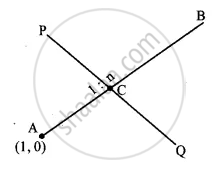
A line perpendicular to the line segment joining the points (1, 0) and (2, 3) divides it in the ratio 1:n. Find the equation of the line.
Advertisements
उत्तर
Line AB passes through the points A(1, 0) and B(2, 3).
∴ Slope of AB = `(3 - 0)/(2 - 1) = 3/1`
PQ ⊥ AB
Slope of AB = `3/1`
∴ Slope of PQ, m = `- 1/(3/1) = -1/3`
PQ intersects line AB at C.
Also, point C divides the line segment AB in the ratio 1 : n.
That is `"C"((1 xx 2 + "n" xx 1)/("n" + 1), (1 xx 3 + "n" xx 0)/("n" + 1))`
or `"C" (("n" + 2)/("n" + 1), 3/("n" + 1))`
Now the equation of line PQ,
`"y" - "y"_1 = "m"("x" - "x"_1)`
Where, x1 = `("n" + 2)/("n" + 1)` and y1 = `3/("n" + 1)`
`"y" - 3/("n" + 1) = -1/3("x" - ("n" + 2)/("n" + 1))`
3(n + 1)y − 9 = −[(n + 1)x − (n + 2)]
or (n + 1)x + 3(n + 1)y = n + 2 + 9 = n + 11
or (n + 1)x + 3(n + 1)y = n + 11
APPEARS IN
संबंधित प्रश्न
Find the equation of the line which satisfy the given condition:
Write the equations for the x and y-axes.
Find the equation of the line which satisfy the given condition:
Passing though (0, 0) with slope m.
Find the equation of the line which satisfy the given condition:
Passing though `(2, 2sqrt3)` and is inclined with the x-axis at an angle of 75°.
Find the equation of the line which satisfy the given condition:
Intersects the x-axis at a distance of 3 units to the left of origin with slope –2.
Find the equation of the line which satisfy the given condition:
Intersects the y-axis at a distance of 2 units above the origin and making an angle of 30° with the positive direction of the x-axis.
Find the equation of the line which satisfy the given condition:
Passing through the points (–1, 1) and (2, –4).
Find the equation of the line which is at a perpendicular distance of 5 units from the origin and the angle made by the perpendicular with the positive x-axis is 30°
Find the equation of a line that cuts off equal intercepts on the coordinate axes and passes through the point (2, 3).
Find equation of the line through the point (0, 2) making an angle `(2pi)/3` with the positive x-axis. Also, find the equation of line parallel to it and crossing the y-axis at a distance of 2 units below the origin.
The perpendicular from the origin to a line meets it at the point (– 2, 9), find the equation of the line.
The length L (in centimetre) of a copper rod is a linear function of its Celsius temperature C. In an experiment, if L = 124.942 when C = 20 and L = 125.134 when C = 110, express L in terms of C
P (a, b) is the mid-point of a line segment between axes. Show that equation of the line is `x/a + y/b = 2`
Point R (h, k) divides a line segment between the axes in the ratio 1:2. Find equation of the line.
By using the concept of equation of a line, prove that the three points (3, 0), (–2, –2) and (8, 2) are collinear.
Find the values of q and p, if the equation x cos q + y sinq = p is the normal form of the line `sqrt3 x` + y + 2 = 0.
Find the image of the point (3, 8) with respect to the line x + 3y = 7 assuming the line to be a plane mirror.
If the lines y = 3x + 1 and 2y = x + 3 are equally inclined to the line y = mx + 4, find the value of m.
Classify the following pair of line as coincident, parallel or intersecting:
2x + y − 1 = 0 and 3x + 2y + 5 = 0
Classify the following pair of line as coincident, parallel or intersecting:
x − y = 0 and 3x − 3y + 5 = 0]
Prove that the lines \[\sqrt{3}x + y = 0, \sqrt{3}y + x = 0, \sqrt{3}x + y = 1 \text { and } \sqrt{3}y + x = 1\] form a rhombus.
Find the equation to the straight line parallel to 3x − 4y + 6 = 0 and passing through the middle point of the join of points (2, 3) and (4, −1).
Prove that the lines 2x − 3y + 1 = 0, x + y = 3, 2x − 3y = 2 and x + y = 4 form a parallelogram.
Find the angle between the lines x = a and by + c = 0..
Prove that the area of the parallelogram formed by the lines a1x + b1y + c1 = 0, a1x + b1y+ d1 = 0, a2x + b2y + c2 = 0, a2x + b2y + d2 = 0 is \[\left| \frac{\left( d_1 - c_1 \right)\left( d_2 - c_2 \right)}{a_1 b_2 - a_2 b_1} \right|\] sq. units.
Deduce the condition for these lines to form a rhombus.
Prove that the area of the parallelogram formed by the lines 3x − 4y + a = 0, 3x − 4y + 3a = 0, 4x − 3y− a = 0 and 4x − 3y − 2a = 0 is \[\frac{2}{7} a^2\] sq. units..
Show that the point (3, −5) lies between the parallel lines 2x + 3y − 7 = 0 and 2x + 3y + 12 = 0 and find the equation of lines through (3, −5) cutting the above lines at an angle of 45°.
Three vertices of a parallelogram taken in order are (−1, −6), (2, −5) and (7, 2). The fourth vertex is
Let ABC be a triangle with A(–3, 1) and ∠ACB = θ, 0 < θ < `π/2`. If the equation of the median through B is 2x + y – 3 = 0 and the equation of angle bisector of C is 7x – 4y – 1 = 0, then tan θ is equal to ______.
