Advertisements
Advertisements
प्रश्न
(a) Draw a neat diagram of a flower showing its various parts. In this diagram mark stem, receptacle, sepals, petals, stamen and carpel.
(b) What name is given to (i) all the petals of a flower, and (ii) all the sepals of a flower?
(c) What are (i) stamen, and (ii) carpel, in a flower?
(d) What is the other name of carpel of a flower?
(e) What is the name of yellow powdery substance present in the anther of a flower?
Advertisements
उत्तर
(a) A flower
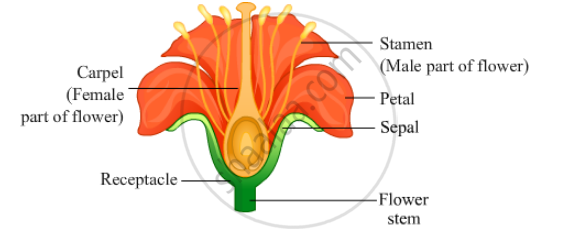
(b) (i) The corolla
(ii) The calyx
(c) (i) Stamen is the male reproductive organ in a flower.
(ii) Carpel is the female reproductive organ in a flower.
(d) The other name of carpel is pistil.
(e) The yellow powdery substance present in the anther of a flower are pollen grains.
APPEARS IN
संबंधित प्रश्न
Name and differentiate between the two modes of pollination in flowering plants.
The process of fusion of the male and female gametes is called ______.
What is the name of female organ of a flower (other than carpel)?
Give some examples of different modes of fertilisation in nature?
Name the part of a seed which contains stored food.
Name the part of a seed which grows into shoot.
Describe the process of fertilisation in a flower with the help of labelled diagrams.
In the figure given alongside, the parts marked A, B and C are sequentially :
(a) cotyledon, plumule and radicle
(b) plumule, radicle and cotyledon
(c) plumule, cotyledon and radicle
(d) radicle, cotyledon and plumule
In what ways is fertilisation in a plant similar to fertilisation in a human?
State whether the following statement is true (T) or false (F):
Stamens make egg cells.
A student is observing the temporary mount of a leaf peel under a microscope. Draw a labelled diagram of the structure of stomata as seen under the microscope
Pollen grains from anther are transferred to the stigma.
The male reproductive part of a flower is ______.
Where is the zygote located in the flower after fertilization?
Double fertilization is essential for formation of ______.
Sketch and label the essential and accessory whorls of flower.
Triple fusion involves ______.
What is puberty?
