Advertisements
Advertisements
प्रश्न
A 4 cm edge cube is cut into 1 cm edge cubes. Calculate the total surface area of all the small cubes.
Advertisements
उत्तर
Edge of cube = 4 cm
Volume of 4 cm cube = (4 cm)3 = 64 cm3
Edge of cube = 1 cm
Volume of 1 cm cube = (1 cm)3
∴ Total number of small cubes = `(64 cm^3)/(1 cm^3) = 64`
∴ Total surface area of 64 cm all cubes
= 64 × 6 × (1 cm)2
= 384 cm2
The total surface area of all the small cubes formed by cutting the 4 cm cube into 1 cm edge cubes is 384 cm2.
संबंधित प्रश्न
A cubical box has each edge 10 cm and another cuboidal box is 12.5 cm long, 10 cm wide and 8 cm high.
(i) Which box has the greater lateral surface area and by how much?
(ii) Which box has the smaller total surface area and by how much?
Water is pouring into a cubiodal reservoir at the rate of 60 litres per minute. If the volume of the reservoir is 108 m3, find the number of hours it will take to fill the reservoir.

The dimensions of a rectangular box are in the ratio of 2 : 3 : 4 and the difference between the cost ofcovering it with sheet of paper at the rates of Rs. 8 and Rs. 9.50 per m2 is Rs.1248. Find the dimensions of the box.
How many planks each of which is 3 m long, 15 cm broad and 5 cm thick can be prepared from a wooden block 6 m long, 75 cm broad and 45 cm thick?
The length of a hall is 18 m and the width 12 m. The sum of the areas of the floor and the flat roof is equal to the sum of the areas of the four walls. Find the height of the wall.
If the sum of all the edges of a cube is 36 cm, then the volume (in cm3) of that cube is
Four cubes, each of edge 9 cm, are joined as shown below :
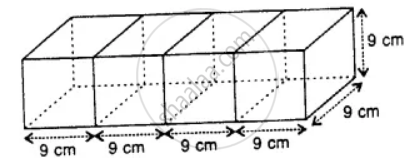
Write the dimensions of the resulting cuboid obtained. Also, find the total surface area and the volume
The length, breadth, and height of a cuboid (rectangular solid) are 4 : 3: 2.
(i) If its surface area is 2548 cm2, find its volume.
(ii) If its volume is 3000 m3, find its surface area.
The length and breadth of a cuboid are 20 cm and 15 cm respectively. If its volume is 2400 cm3, find its height.
