Advertisements
Advertisements
प्रश्न
A cubical box has each edge 10 cm and another cuboidal box is 12.5 cm long, 10 cm wide and 8 cm high.
(i) Which box has the greater lateral surface area and by how much?
(ii) Which box has the smaller total surface area and by how much?
Advertisements
उत्तर
(i) Edge of cube = 10 cm
Length (l) of box = 12.5 cm
Breadth (b) of box = 10 cm
Height (h) of box = 8 cm
Lateral surface area of cubical box = 4(edge)2
= 4(10 cm)2
= 400 cm2
Lateral surface area of cuboidal box = 2[lh + bh]
= [2(12.5 × 8 + 10 × 8)] cm2
= (2 × 180) cm2
= 360 cm2
Clearly, the lateral surface area of the cubical box is greater than the lateral surface area of the cuboidal box.
Lateral surface area of cubical box − Lateral surface area of cuboidal box = 400 cm2 − 360 cm2 = 40 cm2
Therefore, the lateral surface area of the cubical box is greater than the lateral surface area of the cuboidal box by 40 cm2.
(ii) Total surface area of cubical box = 6(edge)2 = 6(10 cm)2 = 600 cm2
Total surface area of cuboidal box
= 2[lh + bh + lb]
= [2(12.5 × 8 + 10 × 8 + 12.5 × 10] cm2
= 610 cm2
Clearly, the total surface area of the cubical box is smaller than that of the cuboidal box.
Total surface area of cuboidal box − Total surface area of cubical box = 610 cm2 − 600 cm2 = 10 cm2
Therefore, the total surface area of the cubical box is smaller than that of the cuboidal box by 10 cm2.
संबंधित प्रश्न
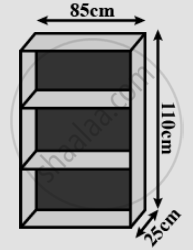
A wooden bookshelf has external dimensions as follows: Height = 110 cm, Depth = 25 cm, Breadth = 85 cm in following figure. The thickness of the plank is 5 cm everywhere. The external faces are to be polished and the inner faces are to be painted. If the rate of polishing is 20 paise per cm2 and the rate of painting is 10 paise per cm2. Find the total expenses required for polishing and painting the surface of the bookshelf.
The volume of a cuboidal box is 48 cm3. If its height and length are 3 cm and 4 cm respectively, find its breadth.
The rainfall on a certain day was 6 cm. How many litres of water fell on 3 hectares of field on that day?
The dimensions of an oil tin are 26 cm × 26 cm × 45 cm. Find the area of the tin sheet required for making 20 such tins. If 1 square metre of the tin sheet costs Rs 10, find the cost of tin sheet used for these 20 tins.
If two cubes each of side 6 cm are joined face to face, then find the volume of the resulting cuboid.
If the length of a diagonal of a cube is `8 sqrt(3)` cm, then its surface area is
The total surface area of a cube is 216 cm2. Find its volume.
The internal length, breadth, and height of a closed box are 1 m, 80 cm, and 25 cm. respectively. If its sides are made of 2.5 cm thick wood; find :
(i) the capacity of the box
(ii) the volume of wood used to make the box.
The diameter of a garden roller is 1.4 m and it 2 m long. Find the maximum area covered by its 50 revolutions?
The length breadth and height of a cuboid are in the ratio of 3 : 3 : 4. Find its volume in m3 if its diagonal is `5sqrt(34)"cm"`.
