Topics
Applied History
Working of the Constitution
Historiography : Development in the West
Geographical discoveries and colonization
- Concept for Geographical Discoveries and Colonization
Africa
- Imperialism - Africa
Asia: India, China, Japan
- Concept for Asia: India, China, Japan
Historiography : Indian Tradition
Working of the Indian Constitution
The Electoral Process
Dictatorships in Europe, Second World War and world
- Concept on Dictatorships in Europe
- Second World War (1939-1945 C.E.)
First world war
The League of Nations
Russian Revolution
- Concept for Russian Revolution
United Nations Organization
- Concept for United Nations Organization
Political Parties
Applied History
Africa
- Emancipation of Africa
Asia
- Emancipation of Asia
Social and Political Movements
History of Indian Arts
Globalization
- Globalization After World War II
Scientific and Technological Progress
- Scientific and Technological Progress After World War II
Cold war
- Formation of the Cold War
Challenges Faced by Indian Democracy
Mass Media and History
Social Diversity and Democracy
- Social Diversity
- Coccept for Caste/Race and Democracy
- Concept for Language and Democracy
- Cocnept for Religion and Democracy
- Concept for Gender and Democracy
- Concept for Democracy and Diversity
Challenges to Democracy Remedial Measures to the Challenges
- Concept for Challenges to Democracy Remedial Measures to the Challenges
Internal work
Democracy
- Democracy - Meaning, Types and Characteristics
Political Parties and Types
- Political Parties
- Importance of Political Parties
- Major National and Regional Parties in India/ Types of Political Parties
Entertainment and History
Sports and History
Tourism and History
Heritage Management
History - Imperialism
History - 20th Century Age of conflict
History - Emancipation of Asia and Africa
History - World after World War 2
Political Science
Notes
UNESCO World Heritage Site:
- UNESCO World Heritage Site is a place that is recognized by the United Nations Educational, Scientific, and Cultural Organization (UNESCO). This is exemplified by the Convention regarding the Protection of the World Cultural and Natural Heritage, accepted by UNESCO in 1972.
- The list of World Heritage Sites is maintained by the 'International World Heritage Programme', administered by the UNESCO World Heritage Committee.
How is a World Heritage Site selected?
- Nomination of a site by the respective government of a country.
- The site should have an Outstanding Universal Value (OUV) for a World Heritage nomination.
- To determine the Outstanding Universal Value (OUV) for World Heritage nomination, there are ten enlisted criteria.
- The proposed nomination must satisfy at least one of these ten criteria.
- The Nomination File is then evaluated by the International Council on Monuments and Sites and the World Conservation Union.
- These bodies then make their recommendations to the World Heritage Committee.
- The Committee meets once per year to determine whether or not to inscribe each nominated property on the World Heritage List and sometimes defers the decision to request more information from the country which nominated the site.
World Cultural Heritage Sites in India:
- India has the sixth-largest number of sites in the world. This vast heritage repository of India is recognized globally as a significant part of its unique cultural identity.
- As on 31.8.2021, India has 40 world heritage sites that include 32 Cultural properties, 7 Natural properties, and 1 Mixed site.
Maharashtra State Board: Class 10
Indian Oral and Intangible Heritage
| Year | Tradition / Heritage |
|---|---|
| 2001 | Koodiyattam, Sanskrit Theatre, Kerala |
| 2003 | Tradition of Vedic Chanting |
| 2005 | Ramlila – traditional performance of the Ramayana in North India |
| 2009 | Ramman – religious festival and ritual theatre of Garhwal, Uttarakhand |
| 2010 | Kalbelia – folk songs and dances of Rajasthan |
| 2010 | Chhau Dance – West Bengal, Jharkhand, Odisha |
| 2010 | Mudiyett – ritual theatre of Kerala |
| 2012 | Buddhist chanting of Ladakh (Jammu and Kashmir) |
| 2013 | Sankirtana – ritual singing, drumming, and dancing of Manipur |
| 2014 | Traditional craft of brass and copper utensils of the Thatheras of Punjab |
| 2016 | Yoga |
Maharashtra State Board: Class 10
World Cultural Heritage Sites - India
| Year | Heritage Sites |
|---|---|
| 1983 | Agra Fort, Ajanta Caves, Ellora Caves |
| 1984 | Taj Mahal, Mahabalipuram Temples, Sun Temple–Konark |
| 1986 | Churches of Goa, Fatehpur Sikri, Hampi Monuments, Khajuraho Temples |
| 1987 | Elephanta Caves, Brihadisvara Temple (Great Living Chola Temples) |
| 1987 | Group of Monuments at Pattadakal |
| 1989 | Sanchi Stupa |
| 1993 | Humayun’s Tomb, Qutub Minar Complex |
| 1999 | Mountain Railways of India |
| 2002 | Mahabodhi Temple, Bodh Gaya |
| 2003 | Rock Shelters of Bhimbetka |
| 2004 | Champaner–Pavagadh, Chhatrapati Shivaji Maharaj Terminus |
| 2004 | Chola Temples (Gangaikonda Cholapuram, Darasuram) |
| 2007 | Red Fort Complex, Delhi |
| 2010 | Jantar Mantar, Jaipur |
| 2013 | Hill Forts of Rajasthan |
| 2014 | Rani-ki-Vav, Patan |
| 2016 | Nalanda Mahavihara, Capitol Complex, Chandigarh |
| 2017 | Ahmedabad – Historic City |
Maharashtra State Board: Class 10
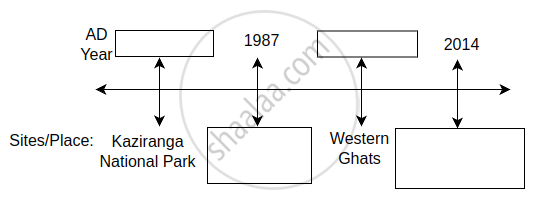
World Natural Heritage Sites
| Year | Heritage Site |
|---|---|
| 1985 | Kaziranga National Park |
| 1985 | Keoladeo National Park |
| 1985 | Manas Wildlife Sanctuary |
| 1987 | Sundarbans National Park |
| 1988 | Nanda Devi & Valley of Flowers |
| 2012 | Western Ghats |
| 2014 | Great Himalayan National Park |
| 2016 | Khangchendzonga National Park |