- Agriculture in India uses 60% of the land and supports a large part of the population.
- India grows food crops like rice, wheat, and cash crops like sugarcane and cotton.
- India is a top fish producer, with 60% from inland and 40% from marine sources.
- Fishing is important in coastal states like Kerala, West Bengal, and Maharashtra.
- India has rich minerals, mainly in the Chhota Nagpur Plateau, with coal, oil, and marble.
Topics
Field Visit
Location and Extent
- Introduction to India and Brazil
- Indian - Location, Size and Extent
- Brazil - Location, Size and Extent
- Historical Background of India
- Historical Background of Brazil
- Difference Between Post-Independence Characteristics of India and Brazil
Physiography and Drainage
- Map Study: Physical Divisions of India
- Map Study: Physical Divisions of Brazil
- Physical Division of India> The Himalayas
- Physical Division of India > North Indian Plains
- Physical Division of India > The Peninsula
- Physical Division of India > The Coastal Plains
- Physical Division of India > The Island Group
- Physical Division of Brazil> The Highlands
- Physical Division of Brazil> The Great Escarpment
- Physical Division of Brazil> The Coasts
- Physical Division of Brazil> The Plains
- Physical Division of Brazil> Islands
- Comparative Study of the Ganga and Amazon River Basins
- Drainage of Brazil
- Drainage of India
Climate
- Map Study: Temperature and Rainfall Distribution (Brazil)
- Map Study: Temperature and Rainfall Overview (India)
- Temperature & Rainfall Graphs of Brazil
- Climate of Brazil
- Temperature & Rainfall Graphs of India
- Climate of India
Natural Vegetation and Wildlife
- Brazil: Physiography, Natural Vegetation and Wildlife
- Brazil Vegetation
- India Vegetation
- Brazil Wildlife
- India-Wildlife
Population
- Population of India
- Population in Brazil
- Population Composition of Brazil and India> Sex Ratio
- Population Composition of Brazil and India> Age and Sex Pyramid
- Population Composition of Brazil and India> Population Growth Rate
- Population Composition of Brazil and India> Life Expectancy
- Population Composition of Brazil and India> Literacy Rate
Human Settlements
Economy and Occupations
Tourism, Transport and Communication
- Map Study: Tourism Trends in Brazil and India
- Tourism in Brazil
- Tourism in India
- Brazil Transport
- India Transport
- Communication in Brazil
- Communication in India
Geography - Physical Divisions of India
Identification of Physical divisions
- Identification of Physical Divisions
Geography - North Indian Mountains
Himalayas
Associated mountains
- Concept of Associated Mountains
Geography - North Indian Plain Region
Deserts
- Desert
Western Plains
- Concept of Western Plains
Central Plains
- Concept on Central Plains
Delta region
- Concept of Delta Region
Eastern Plains
- Concept of Eastern Plains
Geography - Peninsular Plateau Region
Chhotta Nagpur Plateau
- Concept for Chhotta Nagpur Plateau
Malwa Plateau
- Concept on Malwa Plateau
Maharashtra Plateau
- Concept for Maharashtra Plateau
Karnataka Plateau
- Concept for Karnataka Plateau
Telangana Plateau
- Concept for Telangana Plateau
Geography - Western Ghats and Eastern Ghats
Eastern Ghats
- Concept on Eastern Ghats
Sahyadries
- Concept on Sahyadries
Geography - Coastal Region
- Geography - Coastal Region
Eastern coastal plain
- Coastal Region - Eastern Coastal Plain
- Concept for Western Coastal Plain
Western coastal plain
- Concept for Western Coastal Plain
Geography - Indian Islands
- Geography - Indian Islands
Eastern Islands
- Indian Islands - Eastern Islands
Western Islands
- Indian Islands - Western Islands
Geography - Practical 1
Cartography
- Concept on Cartography
Geography - Practical 2
Two dimensional diagrams
- Two Dimensional Shapes
One dimensional diagrams
- Concept on One Dimensional Diagrams
Economics - Introduction of an Economy
Introduction of an Economy
- Types of Economy
- Main Features of Economy
Economics - Basic problems of an economy solution
Solutions
Problems
- Introduction of Basic Problems of an Economy
- Problems- for Whom to Produce
- Problem - How Much to Produce
- Problem - by Whom to Produce
Economics - Inflation
Introduction
Effects of inflation
- Effects of Inflation
Measures of Inflation
- Measures of Inflation
Causes of inflation
- Causes of Inflation
Economics - Public distribution system and consumer protection
- Measures of Inflation
Public Distribution system - meaning and explanation
- Public Distribution System - Meaning and Explanation
Introduction
- Introduction of Public Distribution System and Consumer Protection
Objectives of Public Distribution system
- Objectives of Public Distribution System
Remedial Measures
- Remedial Measures Public Distribution System and Consumer Protection
Consumer Protection
- Consumer Protection - Rights and Duties of Cunsumer, Food Adulteration
Drawbacks of Public Distribution system
- Drawbacks of Public Distribution System
Progress of Public Distribution system
- Progress of Public Distribution System
Notes
Economic Activities in India
Agriculture
- Unlike Brazil, agriculture in India contributes more to GDP and involves a larger chunk of the population. Approximately 60% of India's land is under cultivation. Its vast expanse of level plains, rich soils, high percentage of cultivable land, wide climatic variety, long growing season, and so on provide a solid foundation for agriculture. Agriculture has a long history in India.
- Subsistence agriculture predominates in India. India cultivates rice, wheat, maize, sorghum, and millets as major food crops, as well as plantations of tea, coffee, rubber, and cash crops such as sugarcane, cotton, and jute are also produced. India is also a significant producer of fruits and vegetables.
Fishing
- Fishing plays an important role in the economy of India. India is one of the largest producers of fish, both marine and inland.
- Fisheries contribute to increasing the food supply, creating employment, improving nutritional status, and receiving foreign exchange.
- Many residents of the coastal regions of Kerala, West Bengal, Orissa, Andhra Pradesh, Tamil Nadu, Goa, and Maharashtra include fish in their diet.
- India's coastline measures about 7500 km. Marine fishing, which is limited to coastal waters in the west from Kachchh, Malabar coast to Coromandal coast in the east, accounts for about 40% of the total annual fish production.
- Sardines, mackerel, Bombay duck, and prawns are the main fish species. Horse mackerels, clupeids, and silver belly fish are significant species along the eastern coast.
- In tanks, ponds, lakes, rivers, canals, irrigation channels, etc., freshwater fishing is practised. Silver bellies carp (chopda) etc. forms major freshwater varieties. Inland fisheries produce about 60% of the nation's total fish production.
Mining
- In India, the Chhota Nagpur plateau is a vast treasury of various minerals. The majority of the people work in the mining industry.
- Eastern Maharashtra and Chattisgarh's Korba both have coal mines. Digboi in Assam, Mumbai High in the Arabian Sea close to Maharashtra, Kalol, and Koyali in Gujarat all have mineral oil wells. At the Godavari River's mouth, mineral oil and natural gas reserves have been found. Both Rajasthan and Cuddapah in Andhra Pradesh have stones such as marble.
Example
The following images are related to agricultural activities. Identify and write whether they are practised in Brazil or India.
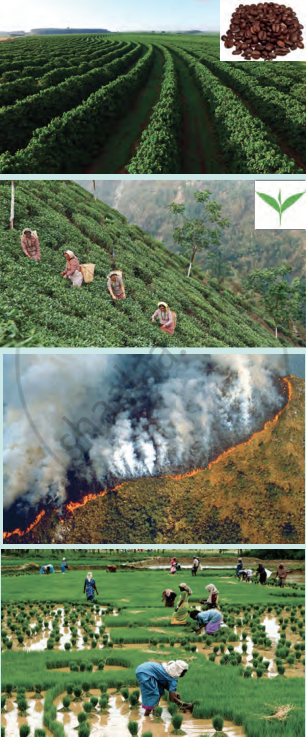
- The first image shows a coffee plantation. Coffee is mainly grown in Brazil. In India, coffee plantations are mostly found in the southern regions of the country.
- The second image shows tea plantations. Tea is mainly cultivated in India, especially in Assam, West Bengal, Tamil Nadu, and Kerala.
- The third image shows shifting cultivation. In this method, forest land is cleared by cutting and burning trees. Subsistence farming has been practised on that land for a few years. When the soil loses its fertility, another patch of land is cleared for cultivation. This type of farming is mainly practised in Brazil and in some regions of India.
- The fourth image shows paddy cultivation, which is mainly practised in areas of India that receive heavy rainfall.
Example
Obtain information regarding pisciculture in India with the help of internet and reference books and write a note.
- Pisciculture comes from the Latin words ‘piscis’ meaning ‘fish’ and ‘culture’ meaning ‘rearing’.
- It involves the artificial breeding, raising, and transporting of fish. Another name for it is fish farming. It involves the commercial cultivation of fish in enclosures or tanks, mainly for food.
- Salmaon, catfish, tilapia, cod, carp, trout, and other fish species are raised on fish farms.
- Commercial fishing operations have increased demand for wild fisheries, leading to widespread overfishing. Pisciculture provides an alternate approach to meet the growing market demand for fish and fish protein.
- During the last few decades, pisciculture has been facing a lot of issues, mostly owing to the problem of marketing, storage and transportation.
Example
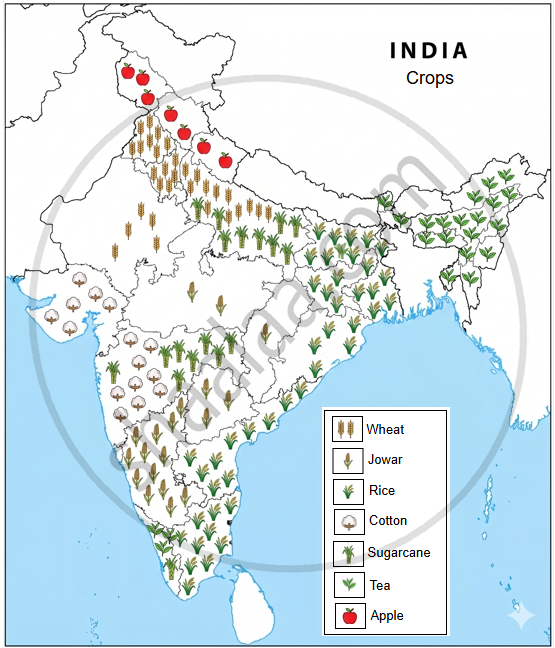
Show the distribution of crops like wheat, jowar, rice, cotton, sugarcane, tea and apple in the outline map of India. using symbols Name the map.
Maharashtra State Board: Class 10

