- The age and sex pyramid shows the percentage of males and females in different age groups of a population.
- Brazil’s population is ageing slowly, while India has more youth, leading to a larger working population in India.
- The proportion of children is higher in India, whereas people aged 80+ are more in Brazil.
- The pyramid helps to study the population structure, including children, youth, and elderly groups.
- India’s population is younger, while Brazil's is gradually becoming older over time.
Topics
Field Visit
Location and Extent
- Introduction to India and Brazil
- Indian - Location, Size and Extent
- Brazil - Location, Size and Extent
- Historical Background of India
- Historical Background of Brazil
- Difference Between Post-Independence Characteristics of India and Brazil
Physiography and Drainage
- Map Study: Physical Divisions of India
- Map Study: Physical Divisions of Brazil
- Physical Division of India> The Himalayas
- Physical Division of India > North Indian Plains
- Physical Division of India > The Peninsula
- Physical Division of India > The Coastal Plains
- Physical Division of India > The Island Group
- Physical Division of Brazil> The Highlands
- Physical Division of Brazil> The Great Escarpment
- Physical Division of Brazil> The Coasts
- Physical Division of Brazil> The Plains
- Physical Division of Brazil> Islands
- Comparative Study of the Ganga and Amazon River Basins
- Drainage of Brazil
- Drainage of India
Climate
- Map Study: Temperature and Rainfall Distribution (Brazil)
- Map Study: Temperature and Rainfall Overview (India)
- Temperature & Rainfall Graphs of Brazil
- Climate of Brazil
- Temperature & Rainfall Graphs of India
- Climate of India
Natural Vegetation and Wildlife
- Brazil: Physiography, Natural Vegetation and Wildlife
- Brazil Vegetation
- India Vegetation
- Brazil Wildlife
- India-Wildlife
Population
- Population of India
- Population in Brazil
- Population Composition of Brazil and India> Sex Ratio
- Population Composition of Brazil and India> Age and Sex Pyramid
- Population Composition of Brazil and India> Population Growth Rate
- Population Composition of Brazil and India> Life Expectancy
- Population Composition of Brazil and India> Literacy Rate
Human Settlements
Economy and Occupations
Tourism, Transport and Communication
- Map Study: Tourism Trends in Brazil and India
- Tourism in Brazil
- Tourism in India
- Brazil Transport
- India Transport
- Communication in Brazil
- Communication in India
Geography - Physical Divisions of India
Identification of Physical divisions
- Identification of Physical Divisions
Geography - North Indian Mountains
Himalayas
Associated mountains
- Concept of Associated Mountains
Geography - North Indian Plain Region
Deserts
- Desert
Western Plains
- Concept of Western Plains
Central Plains
- Concept on Central Plains
Delta region
- Concept of Delta Region
Eastern Plains
- Concept of Eastern Plains
Geography - Peninsular Plateau Region
Chhotta Nagpur Plateau
- Concept for Chhotta Nagpur Plateau
Malwa Plateau
- Concept on Malwa Plateau
Maharashtra Plateau
- Concept for Maharashtra Plateau
Karnataka Plateau
- Concept for Karnataka Plateau
Telangana Plateau
- Concept for Telangana Plateau
Geography - Western Ghats and Eastern Ghats
Eastern Ghats
- Concept on Eastern Ghats
Sahyadries
- Concept on Sahyadries
Geography - Coastal Region
- Geography - Coastal Region
Eastern coastal plain
- Coastal Region - Eastern Coastal Plain
- Concept for Western Coastal Plain
Western coastal plain
- Concept for Western Coastal Plain
Geography - Indian Islands
- Geography - Indian Islands
Eastern Islands
- Indian Islands - Eastern Islands
Western Islands
- Indian Islands - Western Islands
Geography - Practical 1
Cartography
- Concept on Cartography
Geography - Practical 2
Two dimensional diagrams
- Two Dimensional Shapes
One dimensional diagrams
- Concept on One Dimensional Diagrams
Economics - Introduction of an Economy
Introduction of an Economy
- Types of Economy
- Main Features of Economy
Economics - Basic problems of an economy solution
Solutions
Problems
- Introduction of Basic Problems of an Economy
- Problems- for Whom to Produce
- Problem - How Much to Produce
- Problem - by Whom to Produce
Economics - Inflation
Introduction
Effects of inflation
- Effects of Inflation
Measures of Inflation
- Measures of Inflation
Causes of inflation
- Causes of Inflation
Economics - Public distribution system and consumer protection
- Measures of Inflation
Public Distribution system - meaning and explanation
- Public Distribution System - Meaning and Explanation
Introduction
- Introduction of Public Distribution System and Consumer Protection
Objectives of Public Distribution system
- Objectives of Public Distribution System
Remedial Measures
- Remedial Measures Public Distribution System and Consumer Protection
Consumer Protection
- Consumer Protection - Rights and Duties of Cunsumer, Food Adulteration
Drawbacks of Public Distribution system
- Drawbacks of Public Distribution System
Progress of Public Distribution system
- Progress of Public Distribution System
Example
What could be the reasons for the lower sex ratio in any region?
Sex ratio refers to the number of females per thousand males in a region. India has a low sex ratio.
The reasons for lower sex ratio are as follows:
- Illiteracy: People are not aware of the role of women in modern society. This is because of child marriages where girls get married at an early age without having a chance to study and educate themselves.
- Female infanticide: Even though the Government has passed many Acts to stop this inhuman act, people still prefer to have a male child due to many reasons. Hence, girl babies are killed as soon as they are born.
- Domestic violence: Women are considered to be the weaker sex and hence crimes and violence against women is still a common feature in many of the rural households. This makes even the mother stop having a girl child.
- Female foeticide: Due to socio-economic issues like dowry, people destroy the girl foetus in the womb itself. Many laws have been made to prevent this.
- Poverty: Poverty is a major reason for the declining sex ratio. Families living under Below Poverty Line(BPL) generally do not want to have girl children.
- Lack of women empowerment: Due to lack of education, women do not enjoy equal opportunities in many of the rural areas, especially in northern India.
The lower sex ratio, even in the twenty-first century is really a cause of concern.
Example
In India, number of men outnumber women. Is this condition found in all the States of India? Find out!
- In 2011, India had a sex ratio of approximately 940 females for every 1,000 males.
- States with unfavourable sex ratios include Sikkim, Jammu & Kashmir, Punjab, Haryana, Delhi, Chandigarh, Dadra Nagar Haveli, Diu and Daman.
- Kerala is the only state, and Puducherry is the only Union Territory, with a female-to-male ratio of 1084 and 1087 per 1000, respectively.
Example
Is there a relationship between increase in life expectancy and growth of population? If yes, how?
Yes, there is a relationship between an increase in life expectancy and the growth of the population.
- The availability of medical facilities, progress in medical sciences, rapid transportation, the availability of nutritious food, and so on all reduce death rates, resulting in a rise in life expectancy.
- A country’s population grows rapidly when its life expectancy rises, and its birth rate is relatively high.
Example
If the proportion of dependent age groups increases in the composition of population, how will it affect the economy of a country?
- If the proportion of dependent age groups increases in the composition of population, it will have an adverse effect on the economy of a country.
- The reason is if the working population is less, the economic activities will reduce and will have a direct impact on the economic growth and development of that nation.
- The production will decrease in comparison to consumption leading to inflation also the per capita income and GDP will decrease.
- Export will reduce and imports will increase.
- The proportion of the working population will increase, slowing down the pace of development.
Example
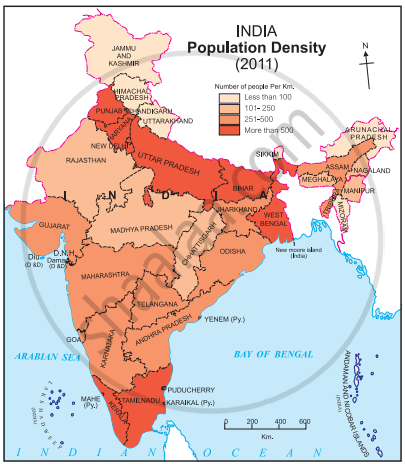
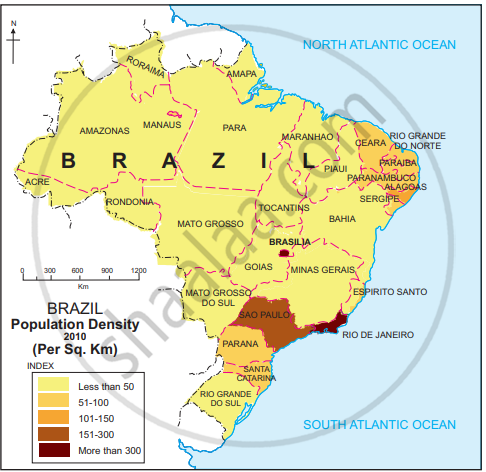
Study the indices of density maps of both the countries. What difference do you find? What conclusions can you draw?
|
India Population Density |
|
Population density in Brazil |
- The study of the indices of density maps of Brazil and India clearly explains the distribution of population among the various states of both countries.
- Brazil is three times bigger than India in terms of its area. But it accounts for only 2.8 per cent of the world’s population whereas India has 16.8 per cent of the world’s population.
- The northern and southern states of India are densely populated, whereas the central states have comparatively less population. The northeastern states are sparsely populated.
- It can be understood that the total population of states like Uttar Pradesh, Bihar, Haryana and Punjab is almost equal to that of Brazil’s total population.
- The country of Brazil has a denser population in its eastern states. The western and northern states are very sparsely populated.
Example
What should be done so that our manpower is utilized properly, sex ratio improves and population growth is controlled? Write two to three sentences on each.
Manpower refers to the human resource of a country. The higher the population, the greater the manpower. The increased population can be a great asset if it is used properly and productively.
Steps to utilize manpower:
- Providing education and improving the standard of education enables the people of a country to gain appropriate skills and knowledge.
- Based on the skills, the manpower can be classified as skilled and unskilled sector and can be placed in various industries.
- Providing basic health facilities to all sections of labourers aid in increased productivity and prevents employees refraining from work due to health issues.
- In large scale sectors, many training programmes can be conducted to improve the talent hidden in the employees.
The number of females per thousand men is referred to as the Sex ratio. Generally, in a country like India, the sex ratio is very poor.
Steps to improve sex ratio:
- Educating and creating awareness among the masses about the role of women in the development of a country may improve the sex ratio.
- Making sure that the laws against female foeticide and infanticide are followed properly.
- Preventing child marriages to avoid the mortality of young girls.
- Granting equal rights to women and making them enjoy equal opportunities on par with men.
- Increasing the self-esteem of women through education, employment and independence.
Increasing population is always a concern and poses a serious threat to the economic development of the country.
Steps to control population:
- Making people, especially the rural masses understand the problems faced due to increased population.
- Adopting various birth control methods.
- Providing education and eradication of poverty which indirectly helps in population control. An educated person can understand the consequences of having too many children. Similarly, if poverty is eradicated, there will be an end to child labour. Child labour persuades a poor man to have children and send them to jobs to earn for himself and his family.
These are some of the steps that can be taken to utilize manpower, improve the sex ratio and control the population of a country.
Example
If the proportion of dependent age groups increases in the composition of population, how will it affect the economy of a country?
- If the proportion of dependent age groups increases in the composition of population, it will have an adverse effect on the economy of a country.
- The reason is if the working population is less, the economic activities will reduce and will have a direct impact on the economic growth and development of that nation.
- The production will decrease in comparison to consumption leading to inflation also the per capita income and GDP will decrease.
- Export will reduce and imports will increase.
- The proportion of the working population will increase, slowing down the pace of development.
Maharashtra State Board: Class 10
