Advertisements
Online Mock Tests
Chapters
I: The Rise of Nationalism in Europe
II: Nationalism in India
Section II : Livelihoods, Economics and Societies
III: The Making of a Global World
▶ IV: The Age of Industrialisation
Section III: Everyday Life, Culture and Politics
V: Print Culture and the Modern World
![NCERT solutions for Social Science India and the Contemporary World 2 [English] Class 10 chapter IV - The Age of Industrialisation - Shaalaa.com](/images/social-science-india-and-the-contemporary-world-2-english-class-10_6:73fb944f40ae4f72a92aa78c628a737c.jpg "NCERT solutions for Social Science India and the Contemporary World 2 [English] Class 10 chapter IV - The Age of Industrialisation")
Advertisements
Solutions for Chapter IV: The Age of Industrialisation
Below listed, you can find solutions for Chapter IV of CBSE NCERT for Social Science India and the Contemporary World 2 [English] Class 10.
NCERT solutions for Social Science India and the Contemporary World 2 [English] Class 10 IV The Age of Industrialisation Intext Questions [Pages 80 - 89]
Activity
Give two examples where modern development that is associated with progress has led to problems. You may like to think of areas related to environmental issues, nuclear weapons or disease.
The way in which historians focus on industrialisation rather than on small workshops is a good example of how what we believe today about the past is influenced by what historians choose to notice and what they ignore. Note down one event or aspect of your own life which adults such as your parents or teachers may think is unimportant, but which you believe to be important.
Look at the figures. Can you see any difference in the way the two images show industrialisation? Explain your view briefly
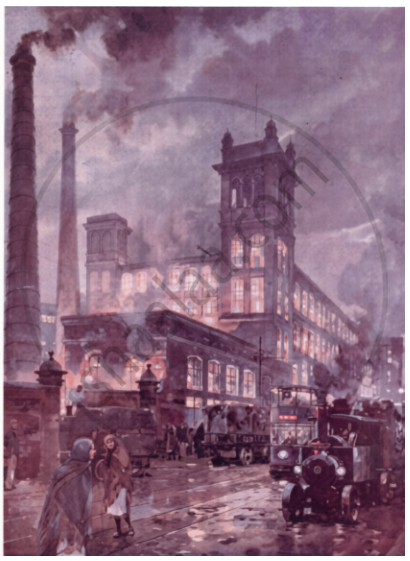
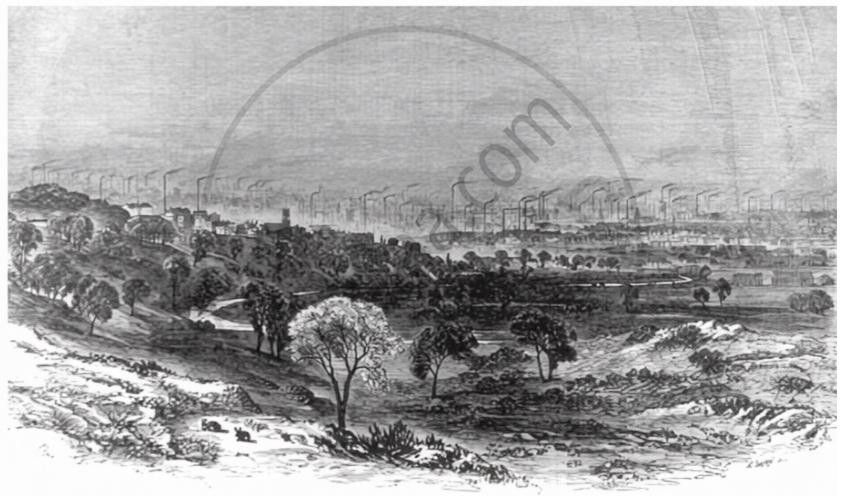
Imagine that you are a merchant writing back to a salesman who has been trying to persuade you to buy a new machine. Explain in your letter what you have heard and why you do not wish to invest in the new technology.
Discuss
Look at the figures, then reread the source. Explain why many workers were opposed to the use of the Spinning Jenny.
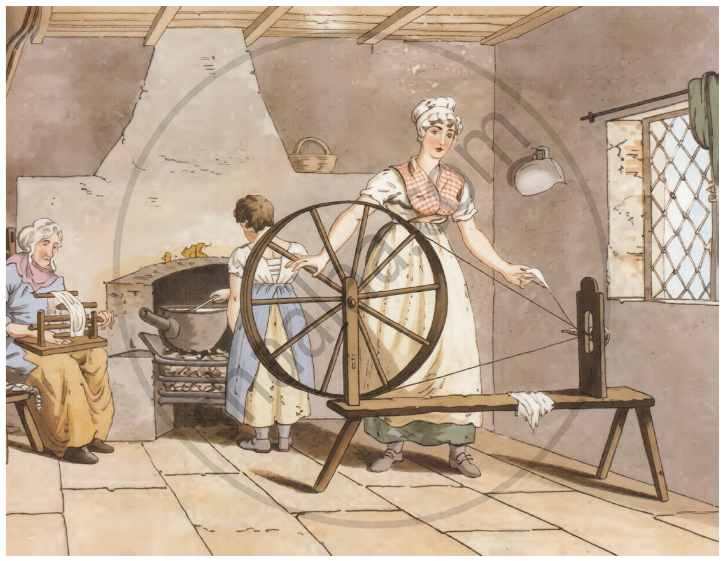
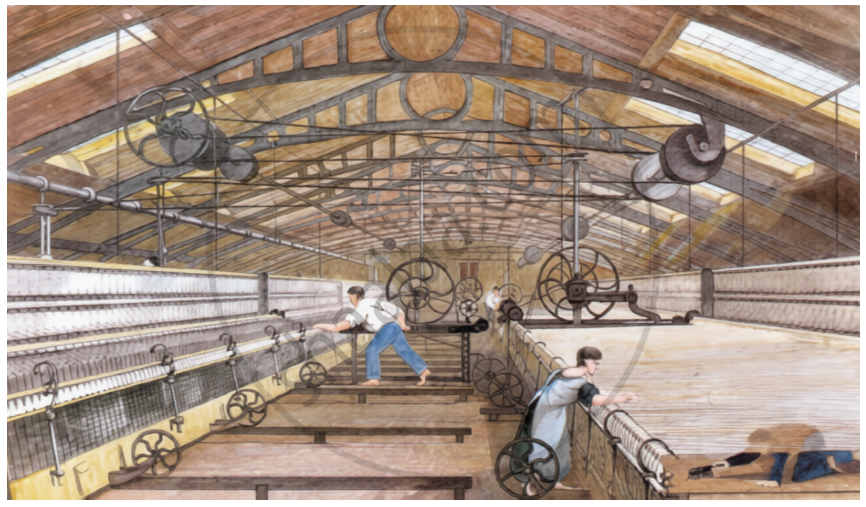
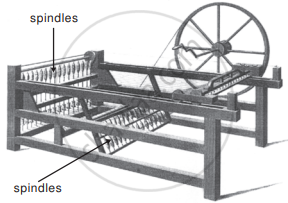
|
A magistrate reported in 1790 about an incident when he was called in to protect a manufacturer’s property from being attacked by workers: ‘From the depredations of a lawless Banditti of colliers and their wives, for the wives had lost their work to spinning engines... they advanced at first with much insolence, avowing their intention of cutting to pieces the machine lately introduced in the woollen manufacture; which they suppose, if generally adopted, will lessen the demand for manual labour. The women became clamorous. The men were more open to conviction and after some expostulation were induced to desist from their purpose and return peaceably home.’ J.L. Hammond and B. Hammond, The Skilled Labourer 1760-1832, quoted in Maxine Berg, The Age of Manufactures. |
Activity
On a map of Asia, find and draw the sea and land links of the textile trade from India to Central Asia, West Asia and Southeast Asia.
NCERT solutions for Social Science India and the Contemporary World 2 [English] Class 10 IV The Age of Industrialisation Exercises [Page 102]
Write in brief
Explain the following:
Women workers in Britain attacked the Spinning Jenny.
Explain the following:
In the seventeenth century, merchants from towns in Europe began employing peasants and artisans within the villages.
Explain the following:
The port of Surat declined by the end of the eighteenth century.
Explain the following:
The East India Company appointed gomasthas to supervise weavers in India.
Write True or False against the statement.
At the end of the nineteenth century, 80 per cent of the total workforce in Europe was employed in the technologically advanced industrial sector.
Write True or False against the statement.
The international market for fine textiles was dominated by India till the eighteenth century.
Write True or False against the statement.
The American Civil War resulted in the reduction of cotton exports from India.
Write True or False against the statement:
The introduction of the fly shuttle enabled handloom workers to improve their productivity.
Explain what is meant by proto-industrialisation.
Discuss
Why did some industrialists in nineteenth-century Europe prefer hand labour over machines?
How did the East India Company procure regular supplies of cotton and silk textiles from Indian weavers?
Imagine that you have been asked to write an article for an encyclopaedia on Britain and the history of cotton. Write your piece using information from the entire chapter.
Why did industrial production in India increase during the First World War?
Project work
Select any one industry in your region and find out its history. How has the technology changed? Where do the workers come from? How are the products advertised and marketed? Try and talk to the employers and some workers to get their views about the industry’s history.
Solutions for IV: The Age of Industrialisation
NCERT solutions for Social Science India and the Contemporary World 2 [English] Class 10 chapter IV - The Age of Industrialisation
Shaalaa.com has the CBSE Mathematics Social Science India and the Contemporary World 2 [English] Class 10 CBSE solutions in a manner that help students grasp basic concepts better and faster. The detailed, step-by-step solutions will help you understand the concepts better and clarify any confusion. NCERT solutions for Mathematics Social Science India and the Contemporary World 2 [English] Class 10 CBSE IV (The Age of Industrialisation) include all questions with answers and detailed explanations. This will clear students' doubts about questions and improve their application skills while preparing for board exams.
Further, we at Shaalaa.com provide such solutions so students can prepare for written exams. NCERT textbook solutions can be a core help for self-study and provide excellent self-help guidance for students.
Concepts covered in Social Science India and the Contemporary World 2 [English] Class 10 chapter IV The Age of Industrialisation are Concept of the Pre-modern World, Nineteenth Century Global Economy, Colonialism, The Inter-war Economy, A World Economy Takes Shape, Proto-industrialization and Pace of Industrial Change, Life of Workers, Industrialization in the Colonies, Early Entrepreneurs and Workers, The Peculiarities of Industrial Growth, Market for Goods, Development of Modern Cities Due to Industrialization in London and Bombay, Housing and Land Reclamation, Social Changes in the Cities, Cities and the Challenge of the Environment, The Coming Up of the Factory, The Pace of Industrial Change, The Early Entrepreneurs, Sources of Industrial Labour, Small-scale Industries Predominate, Introduction to the Age of Industrialisation, Before the Industrial Revolution, Hand Labour and Steam Power, Life of the Workers, Industrialisation in the Colonies, The Age of Indian Textiles, Condition of Weavers under British Rule, Manchester Comes to India, Factories Come up, The Peculiarities of Industrial Growth, Market for Goods, Overview of The Age of Industrialisation, Concept of the Pre-modern World, Nineteenth Century Global Economy, Colonialism, The Inter-war Economy, A World Economy Takes Shape, Proto-industrialization and Pace of Industrial Change, Life of Workers, Industrialization in the Colonies, Early Entrepreneurs and Workers, The Peculiarities of Industrial Growth, Market for Goods, Development of Modern Cities Due to Industrialization in London and Bombay, Housing and Land Reclamation, Social Changes in the Cities, Cities and the Challenge of the Environment, The Coming Up of the Factory, The Pace of Industrial Change, The Early Entrepreneurs, Sources of Industrial Labour, Small-scale Industries Predominate, Introduction to the Age of Industrialisation, Before the Industrial Revolution, Hand Labour and Steam Power, Life of the Workers, Industrialisation in the Colonies, The Age of Indian Textiles, Condition of Weavers under British Rule, Manchester Comes to India, Factories Come up, The Peculiarities of Industrial Growth, Market for Goods, Overview of The Age of Industrialisation.
Using NCERT Social Science India and the Contemporary World 2 [English] Class 10 solutions The Age of Industrialisation exercise by students is an easy way to prepare for the exams, as they involve solutions arranged chapter-wise and also page-wise. The questions involved in NCERT Solutions are essential questions that can be asked in the final exam. Maximum CBSE Social Science India and the Contemporary World 2 [English] Class 10 students prefer NCERT Textbook Solutions to score more in exams.
Get the free view of Chapter IV, The Age of Industrialisation Social Science India and the Contemporary World 2 [English] Class 10 additional questions for Mathematics Social Science India and the Contemporary World 2 [English] Class 10 CBSE, and you can use Shaalaa.com to keep it handy for your exam preparation.
