Advertisements
Advertisements
A homogeneous block floats on water (a) partly immersed (b) completely immersed. In each case state the position of centre of buoyancy B with respect to the centre of gravity G of the block.
Concept: undefined >> undefined
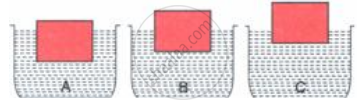
Figure shows the same block of wood floating in three different liquids A, B and C of densities ρ1, ρ2 and ρ3 respectively. Which of the liquid has the highest density? Give a reason for your answer.
Concept: undefined >> undefined
Advertisements
What is the centre of buoyancy? State its position for a floating body with respect to the centre of gravity of the body.
Concept: undefined >> undefined
A balloon filled with helium gas floats in a big closed jar which is connected to an evacuating pump. What will be your observation, if air from the jar is pumped out? Explain your answer.
Concept: undefined >> undefined
Two identical pieces, one of ice (density = 900kg per meter cube) and other wood (density = 300kg per meter cube) float on water.
- Which of the two will have more volume submerged inside water
- Which of two will experience more upthrust due to water.
Concept: undefined >> undefined
A body is held inside water contained in a vessel by tying it with a thread to the base of the vessel. Name the three forces that keep the body in equilibrium, and state the direction in which each force acts.
Concept: undefined >> undefined
What do you mean by reflection of light?
Concept: undefined >> undefined
State which surface of a plane mirror reflects most of the light incident on it: the front smooth surface or the back silvered surface.
Concept: undefined >> undefined
Explain the following term:
Reflected ray. Draw diagram/diagrams to show them.
Concept: undefined >> undefined
Explain the following term:
Angle of incidence. Draw diagram/diagrams to show them.
Concept: undefined >> undefined
Explain the following term:
Angle of reflection. Draw diagram/diagrams to show them.
Concept: undefined >> undefined
With the help of diagrams, explain the difference between the regular and irregular reflection.
Concept: undefined >> undefined
Differentiate between the reflection of light from a plane mirror and that from a plane sheet of paper.
Concept: undefined >> undefined
A light ray is incident normally on a plane mirror. What is the direction of reflected ray? Show it on a diagram.
Concept: undefined >> undefined
A light ray is incident normally on a plane mirror. (a) What is its angle of incidence?
Concept: undefined >> undefined
Draw a diagram to show the reflection of a ray of light using a plane mirror. In the diagram, label the incident ray, the reflected ray, the normal, the angle of incidence and the angle of reflection.
Concept: undefined >> undefined
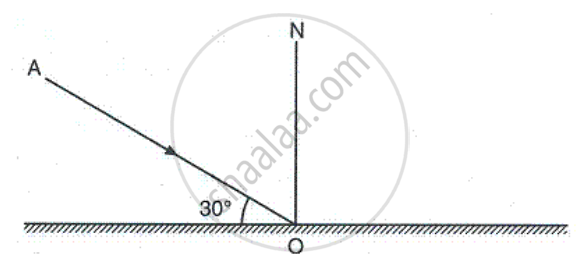
Figure shows an incident ray AO and the normal ON on a plane mirror. The angle which the incident ray AO makes with mirror is 30°. (a) Find the angle of incidence. (b) Draw the reflected ray and then find the angle between the incident and reflected rays.
Concept: undefined >> undefined
The diagram in Figure shows a point object P in front of a plane mirror MM1.
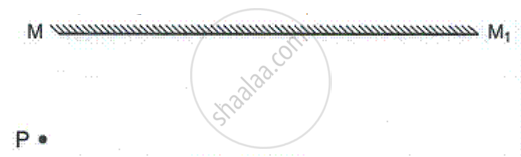
(a) Complete the diagram by taking two rays from the point P to show the formation of its image.
(b) In the diagram, mark the position of eye to see the image.
(c) Is the image formed real or virtual? Explain why?
Concept: undefined >> undefined
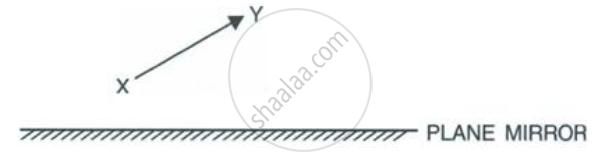
The diagram below in figure shows an object XY in front of a plane mirror MM1 . Draw on the diagram, path of two rays from each point X and Y of the object to show the formation of its image .
Concept: undefined >> undefined
A ray is incident on a plane mirror . Its reflected ray is perpandicular to the incident ray . Find the angle of incidence .
Concept: undefined >> undefined
