Please select a subject first
Advertisements
Advertisements
What effect did the Bhakti and Sufi movements have on Indian society?
Concept: undefined >> undefined
This is the picture of a monument associated with the founder of a religious reform movement in India.
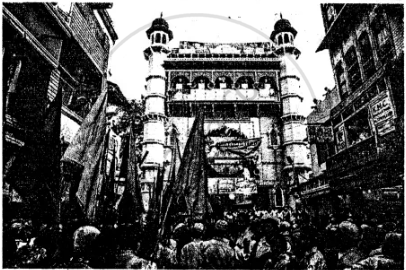
Name the reformer and the movement he started in India.
Concept: undefined >> undefined
Advertisements
This is the picture of a monument associated with the founder of a religious reform movement in India.
Identify the monument.
Concept: undefined >> undefined
This is the picture of a monument associated with the founder of a religious reform movement in India.
Why is this monument famous?
Concept: undefined >> undefined
This is the picture of a monument associated with the founder of a religious reform movement in India.
Mention any four important religious principles of that movement, which are common to the principles of the Bhakti Movement.
Concept: undefined >> undefined
This is the picture of a monument associated with the founder of a religious reform movement in India.
Name any two religious reformers of the Bhakti Movement.
Concept: undefined >> undefined
Important Words: The Constitution
Concept: undefined >> undefined
Important Words: Amendment
Concept: undefined >> undefined
Fill in the blank:
_________ was the chairman of the Constituent Assembly.
Concept: undefined >> undefined
Fill in the blank:
The Constituent Assembly took about ______________ to complete its work.
Concept: undefined >> undefined
Fill in the blank:
The constitution came into force in the year ________.
Concept: undefined >> undefined
Fill in the blank:
Dr. B.R. Ambedkar was the chairman of _______committee of the constitution.
Concept: undefined >> undefined
Match the contents of Column A with those of Column B
| Column A | Column B |
| 1. Pt Jawaharlal Nehru | (a) Chairman of the Drafting Committee. |
| 2. B. R. Ambedkar | (b) First Prime Minister of India |
| 3. Frank Anthony | (c) Representative of the Parsees. |
| 4. Dr. H. P. Modi | (d) Representative of the Anglo-Indian community. |
| 5. A state where the head of the state is an elected person. | (e) Sovereign |
| 6. A state where the government is run by the elected members of the people. | (f) Socialist |
| 7. A state which is independent of external interference. | (g) Secular |
| 8. A state where there is no discrimination against any religion. | (h) Democratic |
| 9. A state which lays emphasis on economic and social equality. | (i) Republic |
Concept: undefined >> undefined
Tick mark (✓) the correct statement or (X) if it is wrong.
The constitution is the supreme law of the land.
Concept: undefined >> undefined
Tick mark (✓) the correct statement or (X) if it is wrong.
Before independence, our country was governed according to our Constitution.
Concept: undefined >> undefined
Answer the following:
What do you mean by the term ‘Constitution’? What does it contain?
Concept: undefined >> undefined
Answer the following:
Why is it necessary to have a Constitution for a country?
Concept: undefined >> undefined
Answer the following:
Name the body that framed the Constitution of India. Who was its chairman?
Concept: undefined >> undefined
Fill in the blank:
The President of India has a fixed term of _______ years.
Concept: undefined >> undefined
Match the following:
| Column A | Column B |
| 1. 1946 | (a) India became independent. |
| 2. 1947 | (b) The Constitution of India was passed. |
| 3. 1949 | (c) The first meeting of the Constituent Assembly was held. |
| 4. 1950 | (d) The Constitution of India was amended. |
| 5. 1976 | (e) India became a sovereign, democratic, Republic. |
Concept: undefined >> undefined
